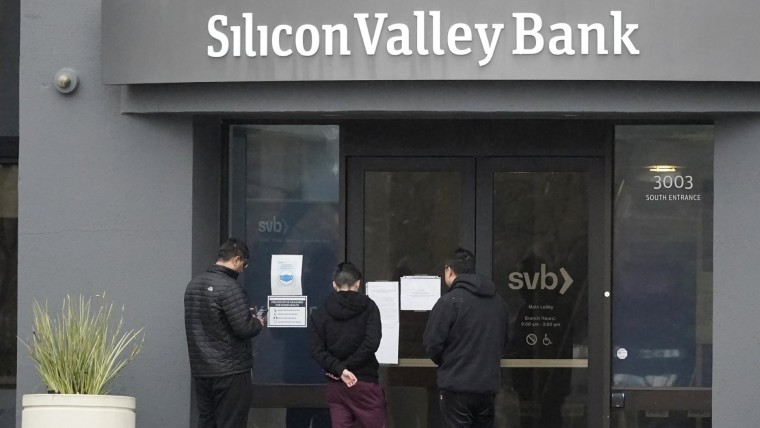
Federal regulators stepped in Sunday to back all Silicon Valley Bank deposits, resolving a key uncertainty surrounding the second-largest bank failure in U.S. history hours before global stock markets resumed trading.
The U.S. Treasury, the Federal Reserve and the Federal Deposit Insurance Corp. said the government would back Silicon Valley Bank deposits beyond the federally insured ceiling of $250,000. The decision addressed concerns around the fate of uninsured funds held at the Santa Clara, California-based bank — the country’s 16th largest — which had $209 billion in assets and more than $175 billion in deposits.
“Depositors will have access to all of their money starting Monday, March 13,” the agencies said in a joint statement Sunday evening. “No losses associated with the resolution of Silicon Valley Bank will be borne by the taxpayer.”
Senior management of SVB will be removed, the statement said.
The announcement marks an extraordinary step by federal regulators to calm financial markets before Monday trading resumed in Asia and Europe, followed by North America. Dow futures jumped Sunday evening following news of the backstop plan, only to fall 200 points Monday morning amid a selloff in bank stocks.
Hours after the federal intervention Sunday, the British bank HSBC said it would buy the SVB’s British assets for just £1 ($1.21), in a deal facilitated by the British government and the central Bank of England. As of Friday, SVB U.K. had loans worth around £5.5 billion ($6.66 billion) and deposits of around £6.7 billion ($8.11 billion).
“This ensures customer deposits are protected and can bank as normal, with no taxpayer support,” British finance minister Jeremy Hunt said in a statement. “I am pleased we have reached a resolution in such short order.”
European markets reacted badly to the SVB saga, with the FTSE 100 index of the United Kingdom's most valuable public companies down 2.4% by mid-morning Monday, a two-month low.
The fallout was particularly felt by European lenders: Swiss bank Credit Suisse and Germany's Commerzbank both saw their share prices fall more than 10% on the Stoxx 600 index of European companies, with the index down 2.5% overall.
Major markets in the Asia-Pacific region had been mixed Monday morning, with Japan’s benchmark Nikkei 225 slipping 1.1% at finish, though the Shanghai Composite rose 1.2% as Chinese shares tracked the gains in U.S. futures.
President Joe Biden said late Sunday that he was pleased after the U.S. move.
“The American people and American businesses can have confidence that their bank deposits will be there when they need them,” he said in a statement. “I am firmly committed to holding those responsible for this mess fully accountable and to continuing our efforts to strengthen oversight and regulation of larger banks so that we are not in this position again.”
He said he would speak more about banking security Monday morning.
Some SVB customers and staffers breathed sighs of relief after the regulators’ announcement.
Vanessa Pham said she was preparing for the possibility that Omsom, the Asian food products business she co-founded that banks with SVB, might run out of money within anywhere from two weeks to three months.
“I will be patiently, eagerly waiting the actual deposit in our bank and our access with it,” she said.
A source inside SVB who worked as a managing director in a regional office before Friday’s shutdown said he was happy for his clients. He welcomed what he called a “favorable resolution,” adding that he feared tens of thousands of jobs could have been lost if uninsured deposits were not covered.
A second SVB employee said Sunday, “The feeling that clients were going to lose money and that they were facing all this disruption on our behalf I think crushed people. So now they’re at least going to be made whole for their deposits, which is a huge sense of relief.”