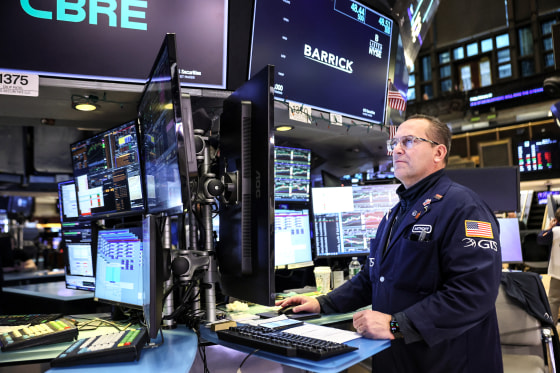
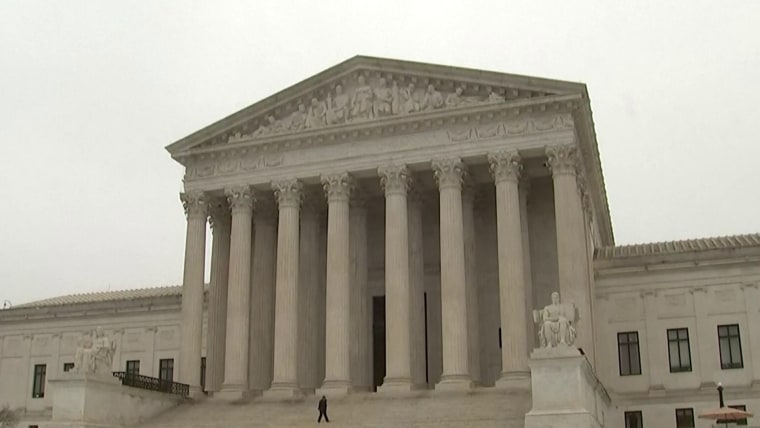
U.S. stocks experienced volatile trading Friday after the Supreme Court said that President Donald Trump could not impose sweeping tariffs under the International Emergency Economic Powers Act.
The major indexes jumped sharply in the minutes after the decision's release and proceeded to waver throughout the day.
By the close of trading, the tech-heavy Nasdaq composite index rose nearly 1%. The S&P 500, the broadest and most-watched index, added almost 0.7%, while the Dow Jones Industrial Average rose 230 points or 0.5%.
The yields on U.S. Treasury bonds jumped across maturities. Yields on the 10-year bond, which mortgage rates often track closely, rose to 4.09%. The 30-year Treasury yield rose above 4.74%.
The U.S. dollar initially jumped against other currencies, such as the British pound, euro and Japan's yen, but ended the day lower as investors digested the ruling.
A stronger dollar is often seen as a sign of investors' trust in U.S. assets and stability.
However, gold and silver prices rallied, a signal that investors don't think companies are entirely in the clear on tariff uncertainty yet.
Companies whose businesses are heavily exposed to tariffs, such as retailers and appliance makers, immediately became some of the best performing stocks of the day.
Amazon and Apple ended the day as two of the best performing Dow stocks. Logistics and trucking firms, such as Old Dominion Freight Line and Paccar, also outperformed the broader market.
The S&P 500 sectors that track consumer discretionary, industrial, real estate and technology stocks finished the day as some of the best performers, outpacing less-tariff-exposed sectors.
"The market was largely expecting these Trump tariffs would be ruled against by the Supreme Court and this morning is a clear blow to the Trump tariff policy," Dan Ives, a managing director at the wealth management company Wedbush Securities, wrote in a note.
"This SCOTUS decision comes at a critical moment for global supply chains as organizations have largely started to change their supply chain operations to navigate the global tariff landscape," he wrote.
Ives noted that while this is a “turning moment for the Trump administration’s tariff agenda, there will be other ways for the administration can leverage to keep these tariff deals made with other countries in place.”
While the court's move to strike down many of Trump's tariffs provides some immediate clarity for U.S. companies, concerns remain that the president will continue to look for new ways to impose import duties.
Michael Pearce, chief U.S. economist at advisory firm Oxford Economics, said in an emailed statement that “any boost to the economy from lowering tariffs in the near-term is likely to be partly offset by a prolonged period of uncertainty, and with the administration likely to rebuild tariffs through other, more durable, means, the overall tariffs rate may yet end up settling close to current levels.”
"Even if the administration is able to replicate the overall level of tariffs using other means, the by-sector and by-country implications could end up looking very different, which will create another bout of trade policy uncertainty for business, investors, and households," Pearce said. "This uncertainty is a key downside risk that could ding, rather than derail, growth this year."
Evercore said in a note that since the Supreme Court didn't give direction on refunds, the process "will be a bit more chaotic."
"The process of sorting out refunds will likely take months and be a legal and bureaucratic morass in its own right," Evercore said.