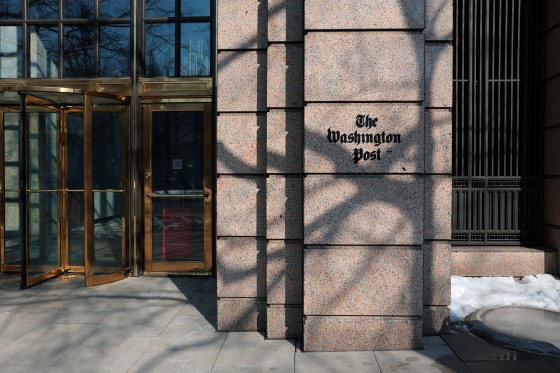
The Washington Post announced sweeping layoffs Wednesday, with cuts expected to greatly reduce some coverage areas at the storied 150-year-old newspaper.
The wide-ranging job losses primarily affected the sports, books and podcast units, according to a source familiar with the situation. Foreign desks were also heavily impacted, along with cuts to business and national teams.
Roughly one-third of the company was affected by the layoffs, a Washington Post spokesperson said.
“The Washington Post is taking a number of difficult but decisive actions today for our future, in what amounts to a significant restructuring across the company," the spokesperson told NBC News.
The Post, which has won dozens of Pulitzer prizes — most famously for its Watergate coverage that led to then-President Richard Nixon’s resignation in 1974 — has been owned since 2013 by Amazon founder Jeff Bezos.
Though many American newspapers have struggled financially in recent years, Bezos is the fourth-richest person in the world, with a net worth of about $260 billion, according to Bloomberg’s Billionaire Index. That hasn't spared the paper from layoffs. The latest round of layoffs follows a 4% staff cut roughly a year ago, though those cuts did not affect the newsroom.
In response to the announcement, the Washington Post Guild, which represents hundreds of newsroom employees, said the staff has been reduced by 400 people over the last three years. "These layoffs are not inevitable. A newsroom cannot be hollowed out without consequences of its credibility, its reach and its future," the union said.
The announcement follows recent scrutiny over newsroom budget decisions, including the paper’s shifting plans around Winter Olympics coverage.
As first reported by The New York Times, the paper initially told more than a dozen journalists it would no longer send them to cover the Winter Olympics in Italy, less than three weeks before the Games were set to begin. After public criticism, including from prominent sports journalists, the paper reversed course again and now expects to send four reporters, NBC News confirmed.
In a statement, former Executive Editor Marty Baron said Wednesday’s announcement “ranks among the darkest days in the history of one of the world’s greatest news organizations.”
Reaction also came in from former Post journalists. Ashley Parker, now at The Atlantic, wrote in an op-ed that “we’re witnessing a murder," and accused Post management of trying to, "kill what makes the paper special."
Parker left in late 2024, after the Post abruptly killed its planned presidential endorsement of Democrat Kamala Harris.
"The Post wasn’t the same paper that had recruited me," wrote Parker, and she did not want to work for “an owner and publisher who couldn’t articulate a vision and confused contempt for the newsroom with a business plan.”
And ahead of the layoffs, members from the Post’s local desk wrote in an open letter dated Jan. 27 to Bezos that they had been warned their section would be “decimated” and left “unrecognizable,” urging leadership to preserve the paper’s local coverage.
Similarly, the guild had also warned in the days leading up to Wednesday’s announcement that the cuts could “potentially leave our newsroom even smaller than the one [Bezos] purchased — and losing twice as much money.”
Several journalists confirmed in posts on X that they were among those laid off. They include: Caroline O’Donovan, who covers Amazon at the Post; Nicole Asbury, an education reporter covering Maryland; and Emmanuel Felton, a race and ethnicity reporter, who wrote, "this wasn’t a financial decision, it was an ideological one."
Meanwhile, the cuts were so extensive that at least one manager sought to leave ahead of the announcement, rather than stay and oversee the loss of so many colleagues. Peter Finn, the Post's international editor, asked to be laid off after he learned about the planned cuts to his section.
The media industry has entered a broader period of reckoning, with both legacy players — from broadcast giants to newspapers — and digital outlets grappling with rising costs and debt-ridden balance sheets as audiences shift how they consume news.


