The latest on Iran's military attacks on Gulf states

NBC News is tracking the daily count of missile and drone strikes on Iran’s neighbors.
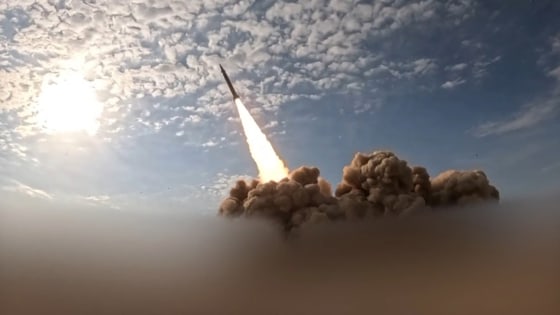
A missile launch in Iran
An image released by the Iranian state broadcaster Thursday shows what it says is a wave of missiles launched against Israel and U.S. bases in the United Arab Emirates and Kuwait. IRIB via AFP - Getty Images

After nearly four weeks of heavy bombardment by U.S. and Israeli forces, Iran is still able to assail its Gulf neighbors and Israel with daily missile and drone attacks.

Tehran has been striking military bases, oil and gas sites, civilian airports, hotels and ports in a retaliatory campaign that has effectively shut the vital Strait of Hormuz waterway and left the global economy reeling.

Iran continues to launch dozens of ballistic missiles and drones across the region on a daily basis, according to an NBC News tally of the Gulf states’ attack counts. Though the number of projectiles it fires has declined markedly since the first few days of the conflict, it has maintained a steady stream of attacks across a swath of regional targets.

The U.S.-Israeli air campaign has battered Tehran and cities across the country, destroying homes and killing more than 1,900 people, according to Iran’s deputy health minister.

U.S. and Israeli officials and commanders say the campaign is designed to decimate Iran’s missile and drone programs and that it will soon succeed in crippling Tehran’s ability to strike at countries in the region. The Israeli military said 70% of Iran’s missile launchers were disabled by the 16th day of the war. The Pentagon says it has degraded about 90% of Iran’s ballistic missile and drone capabilities, though it has not provided more details.

Former military officers and experts say Iran’s missile program will likely be crushed if the air assault continues. But they say wiping out its drone capacity is a more difficult objective. Drones do not necessarily require large production facilities and can be launched from a truck, making them an elusive target.

“The challenge is it’s probably relatively easy to hide these things, and so finding all of them, bombing all of them, is going to be hard,” said Tom Karako, director of the Missile Defense Project at the Center for Strategic and International Studies, a Washington, D.C., think tank.

“It comes down to how good is the intelligence, ours and the Israelis’, in terms of where everything is,” he said.

Iran’s ability to keep up missile and drone attacks has raised questions about the effectiveness of the U.S.-Israeli air campaign, the quality of the intelligence underpinning it and the assumptions that shaped the assault, according to former officials and analysts.

Iran may have dispersed more of its missile arsenal around the country than previously believed, used decoys and quickly excavated damaged missile bases to resume launches, Nicole Grajewski, an assistant professor at the Center for International Research at Sciences Po in Paris, told NBC News.

In the opening days of the war, Iran fired dozens of ballistic missiles at its neighbors. On the third day of the war, the number dropped sharply, and now Iran is typically firing fewer than 25 missiles a day at Gulf states.

As for drones, the number of attacks has also declined from the first few days of the conflict, when Tehran fired hundreds at its neighbors.

After the opening stage of the war, the number of Iranian aerial attacks has varied from day to day and country to country. The number of ballistic missiles fired daily has declined overall. Iran has kept up a steady rate of drone attacks, targeting Gulf states with an average of roughly 120 drone attacks per day since the war’s start.
According to government officials in the region, only a small number of missiles and drones evade air defense systems.

In the first 11 days of the war, the United Arab Emirates successfully intercepted 92% of ballistic missiles fired by Iran and nearly 94% of drones, according to the UAE’s defense ministry.

Kuwait’s government reported that all of the missiles fired at the country since Feb. 28 were either destroyed or fell far from any potential target.

But even with effective air defenses, Iran’s missiles and drones — and the debris from those that are intercepted — have killed and wounded civilians, inflicted significant damage on key energy facilities and jolted the global economy.

As of March 16, the Iranian attacks on Gulf states have killed at least 11 civilians and injured at least 268 others, according to a tally by Human Rights Watch based on information from Gulf states.

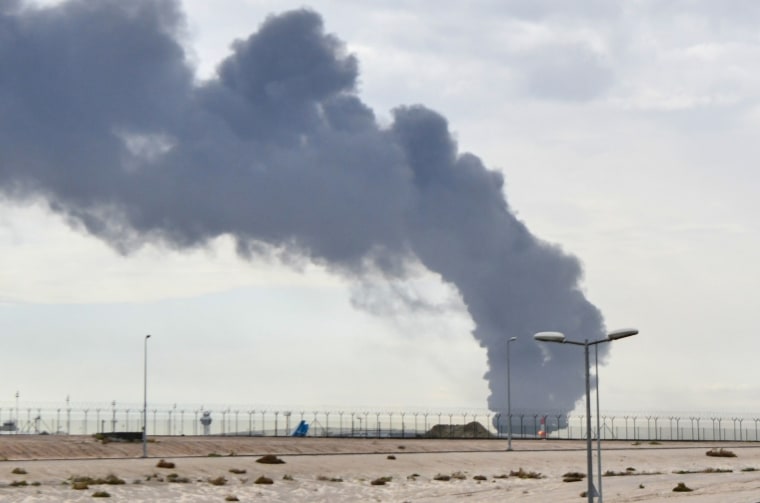
Smoke rises after an Iranian drone attack on a fuel depot at Kuwait International Airport on March 25, 2026.
Smoke rises after an Iranian drone attack Wednesday on a fuel depot at Kuwait International Airport.Anadolu via Getty Images

Taking aim at the region’s economic lifeline, Iran has launched dozens of drone and missile strikes on key parts of the Persian Gulf’s energy infrastructure — including oil fields, refineries, liquefied natural gas facilities and ports in Saudi Arabia, Bahrain, Kuwait, the UAE and Iraq.

Earlier this month, Iran launched two missiles at the joint U.K.-U.S. Diego Garcia military base in the Indian Ocean, covering a distance of more than 2,000 miles. The launch indicated Iran’s missile arsenal was more potent than previously believed. For years, Tehran said it had chosen not to develop missiles with ranges beyond 1,250 miles.

An Iranian missile strike on Qatar’s natural gas facilities on March 18 knocked out 17% of the country’s liquefied natural gas export capacity at an estimated cost of $20 billion in lost revenue.

Iranian air attacks have targeted the Yanbu port in Saudi Arabia on the Red Sea, the Fujairah port on the eastern coast of the United Arab Emirates, the Shaybah oil field in Saudi Arabia, the Ras Tanura refinery in Saudi Arabia, two refineries in Kuwait, the Lanaz refinery in northern Iraq and the Bapco Energies refinery in Bahrain.

Governments in the region say it will take years to fully repair the damage to Gulf energy sites.

Israel also has come under a barrage of retaliatory missile and drone attacks since the war began, but it has not released information on the precise number of attacks or how many Iranian projectiles have been intercepted. Lt. Col. Nadav Shoshani, the Israel Defense Forces’ international spokesperson, last week said Iran has fired around 400 missiles at Israel since the start of the war. At least 18 Israeli civilians have been killed and thousands wounded, according to Israeli authorities.