As the sun set on Washington on Tuesday evening, a rainbow appeared over the Capitol. LGBTQ candidates and advocates hoped it was an early sign that a figurative “rainbow wave” would sweep a historic number of lesbian, bisexual, transgender and queer candidates into office.
Their hopes were arguably fulfilled. With a number of races still too close to call, more than 150 LGBTQ candidates emerged victorious in the midterms as of Friday afternoon. For perspective, there are currently less than 600 openly LGBTQ elected officials in the U.S. — just 0.1 percent of elected officials nationwide, according to the Victory Institute.
“From the U.S. Congress to governors’ mansions to state legislatures and city councils, we are making historic inroads and growing our political power in ways unimaginable even a few years ago,” former Houston Mayor Annise Parker, now the president and CEO of the Victory Institute and Victory Fund, said in a statement sent to NBC News. “We shattered lavender ceilings, achieved historic firsts and brought more LGBTQ representation to legislative bodies across the nation, which will help push equality forward.”
GOVERNOR’S RACES
Four LGBTQ candidates ran for governor, all Democrats, and two are projected to win.
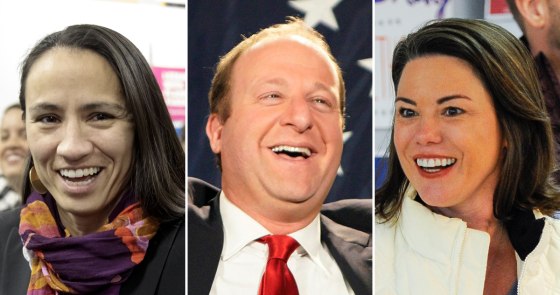
In Colorado, with 99 percent of the votes in as of Friday afternoon, NBC News reported that Jared Polis is ahead of his Republican challenger, Walker Stapleton, with more than 52 percent for the vote. Polis is set to become the first openly gay man elected governor in the U.S.
Patrick Egan, a politics professor at New York University, called Polis’ victory a “remarkable turnaround” for the Centennial State, which in 1992 “was home of Amendment 2,” which prohibited recognition of homosexuals as a protected class. And just over a decade ago, the state also passed Amendment 43, which prohibited same-sex marriage.
“That says something about the transformation of that state, and of our country, when it comes to how voters think about LGBTQ candidates and LGBTQ rights,” Egan said.
Related

Oregon Gov. Kate Brown, a bisexual Democrat who in 2016 became the first openly LGBTQ person to be elected governor, was also projected to win her race. With 99 percent of the vote in on Wednesday afternoon, Brown was 6 percentage points ahead of Republican Knute Buehler.
Lupe Valdez, a lesbian Latina running in Texas, and Christine Hallquist, a transgender woman running in Vermont, were both projected to be defeated by their Republican challengers.
“The big disappointment of the night is Christine Hallquist,” Egan said, noting that she faced a popular Republican incumbent, Gov. Phil Scott. “But I don't think it takes anything anyway from her historic candidacy.”
CONGRESSIONAL RACES
There are currently seven openly LGBTQ members in Congress: Sen. Tammy Baldwin, D-Wis.; Rep. Jared Polis, D-Colo.; Rep. David Cicilline, D-R.I.; Rep. Sean Patrick Maloney, D-N.Y.; Rep. Kyrsten Sinema, D-Ariz.; Rep. Mark Pocan, D-Wis.; and Rep. Mark Takano, D-Calif.
The incoming 116th Congress will welcome several new LGBTQ members, though the overall number of out members will only increase slightly, as some members — like Polis — have sought higher office.
Baldwin, the first openly LGBTQ person elected to the Senate, was projected to win re-election. Sinema, who is running for the Senate seat being vacated by Republican Jeff Flake, is in a tight race with Republican Martha McSally. As of Friday afternoon, the race was still too close to call: With 83 percent of precincts reporting, Sinema was ahead by nearly 10,000 votes. If she wins, she will be the first openly bisexual person elected to the Senate and the first female senator from Arizona.
Of the estimated 20 openly LGBTQ major party candidates running for the House, eight won. The incumbent winners include Rep. Mark Takano, D-Calif.; Rep. Sean Patrick Maloney, D-N.Y.; Rep. David Cicilline, D-R.I.; and Rep. Mark Pocan, D-Wis. The new LGBTQ House members include Democrats Sharice Davids of Kansas, Angie Craig of Minnesota, Chris Pappas of New Hampshire and Katie Hill of California.
Related

When all the races are called, the number of LGBTQ members in both houses of Congress will climb slightly to nine.
“This is a historic night in the fight for equality,” Rep. Cicilline said in a statement. “We will enter the 116th Congress with an unprecedented number of LGBTQ members.”
“We are also celebrating the rise of a Democratic majority,” Cicilline continued. “Issues important to LGBTQ Americans, like the Equality Act’s protection from discrimination and equal and affordable access to health care, will now be top priorities for the People’s House. The LGBTQ members of Congress are ready to lead in the House to ensure equality for all across this country.”
The wins by LGBTQ challengers helped give control of the House to Democrats. Democrats needed to pick up 23 seats to take control of the House, and as of Thursday, they had a net gain of 31.

