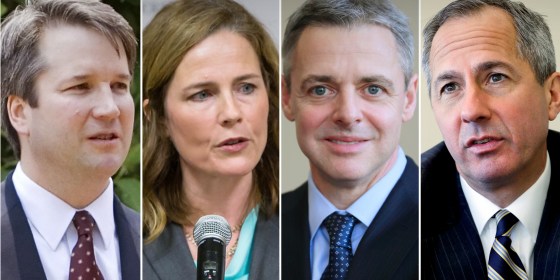
In his more than three decades on the bench, Supreme Court Justice Anthony Kennedy was a crucial swing vote on several decisions that expanded gay rights. With Kennedy’s retirement just weeks away, all eyes are on his potential replacements and how they might decide on key issues, including those pertaining to LGBTQ rights.
President Donald Trump has narrowed down his list of contenders to replace Justice Kennedy to four serious candidates, a source with first-hand knowledge of Trump’s selection process told NBC News. Those candidates are appeals court judges Brett Kavanaugh, Raymond Kethledge, Amy Coney Barrett and Thomas Hardiman.
Following the reports of Trump’s top choices, a number of LGBTQ and civil rights organizations were quick to share their concerns about the president's picks.
"None of the nominees — nobody on this list — has demonstrated a commitment to giving a fair hearing to LGBTQ Americans."
Daniel Goldberg, Alliance for Justice Legal Director
Sharon McGowan, legal director of Lambda Legal and a former Justice Department official, described Trump’s shortlist as “exactly what Trump promised.”
She called the candidates “extraordinarily extreme” and noted they have “the blessing of extreme organizations” and “folks who would put the rights of many communities at risk.”
Daniel Goldberg, legal director of liberal judicial advocacy group Alliance for Justice, echoed McGowan’s assessment of the candidates.
“None of the nominees — nobody on this list — has demonstrated a commitment to giving a fair hearing to LGBTQ Americans,” he said.
Citing the president’s unsuccessful judicial nominations of Damien Schiff and Jeff Mateer, Goldberg said Trump “has made clear through his lower court appointments his contempt for the rights of LGBTQ Americans.”
“He wants to put someone on the bench who will turn back the clock and erode many of our most critical legal principles,” Goldberg added.
Carrie Severino, chief counsel and policy director at the conservative Judicial Crisis Network, said the warnings from LGBTQ advocacy groups have been “very much overblown” and called them “mostly scare tactics.”
She argued the shortlisted nominees do not have a track record on deciding specifically LGBTQ issues, so “we don’t really know what their position is.”
Severino praised the president for looking at a “very deep bench” of candidates and said his shortlist shows he’s on track to “fulfill his most important campaign promise” of choosing conservative justices.
AMY CONEY BARRETT
Barrett, 46, is a former law clerk to Justice Antonin Scalia and was appointed by Trump last year to serve on the 7th U.S. Circuit Court of Appeals in Chicago. Barrett, if selected and confirmed, would be the youngest justice on the high court.
During her Senate confirmation process last year for her current post, Barrett was questioned about important LGBTQ legal precedents, including Obergefell v. Hodges, United States v. Windsor and Lawrence v. Texas. In written responses to senators’ questions, Barrett repeatedly stated these landmark cases are “binding precedents” that she will “faithfully follow if confirmed.”
McGowan, however, noted that such an answer “means nothing when it comes to the Supreme Court.” Not only does the high court have the ability to overturn precedent — as occurred last month in the Janus v. AFSCME Council 31 case, which dealt a crippling blow to public worker unions — McGowan said the court can also “gut or hollow out precedent."
Goldberg said Barrett has “deeply troubling writings when it comes to precedent.”
“I have no doubt these nominees … will come before the Senate and say ‘I respect precedent.’ The burden is on [the nominees] to demonstrate that they will respect the critical precedents … that are essential for ensuring equality under the law for LGBTQ Americans,” Goldberg added.
Related

In an October 2017 letter sent to the Senate Judiciary Committee by 27 LGBTQ groups opposing Barrett’s nomination to the 7th U.S. Circuit Court of Appeals, the organizations voiced concerns about the ability of Barrett, a devout Catholic, to reconcile her “religiously-infused moral beliefs” with her “judicial decision-making about issues of concern to the communities that our organizations serve”
