
Older adults who remain cognitively sharp as they age have a genetic advantage over their peers, new research shows.
Scientists at the University of Illinois College of Medicine Chicago found that so-called super-agers generate twice as many new neurons in the hippocampus — a part of the brain critical to learning and memory — as typical older adults. Their research was published Wednesday in the journal Nature.
“This discovery means that the super-agers have a molecular capability that allows them to have higher [cognitive] performance, and that includes more neurogenesis,” said study co-author Orly Lazarov, the director of UIC’s Alzheimer’s Disease and Related Dementia Training Program. “Neurogenesis is one of the most profound forms of plasticity in the brain.”
In other words, she said, super-agers’ brains are more “accommodating.”
A super-ager is a person 80 or older who boasts the memory capacity of someone at least two to three decades younger, as determined by delayed word recall testing, according to Dr. M. Marsel Mesulam, founder of the Mesulam Institute for Cognitive Neurology and Alzheimer’s Disease at the Northwestern University Feinberg School of Medicine, who coined the term.
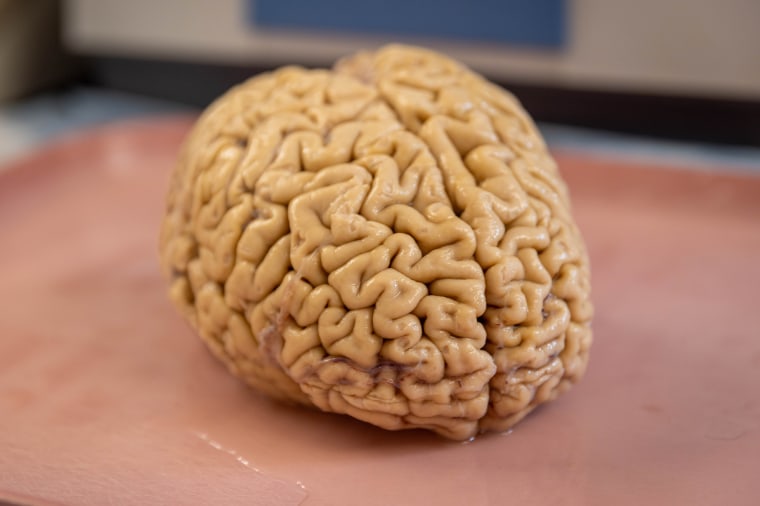
In the new study, Lazarov and her colleagues studied 38 brains from five groups of deceased adults: healthy adults 40 and younger, healthy older adults, people in early stages of cognitive decline, people diagnosed with Alzheimer’s disease and super-agers. The six super-ager brains were donated by Northwestern’s SuperAging Program, which last year celebrated its 25th anniversary.
The researchers examined neurons at different stages of development within the brain tissue samples. Super-agers had twice as many new, or “immature,” neurons as healthy older adults, the study showed. Compared with people with Alzheimer’s, super-agers had two and a half times as many.
As recently as the mid-20th century, it was thought that mammals were born with a fixed number of neurons in the brain. Scientists then uncovered adult neurogenesis in rodents and primates in the 1960s and ’70s.
While studies have since recognized the phenomenon in humans — in a part of the hippocampus called the dentate gyrus — evidence has been mixed and the process poorly understood.
“We have established the presence of this process and its roles in learning and memory in rodents and in primates,” Lazarov said. “Whether the human brain functions in a similar way is a very critical question for us.”
Lazarov’s research suggests that adult human brains are not only capable of generating new neurons but do so as a function of age and cognitive status.
Super-agers’ brains showed a “resilience signature,” Lazarov said. “They are able to cope with aging and perform well in terms of cognition.”
Additionally, her team found that changes in two kinds of cells, astrocytes and CA1 neurons, help regulate memory and cognition in the aging hippocampus.
Still, the study had limitations, the authors said: It had a small sample size, and large amounts of variability among human brain samples is typical.
Super-agers offer 25-plus years of cognitive clues
This research marks the first discovery of a genetic difference between super-agers and typical older adults, according to the Northwestern SuperAging Program.
“These people are in their 80s and 90s, and suddenly you’re seeing that they still have immature neurons that are rewiring themselves,” said program co-director Tamar Gefen, who is also a co-author of the study. “There is no question that their hippocampi [are] completely different than other human beings’, period.”
The program has made other discoveries related to such exceptionally healthy older brains, from personality traits to neurological anomalies. For one, Gefen said, super-agers generally describe themselves as extroverts. They also have more von Economo neurons, which are nerve cells linked to social behavior.
“We’ve heard this time and time again, just how important socialization is for healthy aging, and then on the flip side, how detrimental isolation is in old age,” she said.
