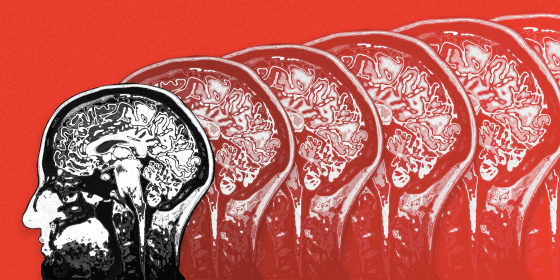
The past decade of Alzheimer's disease research has been fraught with disappointment.
Years of focus on one hallmark of the disease ultimately resulted in no progress toward treatment or prevention.

But next week, when top scientists gather in Los Angeles at the Alzheimer’s Association International Conference, an annual meeting, many will present research on a different target: inflammation.
“The big breakthrough is that neuroinflammation is the target. It's killing the bulk of the nerve cells that leads to dementia,” said Rudolph Tanzi, a professor of neurology at Harvard University and the director of neurology at Massachusetts General Hospital.
Moving beyond plaques
Early research into Alzheimer’s disease pointed toward a conspicuous target: clumps of protein in the brain called amyloid plaques. When scientists studied the brains of people with Alzheimer's disease who died, they noticed the brain tissue was full of these plaques, which are still considered a hallmark of the disease.
But although research has shown time and time again that amyloid plaques may play a role in Alzheimer’s, it's not the singular key to a cure.
Indeed, on Thursday, pharmaceutical companies Amgen and Novartis announced their trial of a drug meant to help block the production of amyloid plaques had failed. In fact, patients who received the drug got worse. The Alzheimer's Association called the outcome “disappointing.”
Related

But according to Tanzi, going after the plaques after they’ve formed means you’re too late. That’s because amyloid develops very early in the Alzheimer's disease process — even 20 years before the first symptoms appear. Attacking amyloid in patients who already have dementia is like trying to stop a forest fire by blowing out a match, he said. It's inflammation that's allowing the fire to rage out of control.
“If you want to hit the plaques, you have to do so early on with early detection,” Tanzi said. “I believe that will be the future for preventing Alzheimer's disease. But for now, how do we help the 5 million patients in this country? You have to put out the forest fire.”
Putting out the inflammation fire
Tanzi is working with a Boston-based company called AZTherapies to find drugs already in existence that can tackle that neuroinflammation. Tanzi serves as director of the company's scientific advisory board, and has financial ties to the company.
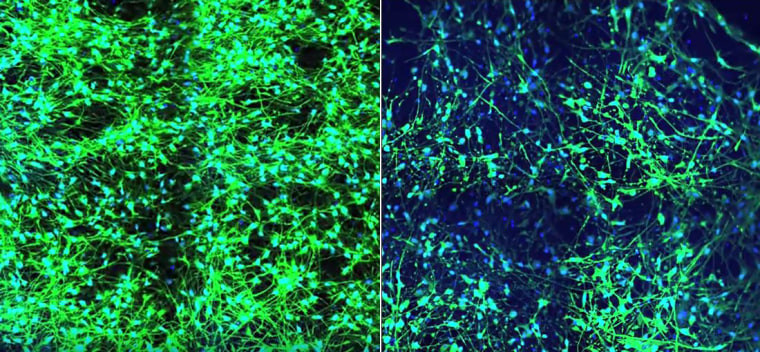
Part of AZTherapies’ research involves a drug used to treat asthma, called Cromolyn, which targets inflammation in the lungs. The company altered the medication so that it reaches the brain, and is testing it in combination with ibuprofen.
“This is one of the first trials to take a relatively safe drug ... reformulate it, and then ask if we turn off neuroinflammation, can we put out the forest fire and, just like a forest, allow it to grow back?” Tanzi said.
AZTherapies has enrolled almost 600 patients for that trial, and expects results within the next year or two. Still, it's far too early to suggest people take anti-inflammatory medications to help stave off dementia. Drugs on the market now either don't reach the brain, or come with other risks associated with long-term use, like increased risk for heart attack, stroke and stomach ulcers.
AZTherapies is not the only company moving away from amyloid research and into areas that target inflammation.
Neurotrope will present research at next week's Alzheimer's Association conference about its drug, bryostatin-1.
Originally tested as a cancer drug, bryostatin-1 works by activating a protein involved with the “wiring” of the brain.
“It induces the regeneration of wiring and synaptic networks that are lost. It prevents neuronal death. And also it is very significantly anti-inflammatory,” Dr. Daniel Alkon, Neurotrope's president, said.
Alkon told NBC News that in early studies of Alzheimer's patients, those taking bryostatin-1 showed cognitive improvement that was sustained for at least a month after treatment.

