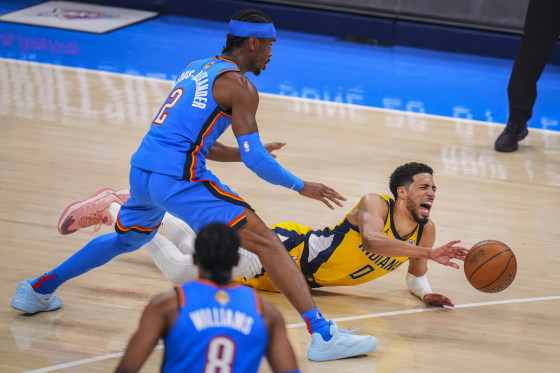
The Indiana Pacers were playing for the NBA championship on Sunday night. But when star Tyrese Haliburton was carried off the floor with an Achilles injury late in the first quarter of Game 7 of the finals, the franchise’s hopes plummeted.
Shai Gilgeous-Alexander and the Oklahoma City Thunder would go on to win the title with a 103-97 victory, but questions remain about what would have happened had Haliburton been able to play the final three quarters.
His injury also reopened discussion about why so many NBA players are tearing their Achilles tendons. This postseason alone, Haliburton, Bucks guard Damian Lillard and Celtics wing Jayson Tatum all sustained the same injury.
Some have argued that 82 regular-season games and a busy playoff schedule result in a higher likelihood of injuries.
But NBA Commissioner Adam Silver said this month that postseason injuries were “considerably down” compared to other years, noting that he didn’t think the more compressed nature of the schedule was linked to more injuries.
“I don’t really see the benefit to reducing the number of games,” he told members of the media. “People used to say you should reduce the number of games because it will lead to reduction in the number of injuries. There’s absolutely no data to suggest that.”
Medical experts say that the high caliber of the sport — not simply the number of games — may provide an explanation.
The Achilles tendon connects the calf muscles to the heel bone. It’s the longest and largest tendon in the body and can take on the stress of about six times a person’s body weight, said Dr. Julia Iafrate, a sports medicine doctor at NYU Langone. But basketball’s continuously fast and explosive movements increase the risk of Achilles injuries, she said.
Basketball players load their tendons more “aggressively,” increasing the risk for injury, she said.
“Usually they are standing still, then they go to take a step aggressively, to speed run somewhere, or to take off, and that’s when the injury happens.”
“I think that there’s more pressure to perform at a high level and with these high level athletes, the expectation of them to constantly be able to push through injury creates an environment that maybe makes them a higher risk,” she added.
Dr. Adam Bitterman, chairman of the department of orthopedic surgery at Northwell Medicine in New York, said Achilles injuries can happen in any activity that produces a sudden eccentric contraction of the Achilles tendon, meaning it’s lengthened when under tension.
Bitterman said he’s noticed higher rates of Achilles tendon injuries recently, from high school athletes to professionals to weekend warriors. The reasons could stem from lifestyle choices, the shoes they’re wearing or pre-existing conditions, he said.
Haliburton suffered a calf strain in Game 5 of the NBA Finals but still went on to play the final two games at less than 100%. After the strain, he said he was determined to be on the floor despite the injury.
“If I can walk, then I want to play,” Haliburton said after the Pacers lost Game 5.
Haliburton said he had an “honest conversation” with head coach Rick Carlisle to take him out of Game 6 if he “was hurting the team.”
“Obviously, I want to be on the floor,” he said. “But I want to win more than anything.”
Haliburton finished with 14 points and five assists in an Indiana win that forced Game 7, but it’s possible the extra tension on his Achilles and the calf strain may have contributed to his Achilles injury, both Bitterman and Iafrate said, neither of whom have treated Haliburton.

