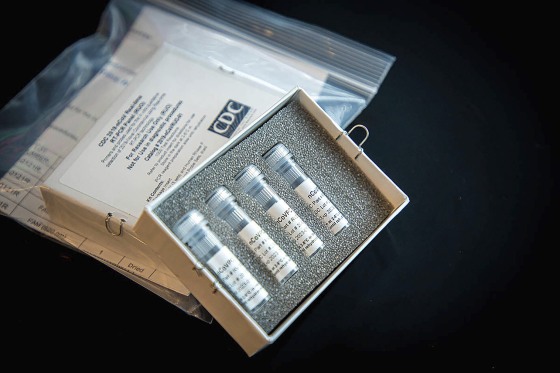
Some states received test kits that were inconclusive or only partially accurate. Other states said they were hamstrung by testing criteria so narrow, it limited who they could screen for the new coronavirus.
For more than a month, officials throughout the country have been asking the Centers for Disease Control and Prevention to enable more widespread testing for the never-before-seen infection, as coronavirus cases around the globe rose past 82,000.
But technical difficulties reduced the number of laboratories in the U.S. with working test kits to only about a dozen, including CDC headquarters in Atlanta. That delayed results for suspected patients and frustrated public health authorities.
Full coverage of the coronavirus outbreak
Things changed this week: Top federal health officials announced they had modified the testing protocol, expanded criteria for who could be tested and worked out the technical problems with the tests, positioning more state and local laboratories to finally have the ability to test for COVID-19, the illness caused by the new coronavirus. But, the officials acknowledged, the process was rocky.
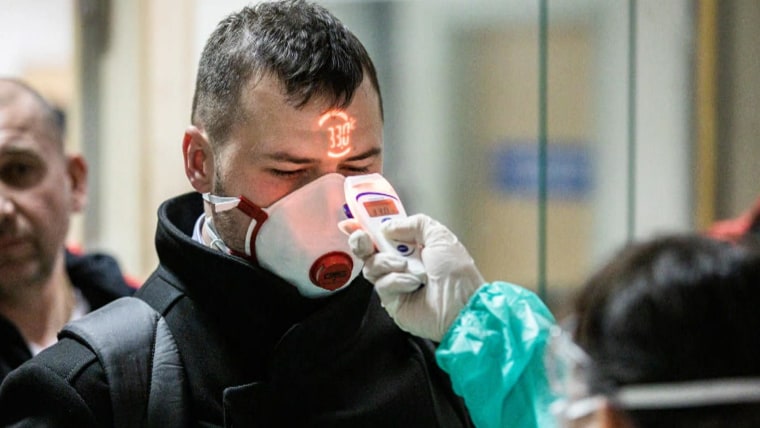
"This has not gone as smoothly as we would have liked," Dr. Nancy Messonnier, director of the CDC's National Center for Immunization and Respiratory Diseases, said in a call with reporters Friday.
The number of U.S. cases so far has been low: Sixty-three as of Friday, nearly three-quarters from a stricken cruise ship overseas.
This week, a severely ill woman at UC Davis Medical Center with no obvious connection to another known coronavirus patient tested positive for the virus, marking the first possible case of "community spread" in the U.S. — meaning the source of the infection is unclear, and there could be other sick patients who have yet to be identified.
Download the NBC News app for full coverage of the coronavirus outbreak
UC Davis said the patient's diagnosis was delayed because she did not meet the CDC criteria for testing, given that she did not appear to have had close contact with any known coronavirus patients and had not traveled to China, where the outbreak started.
The CDC denies initially declining to test the woman. Nevertheless, this week, the federal agency significantly broadened its criteria for testing. Before, testing was recommended only for those with symptoms, including fever and cough, who had recently traveled to China or had contact with an infected individual; on Thursday, the guidance was updated to include some patients with no clear source of exposure as well as those who had recently traveled to Italy, Iran, Japan or South Korea.
Meanwhile, the technical kinks in test kits are also being ironed out.
There were two separate issues, according to Scott Becker, CEO of the Association of Public Health Laboratories, which represents the 100 local and state public health laboratories qualified by the CDC to do this type of testing.
The test kit had three components, Becker said, two of which tested for the novel coronavirus and a third that tested for a host of other viruses. In dozens of labs, the test kit correctly yielded results for the coronavirus — but came back inconclusive for the other viruses, which made the federal health officials question the integrity of the entire kit, he said.
On Thursday, Health and Human Services Secretary Alex Azar informed a congressional hearing that the CDC had modified its testing protocol for the labs who received that test, in such a way that they could test just for the coronavirus.
"The FDA has authorized the use of those tests by using just the first and second step to provide a definitive diagnostic," he said.
That instantly enabled at least 40 labs around the country to use their test kits, he said.
The state public health laboratory in Michigan was one of those sites. Michigan has had five patients test negative for the coronavirus and does not currently have any people believed to be at high risk for the illness. But being able to test in-state with the modified guidelines, as opposed to sending samples out to the CDC headquarters, is "significant," said Dr. Joneigh Khaldun, chief medical executive and chief deputy director for health for the state's Department of Health and Human Services.
"Obviously, we want to identify any positive test as quickly as possible, so our public health system responds appropriately."
"It's very important to us in identifying anyone who is an actual case," Khaldun said. "Obviously, we want to identify any positive test as quickly as possible, so our public health system responds appropriately."

