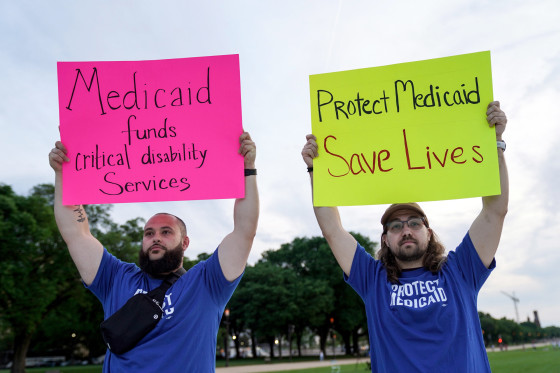
The Medicaid cuts in President Donald Trump’s domestic policy bill could result in more than 1,000 additional deaths every year, according to a report published Wednesday in JAMA Health Forum.
The cuts could also lead to nearly 100,000 more hospitalizations each year, the report found, and around 1.6 million people may delay seeking care.
The projections are at odds with comments made by Health and Human Services Secretary Robert F. Kennedy Jr., who downplayed the bill’s impact during an interview with Fox Business Network’s Larry Kudlow on Monday.
“We’re not going to cut Medicaid and there’s nobody who is going to die from this,” Kennedy said.
HHS did not immediately respond to request for comment.
Wednesday's study reaches a similar conclusion to an analysis published in the Annals of Internal Medicine in June, which also found that the cuts could lead to thousands of preventable deaths annually because people delay care and get sicker.

Medicaid is jointly funded by states and the federal government.
Trump’s legislation — dubbed the “big, beautiful bill” — includes nearly $1 trillion in cuts to the program, mainly through work requirements and reduced federal funding. Most of the changes aren’t slated to take effect until 2027 or 2028.
The new report’s projections are based on an earlier estimate from the Congressional Budget Office that found changes to Medicaid could result in 7.6 million people in the U.S. losing their health insurance by 2034.
The coverage losses are expected to lead people to delay seeking care because they can no longer afford it, said the report’s author, Dr. Sanjay Basu, the chief medical officer at Waymark, a company that aims to improve access and care to Medicaid patients. For many, he said, that delay would result in people getting sicker, leading to hospitalizations and death.
“People tend to worry about cost or coverage,” he said, so they avoid care until “they end up hospitalized or found at home, dead, from an uncontrolled condition.”
Basu added that the report’s projections are likely “an underestimate,” noting that it doesn’t take into account changes in the bill to the Affordable Care Act.
The estimates also assume that states will be able to make the required changes to their Medicaid programs — such as setting up systems to track work requirements — within the two- to three-year time period, he said.
A worst-case scenario in the report projects double the number of additional annual deaths — around 2,000 — and estimates that up to 2.5 million people will delay seeking care.
“This stuff is actually quite complicated for a state, and the deadlines are not too long from now,” Basu said. “We’re not sure how many people will be dropped, not because they’re no longer eligible, but because they procedurally can’t get through things.”
Other health impacts
Jennifer Tolbert, deputy director of the program on Medicaid and the uninsured at the health policy research group KFF, said other studies have repeatedly shown that uninsured people are less likely than those with insurance to get preventive care and treatments for major health conditions and chronic diseases.
Almost a third of uninsured adults report delaying or forgoing care due to cost, compared with 6% of insured adults, according to a KFF report.
“The consequences [of delaying care] can be severe,” she said, “particularly when preventable conditions or chronic diseases go undetected.”