NBC News reached out to the health departments in all 50 states, the five U.S. territories and the District of Columbia about their recommendations for people concerned they may have COVID-19.
As the novel coronavirus spreads and the capacity of the nation’s health care systems is stretched, the basic guidance is largely the same nationwide:
You may not be able to get tested, especially if you do not have severe symptoms. While testing is available in every state and more labs are beginning to test around the country, demand is so high that tests are largely being reserved for high-risk cases: people with severe symptoms, other risk factors like age and complicating health conditions, and health care workers.
If you have coronavirus symptoms (fever, cough, shortness of breath), but do not require emergency medical care, health departments advise that you consult your primary care provider by calling to discuss your symptoms, stay home, self-isolate and take care of your symptoms until they pass to avoid exposing others — there’s no treatment for coronavirus and most cases don’t require hospitalization. If your symptoms become severe, you should seek medical care, but call ahead to the provider or hospital so they can make arrangements to limit exposure to others during your arrival, or inform the 911 dispatcher in an emergency situation.
All state health departments have additional information available on their coronavirus websites, which are frequently updated. Some have also set up COVID-19 hotlines. For details about your health department’s recommendations, testing protocols and where to find additional information, find your state on the drop-down menu below. NBC News will continue to update this list as information changes.
Call a health care provider if you are concerned you may have coronavirus - these include physician practices, emergency departments and urgent care centers. If they determine you should be tested, they will help you make arrangements to have samples taken while minimizing exposure to others.
If you do not have a health care provider, you can call 1-888-264-2256. In the event the line is busy, the department asks that callers try again.
If you need emergency care, call 911. When you speak to the dispatcher, inform them you think you have have coronavirus.
Providers determine if someone should be tested, using the state's criteria, which evaluates a combination of symptoms and risk factors.
Test results from the state public health lab should be available in 24 to 72 hours.
Patients who are not hospitalized should self-isolate at home and remain there until their test results are reported to them by their health care provider.
For more information, the public can call Alabama's 211 system by dialing 2-1-1 or texting 888-421-1266—or visit the Alabama Department of Public Health's coronavirus webpage.
Alaska
Stay home and call your health care provider if you have symptoms to discuss whether you should be evaluated in person for testing. Providers determine if testing is appropriate based on symptoms and risk factors.
Separate yourself from other people and animals in your home as much as possible, including using a separate bathroom, if possible.
Seek prompt medical attention if your illness is worsening (e.g., difficulty breathing). Before seeking care, call your health care provider and tell them that you think you may have COVID-19. Put on a facemask before you enter the facility.
If you have a medical emergency and need to call 911, notify the dispatch personnel that you have, or may have COVID- 19. If possible, put on a facemask before emergency medical services arrive.
The state public health lab and commercial labs are conducting testing. The state public health lab is prioritizing specific cases:
patients with recent close contact to a lab-confirmed of COVID-19
patients with a history of travel to or residence in a community where local transmission of COVID-19 has occurred within the past 14 days
hospitalized patients
residents of long-term care facilities
healthcare workers with a negative flu test
Test results from the state lab are expected in one to three days. Results times from commercial labs may vary.
Patients with COVID-19 should remain under home isolation until their medical provider believes the risk of transmission to others is low.
Your specimens can be collected at the Lyndon B. Johnson Tropical Medical Center. Speak to the department of public health first and call ahead before arriving.
Decisions about testing are made based on the CDC's criteria which looks at symptoms, exposure and risk.
Samples are sent to the state public health lab in Hawaii or the CDC lab in Atlanta for analysis.
Results from Hawaii’s state lab come back within three days while the turnaround time for CDC could be up to a week.
For more information, call the COVID-19 hotline at (684) 633-5871 or (684) 633-5872.
Arizona
Avoid contact with others and call your health care provider if you have symptoms and are concerned. If you do not have a regular provider, you can call an urgent care center.
Providers determine if someone should be tested for coronavirus, based on the state's criteria, which evaluates a combination of symptoms and risk factors.
The Arizona State Public Health Lab and several private labs including Sonora Quest, Mayo, LabCorp and Arup Laboratories are conducting testing in the state.
Test results are typically available 24 hours after they are received by the public health lab. Private lab results times may vary.
If you have coronavirus symptoms (fever, cough, shortness of breath) but have not been tested, stay home away from others until 72 hours after fever is gone and symptoms of acute infection resolve. Call your provider for more guidance.
Call your health care provider if you are symptomatic to discuss whether you should be evaluated in person and considered for testing. Your provider will decide if testing for COVID-19 is necessary based on your symptoms and known exposures.
If you do not have a regular provider, call the nearest health care facility that can provide an evaluation or call an emergency room or 911 if you are in need of emergency care and tell them about your symptoms.
People with symptoms who are considered high risk (older adults and people with underlying chronic medical conditions) should call their provider even if symptoms are mild.
The state public health lab is only performing tests for Arkansans with possible high risk exposure to COVID-19. Test results are available approximately 24 hours after they arrive at the state lab.
Providers can also request testing from private labs in the state, which may have a different turnaround time for results.
People who are mildly ill may be able to self-isolate and care for themselves at home. If emergency warning signs develop, seek medical attention immediately. These signs include: difficulty breathing, persistent pain or pressure in the chest, new confusion or inability to arouse, or bluish lips or face.
If you are experiencing symptoms of COVID-19 and may have had contact with a person with COVID-19, call your health care provider or local public health department before seeking medical care so that appropriate precautions can be taken to limit exposure to others.
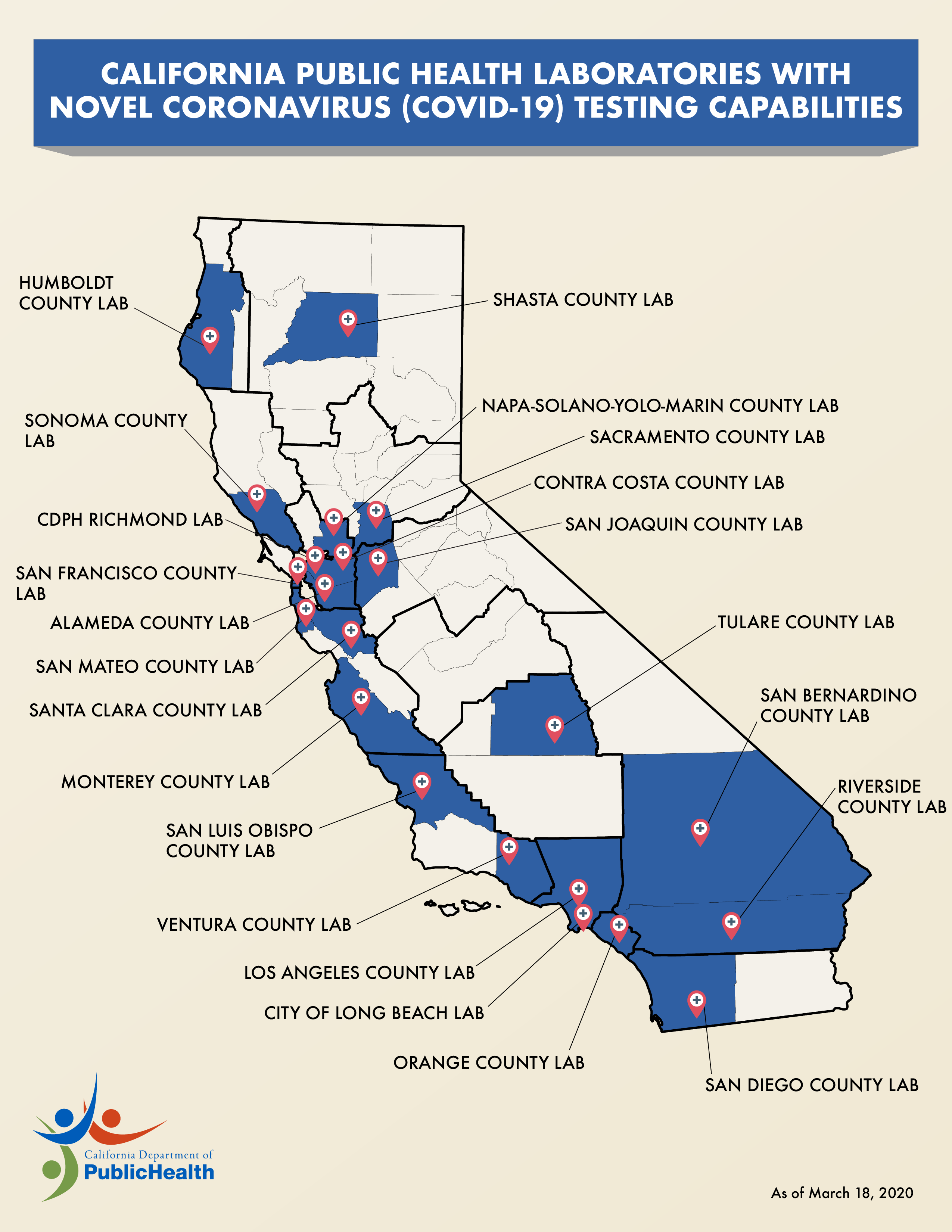
As of March 18, California had 22 public health labs testing for coronavirus and private labs testing as well.
For a patient to be tested by a public health lab, their provider must contact the local public health department for approval and instructions.
Most test results are available within 48 to 72 hours. The state has requested all labs notify the Department of Public Health about positive results.
Local health departments work with the California Department of Public Health and the CDC, and making determinations on whether a patient with COVID-19 requires hospitalization or if home isolation is appropriate. That decision may be based on multiple factors including severity of illness, need for testing, and appropriateness of home for isolation purposes.
Call your health care provider if you have symptoms. It is important to call ahead before going to see a doctor or emergency room to prevent the spread of illness. Tell them your symptoms and that you suspect you were exposed to someone with COVID-19 or had recent travel to a place that is experiencing community spread.
Providers determine if a patient should be tested. If so, they will give advice about where to go for testing, which is being conducted by the state public health lab and private labs.
Patients must be symptomatic and meet the state's criteria, which evaluates a combination of symptoms and risk factors, to be tested by the state public health lab. The public health lab can receive samples from providers and is conducting drive-up testing.
Test results from the state lab should be available within 72 hours, depending on testing volume. Private lab result times may vary.
DO NOT go to an emergency room to ask to be tested for COVID-19. If you are having a medical emergency call ahead to the emergency room or call 911 and inform the dispatcher about your symptoms.
Call your primary care provider if you have symptoms for information regarding local testing locations. Providers decide if testing is needed.
If you do not have a primary care provider and you have the symptoms of COVID-19, call ahead to an urgent care center or to a federally qualified health center to be evaluated for testing.
Testing is only being conducted for people with symptoms consistent with COVID-19. Some hospitals have drive through testing, which, like all coronavirus testing, is only available with a doctor's order.
If you have symptoms, but cannot get in touch with your provider, call one of the following hotlines:
Hartford Healthcare Hotline: (860) 972-8100
Yale New Haven Health: (833) 484-1200
Bristol Hospital Coronavirus Info Line: (860) 261-6855
If you feel sick, stay home and call your primary care doctor if you have concerns about your symptoms, particularly fever and coughing or shortness of breath.
If you do not have a primary care doctor, call the Delaware Division of Public Health's call center at (866) 408-1899.
The state is only recommending testing for people with symptoms.
If a provider determines someone should be tested, they collect the samples and send them to the state's public health lab or a private lab. Approval from the Division of Public Health is required for testing at the state lab, but not for commercial lab testing.
Results from the Division of Public Health's laboratory are typically available within 24 hours. Private lab results times may vary.
For more coronavirus information, visit the Delaware Division of Public Health's website; call the Delaware information line by dialing 1-866-408-1899; or email dphcall@delaware.gov. TTY users should dial 1-800-232-5460.
District of Columbia
Call your primary care doctor or a health care facility if you are experiencing respiratory symptoms to be evaluated for testing. Residents without a primary care provider can call 202-576-1117. Call ahead before arriving at any medical facility in person.
If you think you have symptoms, stay home from work or school until you are free of fever, signs of a fever and any other symptoms for at least 24 hours and without the use of fever-reducing or other symptom-altering medications.
Only patients who meet the CDC's criteria based on exposure and clinical factors and who are pre-approved by DC Health will be tested through the DC Department of Forensic Sciences Public Health Laboratory.
Call your health care provider or county health department if you are symptomatic. They will determine the need for testing.
The state public health lab is prioritizing testing for patients who meet the state's criteria, which evaluates a combination of symptoms and risk factors. Their samples will be sent to the closest laboratory.
If you don't meet priority criteria, you can discuss with your provider about possibly getting tested at a commercial laboratory (e.g. LabCorp or Quest).
State lab results are generally available within 24 to 48 hours. Commercial labs can take three to four days. Turnaround time can for all be affected by demand.
If you develop these emergency warning signs for COVID-19, get medical attention immediately:
If you believe that you are experiencing symptoms or have been exposed to the novel coronavirus, call your primary care doctor or an urgent care clinic. Do not show up unannounced at an emergency room or health care facility.
Your health care provider will determine if you need to be tested and tell you how to get care without exposing other.
To be prioritized for testing at the Georgia Public Health Laboratory, patients must meet the state's criteria, which evaluates a combination of symptoms and risk factors.
Private lab testing is available for symptomatic patients who don't meet the state's priority requirements, if their doctor determines they should be tested.
Stay home and avoid contact with others while symptomatic to prevent spread of the virus and follow your provider's instructions for taking care of yourself. Stay in touch with your doctor, monitor your symptoms.
Call your doctor or a health care facility if you feel sick or think you may have COVID-19 to discuss whether you should be evaluated in person and considered for testing.
If your symptoms are mild and allow you to stay home and self-isolate, but you would still like medical consultation, call one of the Department of Public Health and Social Services' medical hotline numbers to speak with a registered nurse (available daily from 6 a.m. to 10 p.m.):
(671) 480-7859
(671) 480-6760
(671) 480-6763
(671) 480-7883
The Guam public health lab is conducting testing for the territory, prioritizing people with symptoms and high risk cases. More information about testing criteria can be found in the physician's alert on the department's coronavirus website.
NBC News has reached out to the department with questions about testing and is awaiting additional response.
Hawaii
If you become ill with a fever or cough, and have recently left an area having widespread community transmission of COVID-19 or have had prolonged close contact with a person confirmed to have COVID-19, call a health care provider to discuss your symptoms.
The provider will determine if you should be tested based on the CDC's criteria.
If you have symptoms, stay home and avoid contact with others except for seeking medical care. If you need medical care, call ahead to your doctor’s office or an emergency room and let them know about your symptoms. If you need emergent medical care, call 911.
If you have difficulty accessing medical care or have questions about how to care for yourself at home, call the Department of Health at 808-586-4586.
The state's public health lab is conducting tests with authorization from the Department of Health. Tests are also being conducted by the Tripler Army Medical Center lab, which does not require department authorization. Results are typically available within a day.
For more information, visit the Hawaii Department of Health's coronavirus website.
Idaho
You do not need to seek medical attention for a mild respiratory illness such as a cold.
If you have had close contact with a person with known coronavirus or have recently traveled to an area with ongoing spread and you develop fever, cough, or difficulty breathing, call your healthcare provider and ask for instructions about how to seek care.
Health care providers decide if testing is needed on a case-by-case basis. They consult with epidemiologists at the state and at local public health districts to facilitate testing at the state lab for high-risk patients.
Testing is not recommended for people without symptoms.
The state public health lab and some private regional labs are conducting testing for Idaho residents. Test results are usually available 24 hours after they are sent to the state lab. Private lab times may vary.
Stay home if you are sick and call your health care provider if you have coronavirus symptoms to discuss whether you should be evaluated in person and considered for testing.
Providers determine whether to conduct testing based on the Illinois Department of Public Health's criteria, which evaluates a combination of symptoms and risk factors.
To help relieve symptoms: stay home and rest, take pain and fever medications and drink plenty of liquids. Seek medical attention if symptoms worsen.
After a provider sends samples to the public health lab, results should be available approximately 24 hours later.
Commercial labs are also conducting tests, which are then sent to the Illinois Department of Public Health's laboratory for confirmation.
General questions about COVID-19 and Illinois' response can be answered over the phone at 1-800-889-3931 or via email at DPH.SICK@ILLINOIS.GOV. More information is available on the Illinois Department of Public Health's coronavirus website.
Indiana
Contact your health care provider if you experience symptoms such as fever, cough and shortness of breath and have a recent history of travel to areas affected by COVID-19 or contact with someone diagnosed with COVID-19.
Health care providers determine if testing should be done in consultation with the Indiana State Department of Health in order for the test to be evaluated by the department. High risk individuals, including those who have been hospitalized with severe respiratory illness who have tested negative for other respiratory illnesses, will be prioritized. Results are typically available within 24 hours.
Symptomatic individuals who are not high risk can discuss possible private testing with their provider.
The state has a resource guide for Hoosiers looking for assistance, last updated on March 19.
For more information, check the state coronavirus website, direct general questions to the state's 24/7 COVID-19 call center at 877-826-0011 or e-mail epiresource@isdh.in.gov.
Iowa
If you think you've been exposed to COVID-19 and develop a fever, cough and shortness of breath, call your health care provider for advice. They will determine if you should be tested for coronavirus or come in for in-person care. If so, they will instruct you on how how to arrive to limit exposure to others.
Health care providers can request testing from public or private labs and may consult the state department of public health. The State Hygenic Lab conducts tests for patients that meet the state's criteria, which include:
a person who has traveled to a country with a level 3 CDC travel health warning or has taken an international cruise in the two weeks prior to becoming ill with fever and respiratory symptoms (who do not have an alternative diagnosis)
a person with household contact with a lab-confirmed COVID-19 case in the two weeks prior to becoming ill with fever or respiratory symptoms
hospitalized adults older than 60 with fever and respiratory symptoms and chronic medical conditions
hospitalized people with fever and respiratory failure, with no alternate diagnosis
Test results from the state lab should be available in approximately 24 hours. Private lab results times may vary.
Stay home and call your health care provider If you have symptoms such as fever, cough or shortness of breath and have had contact or believe you have had contact with someone who has a laboratory-confirmed case of COVID-19.
If you do not have a health care provider, call your local health department to be connected to one in your area.
People who are mildly ill with COVID-19 are able to isolate at home during their illness. Separate yourself from others as much as possible and clean high-touch surfaces regularly.
Seek prompt medical attention if your symptoms or illness worsens. Call your health care provider ahead of time to let them know you are coming. Call 911 if you have a medical emergency and notify the dispatcher that you have or are being evaluated for COVID-19.
Providers determine if a patient should be tested. Testing is available from private labs and the state public health lab for symptomatic patients.
The state public health lab is prioritizing cases for public health purposes and urgent need that meet the state's criteria:
Health care workers and first responders who have COVID-19 symptoms
Potential clusters of unknown respiratory illness, with priority given to long-term care facilities and healthcare facilities
Hospitalized patients with no alternative diagnosis
Individuals over the age of 60 who have symptoms of COVID-19 with priority given to people who reside in a nursing home, long-term care facility, or other group setting
Individuals with underlying health conditions that would be treated differently if they were infected with COVID-19.
Results are typically available within a day once they are received by the state lab. Results times from private labs may vary.
For more coronavirus information, call the state's hotline at 1-866-534-3463 (available Monday to Friday from 8 a.m. to 7 p.m., Saturday from 10 a.m. to 2 p.m and Sunday from 1 p.m. to 5 p.m.), email covid-19@ks.gov or visit the Kansas Department of Health and Environment's website.
Kentucky
If you think you have been exposed to COVID-19 and develop symptoms, but would not have sought care if not for COVID-19, do not seek in-person care at a doctor's office, hospital or ER. Instead, isolate yourself from others in your home and call your health care provider or local health department for medical advice.
If you are sick and feel you have an emergency, call your doctor or seek medical care, alerting them that you may have coronavirus.
Providers will determine if testing should be done. Tests can be conducted by the state division of laboratory services and commercial labs. Testing is not done on asymptomatic patients.
The Department for Public Health must approve of all tests done by the state lab and is prioritizing cases with the greatest need for evaluation from a public health standpoint, which include:
Symptomatic people who work in critical settings with vulnerable populations, such as health care workers, corrections officers, and people who work in long-term care facilities
People with critical illness, where other pathogens have been ruled out and there is an unusual clinical course or clear exposure reported
Results from the state lab are expected within one to two days of sample collection. Commercial lab result times may vary.
For more information, call the Kentucky coronavirus hotline at 1-800-722-5725 or visit the Kentucky coronavirus website.
Louisiana
Call your primary care physician if you begin to show symptoms and think you may have been in close contact with someone who tested positive. If you do not have a primary care physician, contact the Louisiana 211 Network by dialing 2-1-1 to be connected to the nearest community clinic.
If you have symptoms, self-isolate and call ahead before showing up at a health care provider so they can limit exposure to others. Providers decide if testing should be conducted.
The Louisiana Department of Health recommends testing for any patient with fever, respiratory symptoms and a negative flu test. Testing is not recommended for asymptomatic patients. Any physician can order testing based on their clinical judgement.
Testing is being conducted by the state public health laboratory and some commercial labs. The state lab only tests samples from high-priority patients, which include:
Hospitalized patients with a severe respiratory illness with no other known cause
Patients with recent onset of similar fever and lower respiratory symptoms who are associated with others with a suspected outbreak of COVID-19
Health care workers with direct contact to a laboratory-confirmed COVID-19 case with recent fever and lower respiratory symptoms
Homeless patients with suspected COVID-19
Patients with suspected COVID-19 who are associated with a high-risk exposure setting such as a long-term care facility or a correctional facility
State lab results are typically available within the same day. Results times may vary at commercial labs.
Stay home if you are sick. If you are concerned that you have been exposed to COVID-19, call your health care provider, who will determine whether you should be tested and, as appropriate, submit a sample for testing.
If you do not have a primary care provider or are uninsured, call an urgent care center or local health care facility for evaluation.
Anyone with severe symptoms (difficulty breathing or shortness of breath; persistent pain or chest pressure; new confusion or inability to arouse; bluish lips or face) should call 911 and go to a hospital emergency department.
Providers determine whether testing should be done based on symptoms, history of contact and travel and other risk factors.
Both the state public health lab and private labs are conducting tests. The state lab validates all presumptive positive tests from private labs.
The state lab is prioritizing testing for high risk individuals, which include symptomatic patients in one of the following categories:
Hospitalized patients.
Health care workers.
First responders (EMS, Police, Fire, etc.).
Those living in congregate settings (e.g. long-term care facilities, group homes, assisted livingfacilities, jails, shelters).
Patients older than 60 years.
Patients with underlying medical conditions.
Test results are available within 24 to 48 hours after samples are received by the state lab. Private lab results times may vary.
For more coronavirus information, contact Maine's 211 system by calling 2-1-1 or 1-866-811-5695, texting your ZIP code to 898-211, or emailing info@211maine.org; or visit the Maine Center for Disease Control & Prevention's website.
Maryland
If you become sick with fever, cough or have difficulty breathing, contact your health care provider, especially if you are over 60 years of age or have pre-existing medical conditions. If you do not have a health care provider, contact your local health department.
If you need to seek care, call your health care provider, local health department or emergency room before you go; tell them about your symptoms, any recent travel and close contacts (such as people in your household); and wear a mask, if one is available.
Testing is appropriate for those who are at highest risk for developing severe COVID-19 disease. People who are mildly ill should not go to emergency rooms but stay at home and call their health care provider for guidance.
Your provider will decide if you should be tested based on several factors, including their clinical judgement, the availability of testing supplies and lab resources.
When they deem appropriate, providers order tests and collect samples, which they then send to a laboratory for testing.
There are multiple public and commercial labs conducting testing in the state. Results time varies depending on the lab.
If you develop symptoms and are a close contact of someone with COVID-19 or you are a resident in a community where there is ongoing spread, call your health care provider and tell them about your symptoms and exposure.
People who are mildly ill may be able to isolate and care for themselves at home.
Your provider will decide if you should be tested. If so, they will arrange for you to safely come in so they can take swabs and submit them to the state public health lab or a private lab.
The state public health lab is prioritizing testing that will help identify places where public health action could be used to slow the transmission of disease and protect individuals at increased risk for severe illness and health care and critical infrastructure workforces.
Test results are usually available within 24 hours from the state lab, depending on the volume of tests that day. Results times may vary for private labs.
For more coronavirus information, call the state 2-1-1 line, which is now providing real-time COVID-19 information, resources and referrals in multiple languages, or visit the Massachusetts coronavirus website.
Michigan
Call your health care provider if you have symptoms to discuss whether you should be evaluated in person and considered for testing.
If you do not have a provider or are uninsured, call the nearest urgent care center or hospital. Local health departments may also be able to provide guidance and connect you to a provider.
If you have mild illness, stay home (in a separate room from others, if possible) and monitor your symptoms. If your symptoms get worse, call your health care provider immediately. For medical emergencies, call 911 and notify the dispatch personnel that you have or may have COVID-19.
Providers request testing based on a patient’s signs, symptoms, travel history and risk and communicate with the local health department to keep the state informed.
The state public health lab is prioritizing testing for people with symptoms:
who have been in contact with a known case of COVID-19
who are part of a public health investigation (such as at a long-term care facility)
who become symptomatic during a 14-day monitoring period (such as after travel to a region with widespread transmission)
who have a likelihood of infecting many others (such as healthcare providers)
who are part of a vulnerable population
who are hospitalized without any other clear cause of illness
Testing is also being conducted by private labs and several hospitals labs.
Results from the state lab are available within 48 to 72 hours. The state is working on reducing wait time by training additional scientists and adding a second shift at the lab.
For more coronavirus information, call the state hotline at 1-888-535-6136 (available daily from 8 a.m. to 5 p.m.), email COVID19@michigan.gov or visit the Michigan coronavirus website.
Minnesota
Stay home when sick. If you have symptoms and can manage those symptoms at home, you don't have to seek health care or be tested for COVID-19.
If you are older or have underlying medical conditions, it may be helpful to call your health care provider if you have symptoms to see if they have specific advice for you. If you do not have a provider or are uninsured, call your local public health office, tribal health office or county health department.
If your symptoms worsen, seek medical care right away and call ahead before going to a doctor's office or emergency room to tell them about your symptoms so they can instruct you how to arrive while minimizing exposure to others.
Providers determine if testing is needed and where to send samples. Testing is being conducted by the state public health lab, the University of Minnesota, Mayo Clinic and additional private labs.
Due to limited supplies, the state lab is only testing the highest priority samples, which include hospitalized COVID-19 patients, ill health care workers and ill people living in group settings like nursing homes. People who do not have symptoms should not be tested for COVID-19.
Test results are typically available within 48 to 72 hours.
Patients with symptoms who are not able to be tested should isolate themselves from household and intimate contacts as much as possible. Household and intimate contacts of these individuals should limit their activities in public for 14 days after the incorporating precautions in the home, and monitor for symptoms.
Stay home if you are sick. Call your health care provider if you have symptoms to discuss whether you should be evaluated in person and considered for testing.
Providers determine if someone should be tested. Priority is given by the state public health lab to high-risk patients and those with the most severe symptoms.
The State Department of Health does not recommend testing anyone without symptoms.
The department has a list of testing providers to call if you have symptoms and is setting up six drive-up testing sites across the state.
Individuals who think they are sick or are getting sick should stay home and monitor for cough, shortness of breath, and fever. Practice social distancing to avoid the spread of any illness they may have.
If you are symptomatic and have had contact with a confirmed case of COVID-19, call your health care provider to discuss whether you should be evaluated in person and considered for testing.
If you are symptomatic, do not arrive at a health care provider or emergency room without calling ahead and alerting them to your symptoms.
Providers determine if a patient should be tested and whether to contact the public health authorities or use a commercial lab.
To be tested by the state public health laboratory, patients must meet the state's criteria, which evaluates a combination of symptoms and risk factors.
Patients who don't meet these requirements can consider testing at a commercial laboratory.
State lab results are generally available within 24 hours. Commercial labs take approximately three days.
Stay home if you are sick. Call ahead to a health care professional if you develop a fever and symptoms of respiratory illness, such as cough or difficulty breathing, and have been in close contact with a person known to have COVID-19 or if you live in or have recently traveled to an area with ongoing spread.
If you do not have a primary care provider, you can call a community health center or urgent care clinic.
Providers are testing according to CDC guidance, focused on people with symptoms that could indicate COVID-19. Providers do not need department approval to administer a test, but the department consults on cases as necessary.
Test results from the state public health lab are typically returned daily.
For more coronavirus information, call the Joint Information Center at 1-888-333-0461, email covid19info@mt.gov, visit the Montana Department of Public Health and Human Services website or contact your county or tribal health department.
Nebraska
Stay at home if you are sick. Call ahead to your health care provider if you are showing signs and symptoms of coronavirus to be evaluated and determine if you need to be tested.
If you do not have a health care provider, there are several health care networks in the state you can call for assistance and evaluation. Call ahead and describe your symptoms before arriving in person so providers can limit potential exposure to others.
Providers will determine if you should be tested based on your symptoms and risk of exposure through contact or travel.
Test results from the state public health lab are expected between 24 to 48 hours. Private lab results can take three to four days.
If you are symptomatic and in need of medical care, call your health care provider to identify the safest way to receive care. Let them know if you have traveled to an affected area within the last 14 days or have been in close contact with a person known to have COVID-19.
Local health districts urge residents to only contact their medical professional if it is a serious situation, in order to prevent health care facilities from being inundated with calls and avoid patients arriving at their locations without prior appointments.
Testing decisions are made by the health care provider and public health departments on a case-by-case basis depending upon symptoms and potential exposures. Nevada has two public health laboratories conducting testing.
For more information, visit the Nevada coronavirus website or call the Southern Nevada Health District’s Information Line at 702-759-INFO.
New Hampshire
If you develop a fever and symptoms of respiratory illness, such as cough or shortness of breath, call ahead to your health care provider. They will determine if you need to be tested for COVID-19.
To decide whether you need testing, providers refer to the CDC criteria, which evaluates a combination of symptoms and risk factors.
Providers collect specimens before sending them to labs for analysis to the New Hampshire Public Health Laboratories. Results are generally available within 24 hours.
If you are not being tested and can manage your symptoms at home, self-isolate until at least seven days have passed since symptoms first appear and at least three days have passed since the resolution of your fever (without the use of fever-reducing medication.
Stay home when you are sick. Call your doctor to discuss your symptoms and whether you should be evaluated in person and considered for testing. Patients who don't have a primary care doctor can call a federally qualified health center or emergency department.
People who are mildly ill with COVID-19 are able to isolate themselves at home while they are sick. Separate yourself from others in your home as much as possible, staying in a specific room away from others and using a separate bathroom, if possible.
Providers determine whether a patient should be tested based on their clinical judgement and the CDC criteria, which evaluates a combination of symptoms and risk factors.
The New Jersey's Public Health and Environmental Laboratory is prioritizing testing for vulnerable populations at greatest risk for adverse outcomes, those in high-risk professions and testing associated with public health investigations. Results from the state lab are generally available within 24 to 48 hours.
Providers can also request testing from commercial labs, where results times may vary.
Call your doctor or a health care provider if you have symptoms to discuss if you should be evaluated in person and considered for testing.
If you develop severe symptoms and haven't been tested, you should call ahead to an ER to tell them you are coming, or contact emergency medical services for transport to the facility. This advanced notice allowing the facility time to prepare and minimize unnecessary exposure to staff and other patients.
The New Mexico Department of Health is implementing a 14-day home quarantine for people who have been in contact with confirmed COVID-19 cases, or who have traveled to areas of the world that are considered high-risk. The department conducts daily symptom and fever monitoring to determine if they develop symptoms. If so, epidemiologists arrange immediate testing and medical evaluation.
People without symptoms of a respiratory infection are currently not being tested. Test results may not be accurate for asymptomatic people and do not reflect the risk of becoming infected in the future, according to the New Mexico Department of Health.
The Department of Health's scientific labs and select TriCore locations are conducting testing.
Test results are generally available in 24 to 48 hours.
For more coronavirus information, check the New Mexico Department of Health's website or call the state hotline, available in English and Spanish, at 1-855-600-3453 or 10833-551-0518 for non-health related coronavirus requests.
New York
If you are sick or had close contact with someone who is sick in the last 14 days, stay home. Call your doctor or a health care provider if you have symptoms, before seeking treatment in person.
New York City emergency responders are experiencing a surge in unnecessary calls and ask that the public only call 911 if they have a heart condition, are choking, are having true difficulties breathing or cannot breathe. Non-emergency calls should be directed to your health care provider or the city's 311 system, which can help you determine next steps.
Testing can be ordered by a health care provider, who determine whether a test should be done, or by calling the state COVID-19 hotline at 1-888-364-3065. Patients must meet the state's criteria to be tested, which evaluates a combination of symptoms and risk factors.
Providers use the Department of Health's criteria for determining if testing should be done, prioritizing:
An individual has come within proximate contact (same classroom, office, or gatherings) of another person known to be positive
An individual has traveled to a country that the CDC has issued a Level 2 or Level 3 Travel Health Notice, and shows symptoms of illness
An individual is quarantined (mandatory or precautionary) and has shown symptoms of COVID-19 illness
An individual is symptomatic and has not tested positive for any other infection; or
Other cases where the facts and circumstances warrant as determined by the treating clinician in consultation with state and local department of health officials.
New York state had 28 public and private labs conducting testing. The state's public health lab can complete a test in three to five hours. Other lab results times may vary.
If you think you may need to be tested, you can fill out the state's online assessment form to be screened for testing.
Appointment-based drive through testing is also available in New Rochelle (serving all of Westchester County), Nassau County, Suffolk County, Rockland County, Staten Island and the Bronx. Drive-through sites are prioritizing testing individuals that are part of the highest risk populations. To make an appointment, call 888-364-3065.
On Friday, March 20, the New York City health department issued a directive that providers in the city should only test hospitalized patients.
If you think you may have coronavirus or may have been exposed to someone with coronavirus, stay home, monitor yourself for symptoms and contact your health care provider if you start suffering from severe illness.
If you are having a medical emergency, call 911 or call ahead before going to the emergency room.
Providers determine if patients should be tested based on CDC criteria.
The state public health lab is prioritizing patients based on the state Department of Health and Human Services' criteria:
Patients with fever or lower respiratory symptoms (cough, shortness of breath) and close contact with a confirmed COVID-19 case within the past 14 days
Patients with fever and lower respiratory symptoms (cough, shortness of breath) and a negative rapid flu test
Other symptomatic patients may be tested by commercial labs if a provider determines it appropriate. It is not necessary for everyone to be tested at this time.
Stay home and call your health care provider if you have symptoms for advice. If you do not have a primary care provider, you can call a local clinic or your local public health unit.
If your illness worsens and you develop severe symptoms, seek medical care by calling ahead to the clinic or hospital you plan to go to and telling them about your symptoms. If you have a medical emergency, call 911 and inform the dispatcher that you may have COVID-19.
Providers decide if testing is needed and collect samples. The Department of Health then arranges for sample transport to the lab for analysis.
Testing is conducted by the state public health lab and results should be available in less than 24 hours.
Only symptomatic people are being tested at this time.
If you are in the Commonwealth of the Northern Mariana Islands, feel unwell and have a temperature higher than 100 degrees Fahrenheit or have difficulty breathing, call your primary care provider.
If you do not have a primary care doctor, call the Commonwealth Healthcare Corporation (CHCC) or visit its Family Care Clinic.
CHCC now has a screening tent outside its main entrance where concerned individuals can speak with a physician, who will determine if further evaluation is necessary. The screening does not include testing.
If you feel unwell, but don’t have a temperature higher than 100 degrees Fahrenheit or don’t have difficulty breathing, stay home and take care of your symptoms.
Doctors determine who should be tested and are focusing on those most at risk of developing severe symptoms. There is no testing for people without symptoms. Depending on the location of patients approved for testing, samples are collected at the CHCC, the Tinian Health Center or the Rota Health Center.
The CNMI is sending samples to Guam's public health lab for testing based on CDC criteria.
Results times vary based on when flights to Guam depart and the Guam lab's schedule. The testing itself usually takes four to six hours.
For more coronavirus information, visit the CHCC's website, read its fact sheet, or call on the CHCC's numbers:
670-285-1352
670-285-1542
670-285-1672
670-285-1854
Ohio
Call a health care professional if you develop a fever and/or symptoms of respiratory illness - such as cough or shortness of breath - within 14 days of travel from an affected area or within 14 days of close contact with a COVID-19 patient.
If you do not have a primary care provider, call local health district. They will be able to walk through symptoms with you and determine the next steps if you need to be tested.
Older people, people with underlying medical conditions, and people with compromised immune symptoms should contact a healthcare provider early.
If you experience severe symptoms (e.g., persistent pain or pressure in the chest, new confusion or inability to arouse, or bluish lips of face), contact a health care provider or emergency department and seek care immediately.
To determine who should be tested, providers evaluates a combination of symptoms and risk factors, which include:
Patients with a fever or signs/symptoms of lower respiratory illness who have had close contact with a laboratory-confirmed COVID-19 patient within 14 days of symptom onset.
Patients who are hospitalized with a fever and signs/symptoms of lower respiratory illness, and a history of travel from affected geographic areas with widespread or sustained community transmission within 14 days of symptom onset.
Patients with a fever, severe acute lower respiratory illness and a lack of alternative diagnosis.
At this time, asymptomatic people are not being tested.
Testing is available from the Ohio Department of Health State lab, some private labs and several hospitals. Results are generally available in 24 to 48 hours.
If you are sick with COVID-19 or suspect you are infected with the virus that causes COVID-19, stay home and separate yourself from others as much as possible. People who are mildly ill with COVID-19 are able to isolate at home during their illness.
Call your health care provider if you are symptomatic to discuss whether you should be evaluated in person and considered for testing. If you do not have a provider, you can call the coronavirus call center at 877-215-8336.
Older patients and individuals who have severe underlying medical conditions or are immunocompromised should contact their healthcare provider early, even if their illness is mild.
Seek prompt medical attention if your illness is worsening (e.g., difficulty breathing). Before seeking care, call the provider and inform them you may have COVID-19.
Providers determine if testing should be done for symptomatic patients based on if they fall into one of the state department of health's priority categories:
Hospitalized patients who have signs and symptoms compatible with COVID-19 where other respiratory illnesses have been ruled-out.
Other symptomatic individuals at higher risk for poor outcomes, including those who are 65 years old or older, immunocompromised or have chronic medical conditions.
A suspected outbreak of COVID-19 among associated individuals with recent onset of similar fever and lower respiratory symptoms.
A patient with suspected COVID-19 associated with a high-risk exposure setting such as a long-term care facility.
Patients, including healthcare personnel, who within 14 days of symptom onset had close contact with a suspect or laboratory-confirmed COVID-19 patient, or who have a history of travel from affected geographic areas.
Labs around the state are conducting testing or soon will be, including the state public health lab and four satellite locations, Diagnostic Laboratories of Oklahoma and Oklahoma State University and the Uniersity of Oklahoma.
Stay home if you feel sick and call your health care provider if you are symptomatic. For help finding a local health care provider near you, call Oregon's 2-1-1 hotline or contact your county health clinic.
If you need urgent medical care, call 911.
If you have flu-like symptoms or have reason to think you might have COVID-19, let your health care provider know before you visit. This will help avoid exposing anyone else at the provider’s facility.
Your provider will determine if you should be seen in-person and plan a way for you to arrive that decreases exposure to others. They will also decide if you should be tested.
Testing is available from the state public health lab and private labs. Local health systems are expected to start testing soon. The state is prioritizing testing for:
Symptomatic residents or inmates in long-term-care facilities, corrections and other high-risk congregate settings; and workers and staff in these facilities, and workers in critical infrastructure.
Hospitalized patients with otherwise unexplained, apparently viral, pneumonia
Symptomatic individuals identified by local and tribal public health authorities who, if they have COVID-19, could pose risk to vulnerable populations.
There is limited testing of symptomatic outpatients, through our the state's “Sentinel Provider” surveillance system (for influenza-like illness).
Stay home and call your doctor for advice if you are feeling sick, but would not have sought care under normal circumstances.
If you feel sick and believe you need immediate care, call your doctor or seek medical care. If you do not have a regular doctor, call your local health department or 1-877-PA-HEALTH.
The state typically only tests people who are symptomatic. If you are not symptomatic, decisions are made on a case by case basis.
Pennsylvania has both public and private labs that can conduct tests. The state health department approves tests for the state lab and is prioritizing patients who are sick and:
have contact with a confirmed case
reside in a congregate care setting
are a health care worker
are hospitalized with relevant symptoms and have no alternative diagnosis
Results from the state lab can be available in less than a day — testing takes on average four to six hours.
Call your doctor if you are symptomatic to discuss whether you should be evaluated in person and considered for testing. If you do not have a primary care doctor, contact an emergency room.
If you are seeking medical care, call ahead to the facility and tell them that you may have coronavirus. This will allow the clinic or hospital to prepare before your arrival to protect staff, other patients and visitors.
Doctors evaluate if testing should be done based on symptoms and risk and then order testing from the health department.
Only people with symptoms are being tested.
Samples are sent to the territory's laboratory of public health for analysis and results are generally available between two and six hours after testing begins.
If you think you may have COVID-19, stay home and call your health care provider. Do not go directly to a health care facility without calling a provider unless you are experiencing a medical emergency.
Testing is decided on a case by case basis, considering symptoms, travel history and contact history and is only available for people with symptoms.
Specimens are collected by the provider, then sent to the Rhode Island Department of Health's State Health Laboratories for analysis.
Results are generally available within 24 to 48 hours.
For more coronavirus information call 401-222-8022 (available 8:30 a.m. to 4:30 p.m. Monday to Friday), email RIDOH.COVID19Questions@health.ri.gov or visit the Rhode Island Department of Health's website.
South Carolina
If you are not severely ill and do not have significant underlying medical conditions, stay home, monitor your condition and call your provider if your condition worsens.
If you develop symptoms, call your provider to seek care. Several South Carolina health systems are offering telehealth options to the public.
If you have underlying medical conditions it may be useful to call your provider early. The provider can explain what to look for in monitoring your condition.
Providers determine if patients should be tested and collect samples to send to a lab. You should not be tested if you are not ill.
Testing is conducted by the South Carolina Public Health Laboratory and two private labs, LabQuest and LabCorp.
Results from the state lab are generally available within 24 hours. Private lab results times may vary.
If you are symptomatic and concerned you may have COVID-19, avoid contact with others and call your health care provider. Call ahead before going to a clinic or hospital to prevent spread of the disease in health care facilities.
Your provider will determine if you should be tested.
If you do not have a provider, you can contact your local federally qualified health center for medical advice. Follow the directions of your health care provider and public health officials.
Asymptomatic people are not being tested. The state public health lab is prioritizing testing for people with symptoms who are hospitalized, in group living settings such as long-term care facilities and health care workers and first responders.
Specimens are collected by the provider, then sent to the public health laboratory. Results may take up to 48 hours.
For more information, call the South Dakota coronavirus information line at 1-800-977-2880 or visit the South Dakota Department of Health's website.
Tennessee
Call your health care provider if you have symptoms to discuss whether you should be evaluated in person and considered for testing. If you are symptomatic but don't have a health care provider, you can call your county health department and be referred to a clinic for evaluation.
If your symptoms are mild, stay home and monitor your health. If you need a medical assessment, call the health clinic or hospital before you arrive and tell the provider about your symptoms. This will help the healthcare provider’s office take steps to keep other people from getting infected or exposed.
Your provider will determine if you should be tested. If so, samples can be collected at most health care facilities, then sent to the state public health laboratory or a commercial lab for analysis.Tests performed by the state lab have to be approved by the Tennessee Department of Health. Private labs do not require approval.
The public health lab is prioritizing testing for high-risk groups, including:
hospitalized patients
contacts of confirmed COVID-19 cases
workers in occupations with exposure to large numbers of contacts
health care workers
nursing home residents
severely immunocompromised patients
pregnant women
Results from the state lab should be available within 24 to 48 hours. Turnaround time can be affected by demand.
For more information, call the department's COVID-19 public information hotline at 877-857-2945 or 833-556-2476 (available daily from 10 a.m. to 10 p.m.) or visit the state's coronavirus website.
Texas
If you are in generally good health and have mild symptoms, stay home and take care of yourself like you would for a cold or the flu. If symptoms worsen, call your doctor. If you need help finding a doctor or accessing medical care, call 2‑1‑1 and they can direct you to low- or no-cost providers in your area.
If you develop symptoms and are a high-risk individual (people 65 years or older, and/or people with medical issues, like heart disease, diabetes, high blood pressure, cancer, or a weakened immune system), call your doctor and follow their instructions.
Doctors determine if patients should be tested. You do not need health insurance to be tested if your health care provider recommends it.
Testing is available from public and private labs in the state. To be tested by the public health laboratory, patients must meet the state's criteria, which evaluates a combination of symptoms and risk factors. Public health testing also requires the local health department's approval.
The state has several drive-through testing sites. Locations may use different screening criteria to determine testing eligibility, call ahead to see if you meet that criteria.
Turnaround time for results depends on where the test is done and when it was sent.
If you or a loved one are showing coronavirus symptoms and have recently traveled to an area with person-to-person spread, or been in contact with someone with coronavirus, contact the Department of Health at 340-712-6299 or 340-776-1519. You will be given instructions on what to do next, which may include isolating yourself from others.
If you are seeking medical care, call ahead to your doctor's office or emergency room before arriving. Tell the health care provider about your symptoms and any recent travel. If you call 911 for a medical emergency, inform the operator you have COVID-19 symptoms.
To decide whether testing is needed, the Department of Health uses the CDC criteria, which evaluates a combination of symptoms and risk factors.
USVI does not currently have the ability to test for coronavirus and is sending samples to the CDC. The public health lab in the USVI is preparing to conduct tests and could begin testing samples as soon as next week. As of March 19, private testing is also being done by LabCorp.
Test results are typically available from the CDC within six days. LabCorp results are expected in 72 hours. The public health lab will have an expected results time of 24 hours.
If you have symptoms of COVID-19, avoid contact with others and call your doctor.
If you do not have a health care provider, you can call the Utah coronavirus hotline at 1-800-456-7707, which will connect you with a provider - Intermountain Healthcare, University of Utah Health and MountainStar HCA have partnered with the state department of health to help triage patients without a primary care doctor and determine patient needs for care and possible testing.
Providers determine if testing should be done and can request tests from the Utah Department of Health based on a patient's symptoms, travel history and risk. The state public health lab is prioritizing testing for people who are symptomatic and have exposure or risk.
Providers can also choose to send samples to commercial labs for testing.
For more information, call the Utah coronavirus hotline at 1-800-456-7707 or visit the state's coronavirus website.
Vermont
If you have symptoms of COVID-19 and mild illness, you can stay home and treat your symptoms. Not everyone needs to be tested.
If you are sick or concerned about your health, call your health care provider. Do not go to the doctor's office unless instructed to do so. Do not call the health department and do not go to the hospital, except in a life-threatening situation.
Providers determine whether testing should be done based on the state's criteria, which evaluates a combination of symptoms and risk factors.
Your health care provider will arrange for testing if they determine that a test is needed. The state will ensure that anyone who meets the medical requirements for testing for COVID-19 can do so at no cost.
Results are generally available within one to three days from the state lab and are reported to the hospital or clinical lab where the test was collected. If you are tested, wait for your provider to inform you about your results.
Stay home and call your health care provider if you feel sick with fever, cough, or difficulty breathing, and have been in close contact with a person known to have COVID-19, or if you live in or have recently traveled from an area with ongoing spread of COVID-19.
Monitor your symptoms and seek prompt medical attention if your illness worsens (e.g., difficulty breathing). If you need emergency medical care, call 911 and notify the dispatch personnel that you have, or may have COVID-19.
Your provider will determine if you need to be tested for COVID-19 and may consult with your local health department if needed. Do not go to your local health department for testing.Testing is available from the state public health lab and some private labs. The state lab is prioritizing testing for:
Healthcare workers and first responders with fever or signs/symptoms of a lower respiratory illness
Potential clusters of unknown respiratory illness where influenza has been ruled out, with priority for health care facility outbreaks
People hospitalized with fever or signs of lower respiratory illness
People who reside or work in a congregate setting (e.g., homeless shelter, assisted living facility, group home, prison, detention center, jail, or nursing home), who have fever or signs/symptoms of a lower respiratory illness and have tested negative for influenza
Results from the state's public health lab are generally available within 24 hours. Private lab results times may vary.
For more coronavirus information, call the state hotline at 877-ASK-VDH3 or visit the Virginia Department of Health's website.
Washington
If you are ill with fever and a cough or shortness of breath, stay home. If you are unsure of how to care for yourself or are concerned about your condition, call your health care provider for advice. If you feel you need to visit your doctor, call them first.
Anyone with a fever and cough should assume their illness could be COVID-19 and take steps to protect others in the community and household from the disease.
Providers determine who should be tested, following guidance to focus testing on high-priority symptomatic patients, which include:
Patients hospitalized with severe lower respiratory illness
Patients who work in any setting where health care services are delivered (including: hospital, department of corrections, juvenile detention centers, mental/behavioral health clinics, long-term care facilities)
Patients working in other public safety occupations (e.g., law enforcement, fire fighting, EMS)
Patients who live or work in an institutional or congregate setting (e.g., corrections, long-term care facility, homeless shelters)
Patients working in critical infrastructure occupations (e.g., grocery stores, pharmacies, restaurants, gas stations, public utilities, etc.)
Providers arrange for sample collection. Samples are then sent to the state public health lab, commercial labs, or the University of Washington Virology Lab for analysis.
Results are generally available within 24 to 48 hours. Turnaround time can be affected by demand.
If you think you are sick, stay home except to get medical care. People who are mildly ill with COVID-19 are able to isolate at home during their illness.
If you develop a fever and symptoms of respiratory illness, such as cough or difficulty breathing, call your health care provider immediately and tell them that you may have COVID-19.
If you have a medical emergency and need to call 911, notify the dispatch personnel that you have, or are being evaluated for COVID-19. If possible, put on a facemask before emergency medical services arrive.
Providers decide whether patients should be tested based on the state's criteria, which prioritizes:
Patients involved in an illness cluster or in a congregate setting
Close contacts of laboratory-confirmed cases
Hospitalized patients with symptoms and no other identified cause for illness
Health care workers with symptoms and no other identified cause for illness
Public safety workers (law enforcement, fire fighters, EMS) with symptoms and no other identified cause for illness
High-risk individuals (over 60 years old, with serious underlying medical conditions, immunocompromised, pregnant) with symptoms and no other identified cause for illness
Sample collection is done at the provider's office then may be sent to the state public health lab, a commercial labs and or some hospital labs.
Results from the state lab are typically available in 24 hours, but can take up to 72 hours. Other lab result times may vary.
If you think you are sick, stay home and call your doctor. People who are mildly ill with COVID-19 are able to recover at home. Do not leave, except to get medical care.
If your symptoms worsen (for example, if you have difficulty breathing), seek medical care. Call your doctor’s office or emergency department, and tell them you have or may have COVID-19. This will help the office protect themselves and other patients.
If you develop emergency warning signs for COVID-19 (trouble breathing, persistent pain or pressure in the chest, new confusion or inability to arouse, bluish lips or face) get medical attention immediately - call 911 and notify the operator you may have COVID-19. If possible, put on a facemask before the medical help arrives.
Providers determine if patients should be tested. The state is prioritizing testing for patients who:
are critically ill and receiving ICU level care with unexplained viral pneumonia or respiratory failure
are hospitalized (non-ICU) with fever or signs and symptoms of lower respiratory tract illness (cough, shortness of breath)
are health care workers with unexplained fever and signs and symptoms of a lower-respiratory illness
asymptomatic patients are not being tested
Providers arrange for sample collection and send them to a lab for analysis. Tests are being analyzed by private labs, the Wisconsin State Lab of Hygiene and Milwaukee Health Department Lab.
Test results are generally available within 24 to 48 hours.
Stay home when sick and avoid contact with other people unless you need medical attention. Call your health care provider to discuss your symptoms, and whether you should be evaluated in person and considered for testing.
Providers determine if a patient should be tested based on the state criteria. The state is prioritizing testing that informs clinical management or public health actions. These include:
healthcare workers
hospitalized patients
patients in communal living settings
persons at risk for severe disease or their contacts
contacts of confirmed cases
Providers collect specimens and send them to the state public health lab or commercial labs for analysis.
Results from the public lab are generally available within 24 hours. Turnaround times for commercial labs are currently unknown.