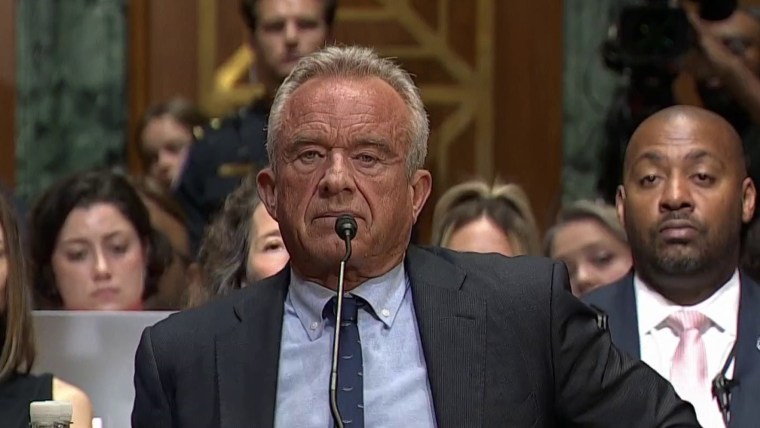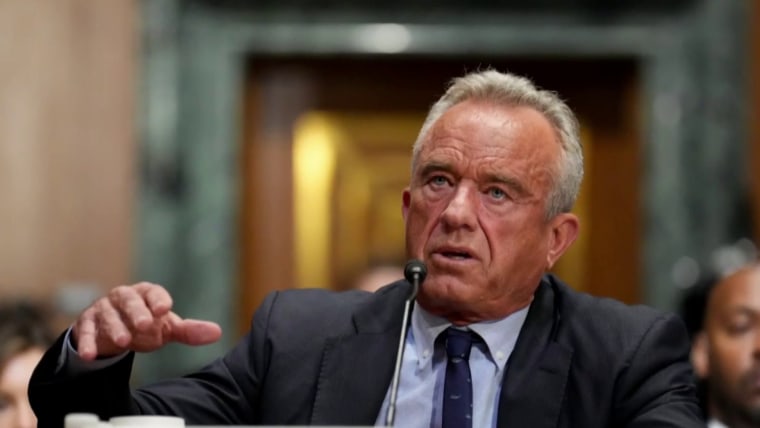
WASHINGTON — A rare display of bipartisan consensus was seen Thursday at a remarkably contentious Senate hearing with Health Secretary Robert F. Kennedy Jr.
Kennedy appeared before the Senate Finance Committee after an extraordinarily tumultuous week and a half in which he announced limited access to Covid vaccines and fired the newly confirmed director of Centers for Disease Control and Prevention, Susan Monarez, leading to an exodus of senior officials at the agency.
Over roughly three hours of questioning, Kennedy was more vocal in his anti-vaccine views than at previous Senate hearings and seemed to return to embracing fringe positions that experts have warned could seriously damage public health.
He told Sen. Michael Bennet, D-Colo., that he believes vaccines developed with mRNA — the technology used for Pfizer’s and Moderna’s Covid shots — cause serious harm, including death. He later doubled down on the remark during an exchange with Sen. Thom Tillis, R-N.C.
It was Kennedy’s criticism of vaccines that drew bipartisan condemnation.
Several Republicans sought to highlight a divide between Kennedy and what they said was one of President Donald Trump’s biggest accomplishments of his first term: Operation Warp Speed, the public-private program to quickly develop and distribute the first Covid shots.
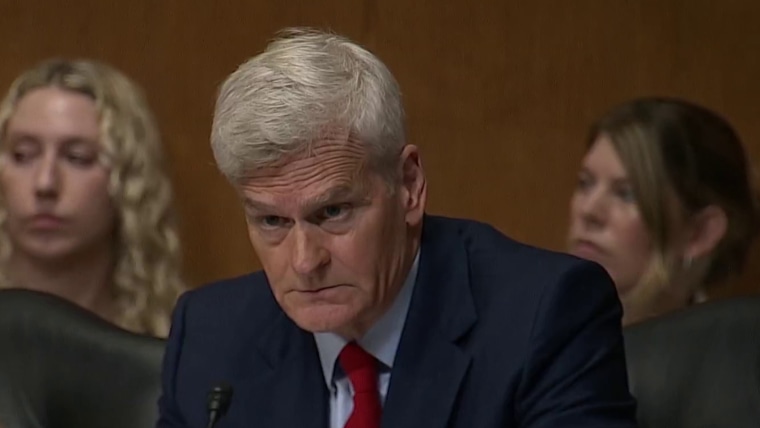
Sen. Bill Cassidy, R-La., asked whether Trump deserved a Nobel Prize for the initiative, to which Kennedy said: “Absolutely, senator.”
“As lead attorney for the Children’s Health Defense, you engaged in multiple lawsuits attempting to restrict access to the Covid vaccine,” Cassidy responded. “Again, it surprises me that you think so highly of Operation Warp Speed, when, as an attorney, you attempted to restrict access.”
Cassidy’s line of questioning was eagerly anticipated. The senator was a key vote in Kennedy’s confirmation but has since been critical of some of his decisions. Earlier this week, Cassidy would not say whether he regretted his vote to confirm the secretary.
He also read aloud a post on X from conservative talk show host Erick Erickson, whose wife has Stage 4 lung cancer and — according to Erickson — was unable to get a Covid vaccine “thanks to the current mess at HHS.”
“I would say, effectively, we’re denying people vaccine,” Cassidy said.
Sen. John Barrasso, R-Wyo., highlighted the turmoil at the CDC and questioned Kennedy’s response to the measles outbreak in western Texas. During the outbreak, Kennedy downplayed the benefits of vaccination and pushed unproven treatments.
“Secretary Kennedy, in your confirmation hearings, you promised to uphold the highest standards for vaccines,” Barrasso said. “Since then, I’ve grown deeply concerned.”
Barrasso’s ardent defense of vaccines (he is also a medical doctor) and line of questioning was notable given his leadership position in the Senate, where he serves as majority whip.
Tillis pointed to several examples of what he said were contradictions between Kennedy’s words and actions, including Kennedy promising not to impose his beliefs on others, then firing the CDC director, canceling $500 million in mRNA research contracts and ousting longtime members of the CDC’s vaccine advisory board.
“You said you’re going to empower the scientists at HHS to do their job. I’d just like to see evidence where you’ve done that,” Tillis said.
Chaos at the CDC
The chaos at the CDC, including the firing of Monarez, was a flashpoint for both Democrats and Republicans. In a Wall Street Journal op-ed published shortly before the hearing, Monarez said she was fired after being told to preapprove recommendations made by a vaccine advisory panel whose members have expressed skepticism about vaccines.
“Mr. Secretary, did you in fact do what Director Monarez said you did, which is tell her to just go along with vaccine recommendations, even if she didn’t think such recommendations aligned with scientific evidence?” asked Sen. Ron Wyden, D-Ore., the ranking member of the Finance Committee. (Earlier Thursday, Wyden, along with other Democratic senators, called on Kennedy to resign.)