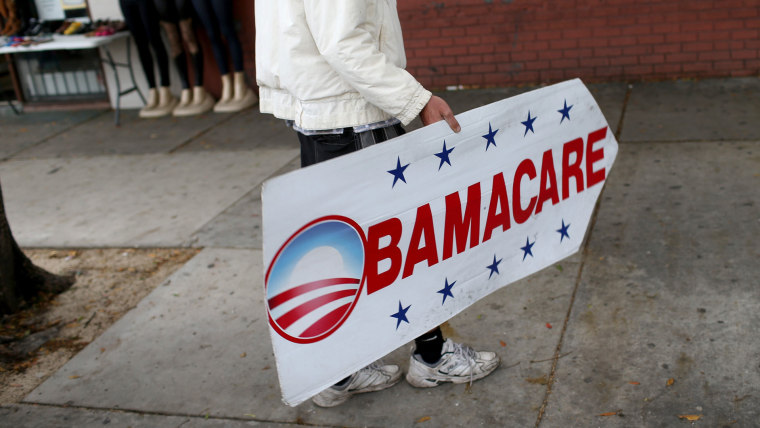
As open enrollment for Affordable Care Act insurance comes to an end, people are moving to cheaper plans or dropping their coverage entirely, according to state and federal data.
Last year, Congress failed to extend enhanced tax credits for Obamacare customers. The result was soaring monthly premiums across the U.S.
“People are saying: ‘I just can’t make the math work. I cannot afford this. I’m going to just have to roll the dice and hope I don’t have any health issues this year,’” said Audrey Morse Gasteier, executive director of the Massachusetts Health Connector, the state’s ACA marketplace.
NBC News reached out to the 20 states, plus Washington, D.C., that run their own ACA exchanges about changes in sign-ups for 2026. Ten state health officials responded with their latest numbers. In the 30 states that NBC did not ask, people purchase their ACA insurance through HealthCare.gov, run by the Centers for Medicare & Medicaid Services.
On Monday, the agency released data showing that nationally, sign-ups are down more than 800,000 from last year. Fewer new enrollees are signing up and fewer people are renewing their coverage.
In three states, Idaho, Massachusetts and Virginia, state health officials say roughly twice as many people have dropped their coverage for 2026 compared with the same point last year. In Pennsylvania, terminations have more than tripled, to above 70,000, officials say, and are still growing.
Other states, California, Kentucky and New York, report that new sign-ups are down and that more enrollees are shifting to bronze plans, the lowest-tier option, which come with high deductibles. Three other states, Colorado, Minnesota and New Mexico, say overall sign-ups are flat or higher.
State officials and health policy experts caution that the sign-up totals do not necessarily reflect how many people will ultimately have health insurance this year. The open enrollment period ends Jan. 15 in most states, meaning there is still a chance for people to sign up.
State data also offers only a partial picture, and final nationwide enrollment figures from the federal government are still likely to be weeks away.
Cynthia Cox, director of the program on the ACA at KFF, a nonpartisan health policy research group, said that based on her research, “it sounds like national sign-ups are down from last year, but on the surface they don’t seem to be down as much as some had expected.”
It’s possible that Congress could still pass a bill to restore the enhanced subsidies. Last week, the House passed a bill to extend the credits three more years, and the Senate is drafting its own separate version.
President Donald Trump said Sunday, however, that he might veto the legislation on the three-year extension.

Coverage losses to get worse
Some people who signed up for 2026 plans may never make their first premium payments, and insurers typically terminate unpaid plans weeks or months later — meaning the full scope of coverage losses may not become clear until late spring or summer.
“It’s kind of like the difference between putting something in your shopping cart and paying for it,” Cox said. “The sign-up data could make it look like more people are enrolled than actually are.”
State health officials in Virginia said they expect more people to drop their coverage through March — when the grace period for people to make their first payments ends and insurers can terminate coverage.
“The worst is yet to come for the enrollment trend,” said Kevin Patchett, the director of Virginia’s Insurance Marketplace. “It’s going to be another month or two before we see the impacts.”
Idaho health officials expect more people to drop coverage through April.
Pat Kelly, executive director of Your Health Idaho, the state’s ACA marketplace, said there is an optional questionnaire when people disenroll. “We saw about three times as many consumers citing affordability on that question than we saw over the same period last year,” he said.
Moving to a cheaper option
Sophie-Charlotte Bidet, a contract public defender in Mammoth Lakes, California, said her family’s health insurance premium was going to triple to $3,300 a month after the enhanced tax credits expired.