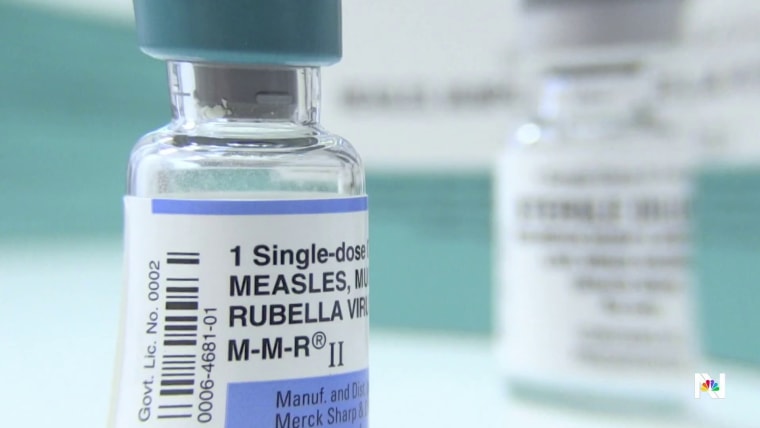
They’re prominent talking points for Health Secretary Robert F. Kennedy Jr. and his top officials: Taking Tylenol while pregnant could be linked to autism. Antidepressants may be harmful during pregnancy. Aluminum salts in vaccines might pose a health risk. And Covid shots don’t benefit healthy children.
The remarks have sowed confusion over the past year, as scientists warn there isn’t evidence to back them up. Nevertheless, federal health agencies have pursued policies based on the assertions.
Now, a spate of new research released in the last few months offers some of the strongest rebuttals to date.
The latest finding came this month: After Food and Drug Administration officials questioned the safety of taking antidepressants during pregnancy, new research presented at an annual meeting of the Society for Maternal-Fetal Medicine found that pregnant patients who discontinued the medications nearly doubled their risk of mental health-related emergency room visits.
Other recent studies have also found that aluminum salts in vaccines aren’t linked to major safety concerns and that Covid shots have a protective benefit for children.
Some papers were initiated in response to statements from Kennedy and the White House, while others had already been underway.
“These are just the latest examples in a record that stretches back a decade of Secretary Kennedy making claims about vaccines that are contradicted by facts and data,” Michael Osterholm, executive director of the University of Minnesota’s Vaccine Integrity Project, said in a statement. The project was started after Kennedy’s confirmation to create an independent, transparent process for evaluating vaccine safety, he said.

Emily Hilliard, a spokesperson for the Health and Human Services Department, said in a statement that “HHS remains focused on rigorous scientific review, transparency, and ensuring the continued safety and effectiveness of the U.S. vaccine supply.”
The Trump administration has pledged to conduct its own “gold standard” studies of vaccine safety and the causes of autism, among other topics of interest to Kennedy. But those studies haven’t yet come — and many public health experts question whether they will be free of bias when they do. (Decades of studies have debunked the link between vaccines and autism.)
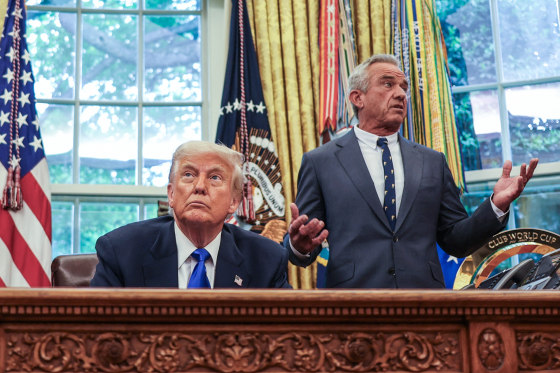
Already, some of the administration’s high-profile claims about drugs and vaccines have become the official stances of federal health agencies: The Centers for Disease Control and Prevention stopped recommending Covid shots for healthy children last year, and in September, with Kennedy standing behind him, President Donald Trump told pregnant women to “fight like hell” not to take Tylenol.
What’s safe to take while pregnant?
In the past year, several top health officials have warned of potential harms from taking Tylenol and antidepressants while pregnant. But the latest evidence released since January doesn’t substantiate those concerns.
The FDA convened a panel in July in which nearly all the panelists raised concerns about pregnant women taking selective serotonin reuptake inhibitors — a class of antidepressants that includes Lexapro, Prozac and Zoloft. The stance went against the American College of Obstetricians and Gynecologists’ recommendation that pregnant patients stay on the medications. Psychiatrists widely criticized the event.
The FDA commissioner, Dr. Marty Makary, said during the panel that SSRIs may lead to birth defects and questioned their effectiveness, claiming that “the more antidepressants we prescribe, the more depression there is.” Some panelists also called for stronger warnings on SSRI drug labels.
Hilliard told NBC News that “the FDA will thoroughly review the data and update products labels as appropriate” if high-quality research shows safety concerns beyond what is mentioned on the labels.
SSRI labels currently refer to a potential increased risk of excessive bleeding known as postpartum hemorrhage in the mother or a life-threatening breathing issue called persistent pulmonary hypertension in the newborn. However, evidence suggests that those risks are minimal, especially when they are compared with the risks of depression itself.
“In general, we don’t think of it as being so risky that we would ever recommend a patient stop their medication because of it,” said Dr. Kelly Zafman, a maternal-fetal medicine fellow at the Hospital of the University of Pennsylvania.
On its own, untreated depression can elevate the risk of preterm birth and pre-eclampsia. Scientists also haven’t found strong evidence that SSRIs are linked to autism or birth defects.
Zafman presented fresh research this month that analyzed health insurance claims of nearly 4,000 patients with depression or anxiety who took antidepressants before their pregnancies. Among women who discontinued the antidepressants in pregnancy, 1,357 had mental health-related ER visits, compared with 795 who stayed on their prescriptions.