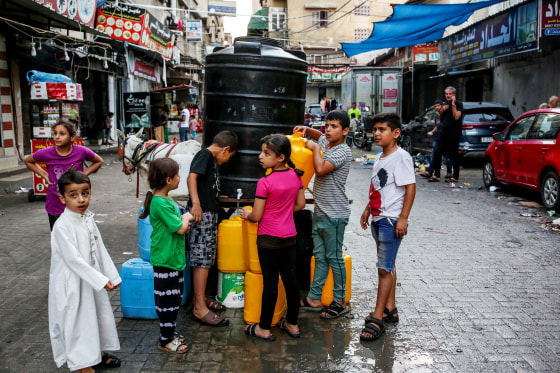
Clean drinking water is running out in Gaza, furthering an already catastrophic situation.
After Hamas' surprise terrorist attack on Israel on Oct. 7, which killed more than 1,400 people, Israel cut off water, electricity and fuel to the Gaza Strip in retaliation.
"If we look at the issue of water — we all know water is life — Gaza is running out of water, and Gaza is running out of life," Philippe Lazzarini, the commissioner-general of the United Nations Relief and Works Agency for Palestine Refugees in the Near East, said in a statement last weekend.
Dr. Adam Levine, the chief of global emergency medicine at the Brown University Alpert Medical School and School of Public Health, said, "We know that in other conflicts around the world, whether it be in Africa or the Middle East or South Asia, that infectious diseases actually kill more civilians than bombs or bullets."
Follow live coverage from NBC News here.
Infectious disease is a particular concern for people in Gaza, "a population with decreased access to clean water and sanitation," Levine said, as well as "a population that has been displaced and is sheltering together in very crowded conditions."
Without clean water, Gazans are forced to drink or cook with tainted water.
That water is likely to be rife with bacteria that can lead to violent intestinal diseases, such as dysentery and cholera.
With cholera, "you can become dehydrated and die in an incredibly short period of time," said Dr. Paul Spiegel, the director of the Johns Hopkins Center for Humanitarian Health.
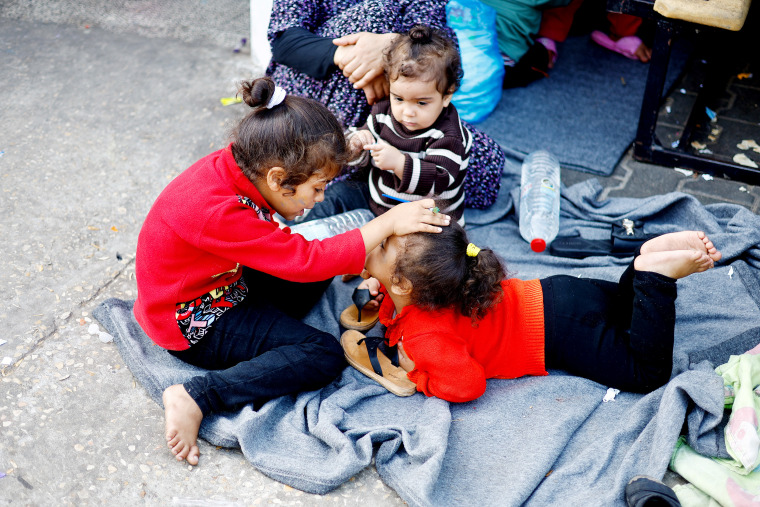
Most at risk, doctors said, are children, because they have much less blood volume compared to adults.
"In general, they're going to dehydrate faster than adults would," Levine said.
An outbreak of cholera or other diarrheal diseases may have an especially widespread impact on Gaza's population, nearly half of which is ages 18 and younger, according to the U.N.
"The younger the child is, the more at risk they're going to be," Levine said.
Flu and other viruses
There are also signs that other illnesses — specifically, respiratory viruses — are beginning to spread as thousands of evacuees from northern Gaza are forced into cramped, crowded areas in the southern half of the territory.
Dr. Ahmad Moghrabi, the head of plastic surgery at Nasser Hospital in the city of Khan Younis in southern Gaza, said he has seen what he believes is a rise in the flu "even among medical personnel," though tests aren't available.
Spiegel said Covid is also expected to "rear its head" in Gaza. "As people are moving from north to south, it's going to be more and more congested and more and more ripe for infectious diseases," he said.
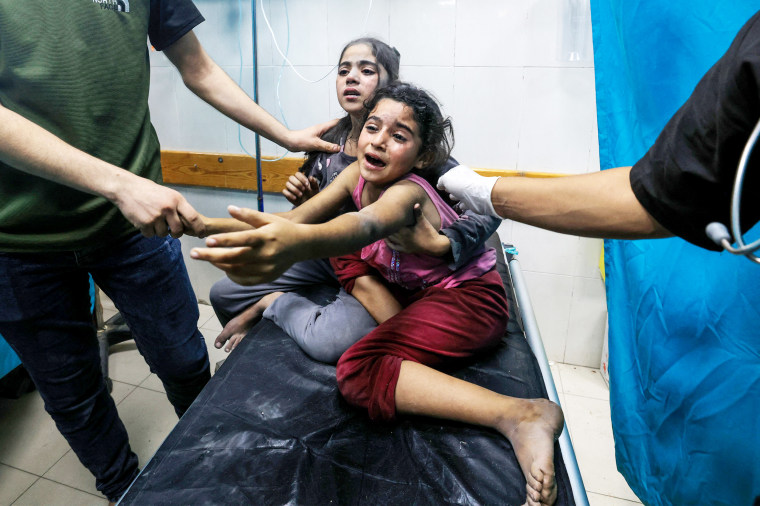
Widespread vaccination against flu or other viruses, such as RSV or Covid, is out of the question as the conflict continues. "It's impossible," Moghrabi said.
There is no evidence that measles is spreading, but it is a virus that concerns doctors. Measles is one of the most contagious viruses in the world. One case in a crowded shelter can infect anyone and everyone there who remains unvaccinated.

