Changes are coming in 2026 for GLP-1 drugs.
Long defined by high prices, shortages and weekly injections, drugs including Wegovy and Zepbound are expected to be easier to access and afford. And new options for people averse to needles are coming.
“The GLP-1 landscape is expected to broaden significantly,” said Dr. Christopher McGowan, a gastroenterologist who runs a weight loss clinic in Cary, North Carolina. “For the first time, medical obesity treatment will move away from a one-size-fits-all model.”
Weight loss pills
GLP-1 pills for weight loss may mark the most significant shift yet.
Last month, Novo Nordisk won Food and Drug Administration approval for the first GLP-1 pill for weight loss. The medication, marketed as the Wegovy pill, is expected to be widely available this month.
Another GLP-1 pill, from Eli Lilly, is expected to gain approval later this year.
Dr. Shauna Levy, medical director of the Tulane Weight Loss Center, said the pills will be a great option for patients who prefer oral medications or who have struggled to access the injectable versions.
“With so much product in the market, I hope the competition will further reduce prices,” Levy said.
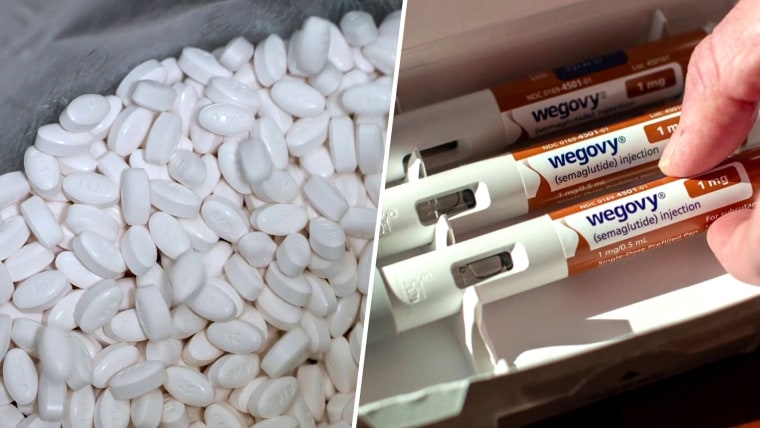
A month’s supply of the pills is expected to be cheaper than a month’s supply of injections.
Novo Nordisk hasn’t announced the list price for the Wegovy pill yet, but it has said that the two lowest doses will cost $149 a month for people paying in cash and not using insurance. The lowest dose of the Wegovy injection, by comparison, is $349 a month for people paying in cash.
Starting Monday, the two higher doses of the pills will be priced at $299 a month for people paying in cash. For those with insurance that covers the drugs, out-of-pocket costs could be as low as $25 a month, according to the company.
Dr. Daniela Hurtado Andrade, an endocrinologist at the Mayo Clinic in Jacksonville, Florida, said the lower prices will most likely expand access. Still, she noted, the most drastic weight loss in the trials came from the highest dose, which means people would likely have to pay more if they want to lose more weight.
Even $149 a month for some is still too expensive, she said.
“It’s something that needs to be discussed with patients,” Andrade said, “because they may have expectations that are not real.”
Levy said that one drawback to the pill is that it must be taken on a strict schedule to get the best results: every morning on an empty stomach. In a late-stage clinical trial, people who adhered to the schedule lost 16.6% of their body weight, on average. That fell to 13.6% when people didn’t take the pill exactly as prescribed.
“I think we need to consider that the efficacy of these medications is decreased if they are not taken consistently, and I am curious to see how they perform in real life,” Levy said. There’s a bit more flexibility around Lilly’s pill, which still must be taken daily but can be taken any time of the day.
Chris Mertens, 35, of Menominee Falls, Wisconsin, said he had no trouble remembering to take the Wegovy pill every morning, which he did as part of a clinical trial in late 2022. Though he didn’t know it at the time, he got the real medication, not a placebo.
When he began the trial, he weighed about 260 pounds, with a body mass index of around 32, and hoped to get closer to 200 pounds. After a year and a half on the medication, Mertens said he lost about 40 pounds, eventually plateauing at around 220. The weight loss, he said, gave him more energy at work and at home and changed his relationship with food.
A stronger injection
Lilly is getting closer to finishing its clinical trials on what could be the most powerful GLP-1 drug yet, called retatrutide.