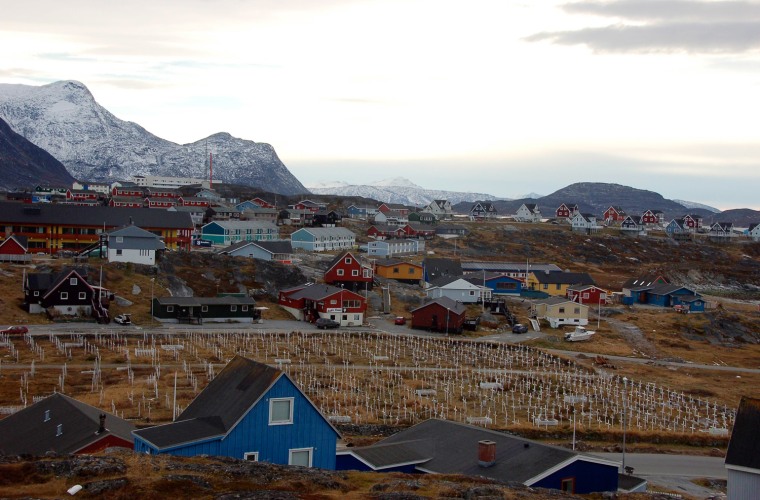
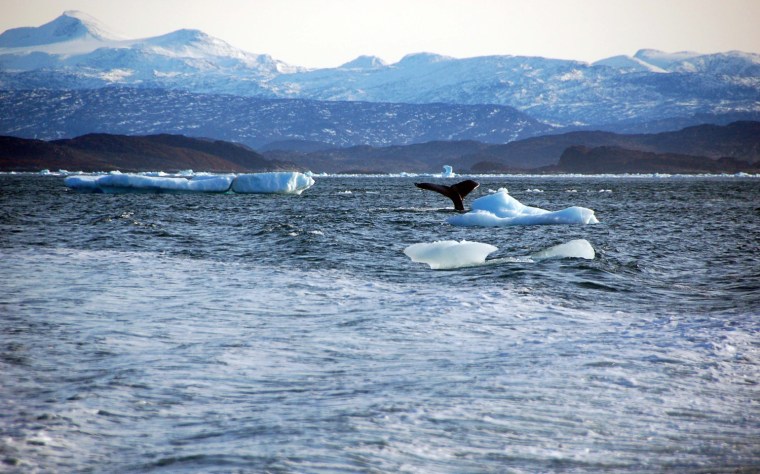
By a remote fjord where icebergs float in silence and hunters stalk reindeer, plans are being drawn up for a huge iron ore mine that would lift Greenland's population by four percent at a stroke -- by hiring Chinese workers.
The $2.3-billion project by the small, British company London Mining would also bring diesel power plants, a road and a port near Greenland's capital Nuuk. It would supply China with much needed iron.
With global warming thawing its Arctic sea lanes, and global industry eyeing minerals under this barren island a quarter the size of the United States, the 57,000 Greenlanders are wrestling with opportunities that offer rich rewards but risk harming a pristine environment and a traditional society that is trying to make its own way in the world after centuries of European rule.
Scramble under way
Great expectations could lead to greater disappointments, for locals and investors. Yet a scramble for Greenland already may be under way, in which some see China trying to exploit the icebound territory as a staging ground in a global battle for Arctic resources and strategic control of new shipping routes.
Whether in iron, zinc or rare earth minerals vital for 21st-century technology like smartphones, China, the emerging economic superpower is eyeing investments in the Danish-ruled country whose own, increasingly autonomous, national government is looking further afield for investors.
"This is not just a region of ice and polar bears," Prime Minister Kuupik Kleist told Reuters in the capital Nuuk, formerly known by its Danish name Godthab. "Developing countries are interested in a more political role in opening up of the Arctic. Greenland could serve as a stepping stone."
‘Polar Paranoia’?
Talk in Europe or North America of a Chinese grand design to take over the Arctic is mocked as overblown by many in Greenland -- an recent exhibition of cartoons recently in Nuuk featured one drawing of an iceberg, Greenland-shaped above the water line, and in the form of China below. Its caption: "Polar Paranoia."
Compared to its investments in Africa or Latin America, Beijing has a light footprint in the Arctic. In Greenland, not one mining or oil project has yet got off the ground. Appetite for exploration is tempered by political polarization, as Greenland's leaders square off over how to regulate and tax new wealth under a self-government regime just three years old.
"There are great expectations in Greenland, but no results," said Rasmus Ole Rasmussen, a senior researcher specializing in Arctic affairs at the Nordregio institute in Stockholm.
Still, transformation is approaching rapidly for a land still mostly inhabited by indigenous Inuits engaged in an economy dominated by fishing. And China may play a larger role in this than Europeans and North Americans find comfortable.
"It's fair to say countries like China and South Korea are far more active than Americans and Europeans in showing their interest in investing," said Kleist, who adds that the West, for which Greenland remains part of its Cold War-era NATO defense pact, can appear complacent, despite new geopolitical currents.
Two traffic lights, but a booming economy
In Nuuk, home to 16,000 people on the southwestern coast, 1,000 sea miles north of Newfoundland, there are just two traffic lights. But new construction is everywhere: gleaming office buildings that house foreign companies and even a new mall where one can buy olives and French cheeses -- for a price.
Greenland's Bureau of Minerals and Petroleum has now awarded overall some 150 licenses for mineral exploration compared with only a handful in existence a decade ago, with around $100 million spent by companies last year alone. Oil companies have spent more than $1 billion in exploring offshore.
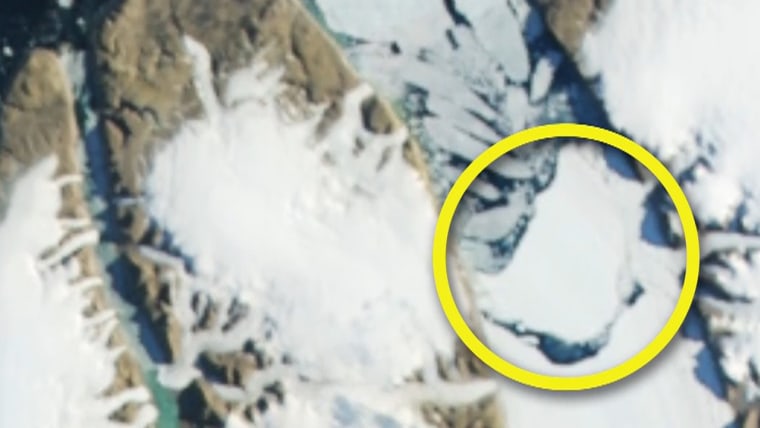
That includes exploration of rare earth minerals, used in products from wind turbines to hybrid-powered cars. China currently accounts for the vast majority of the world's supply.
London Mining plans construction at the Isua iron ore deposit next year if Greenland gives the go-ahead. The project, which aims for finance from China, would ship some 15 million metric tons of iron ore annually from fjords near Nuuk to China.
An icebreaker completed China's first crossing of the Arctic Ocean this past summer, and diplomacy earlier in the year has also underlined China's interests in the north Atlantic.
Clinton: 'What is happening with rare earths'?
Premier Wen Jiabao began a tour of Europe in April with a visit to Iceland, population 320,000, where there has been much talk of a Chinese developer's bid to lease a vast tract of land.