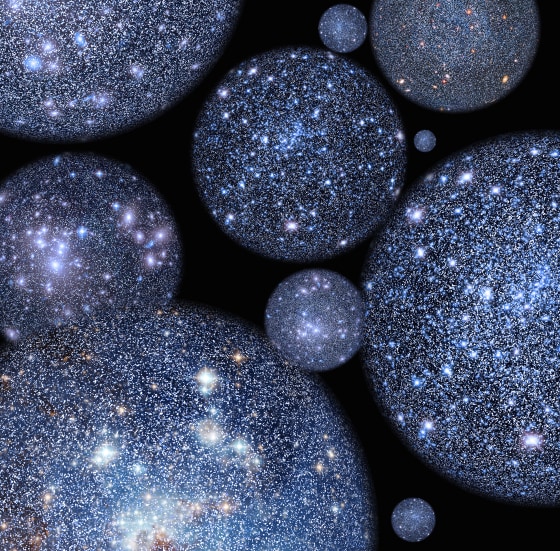
It sounds wild. But the idea that we live in a multiverse — a cosmos where an infinite number of universes exist beside our own — is no longer confined to science fiction. It’s a respectable theory among scientists, so much so that some are on the hunt for proof of a nearby universe.
Now, scientists might be one step closer. A study recently submitted to “Monthly Notices of the Royal Astronomical Society” actually places the multiverse theory on firmer ground. Ruari Mackenzie, a graduate student at England’s University of Durham, took a deeper look at a region in the sky that’s so frigid and so large that most scientists don’t think it can be a statistical fluke. Instead, some astronomers think this so-called “cold spot” is an optical illusion produced by a lack of intervening galaxies. But Mackenzie and his colleagues found that those galaxies are no less dense than anywhere else in the universe, disproving that theory.
Related: Newfound Alien Planet is Hottest Ever Discovered
Believe it or not, the next reasonable explanation (so long as you don’t buy into the theory that it’s just a statistical fluke) is that the cold spot might be a bruise left after an ancient collision with another universe. There’s no proof — at least not yet. But a forthcoming map of the cold spot might let scientists nail down whether it is truly a footprint of another universe — a result that would turn our understanding of the universe on its head.
Chilled to the Bones
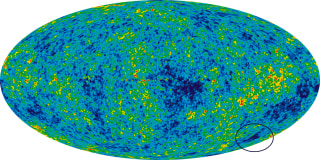
Peer as far out in space and as far back in time as you can and you’ll reach the cosmic microwave background (CMB) — the ancient light that formed just 370,000 years after the Big Bang. Given its age, it’s no surprise that the light might hold secrets about the universe’s fiery birth and answer fundamental questions about where we came from. For this reason, astronomers have long sought to capture this afterglow.
For years, they have perfected a map speckled with blue and red dots that signify temperature (and therefore density) variations within the CMB where galaxies or giant voids of nearly empty space would one day form. Typically these dots represent only minute changes in temperature — except for one. In 2004, astronomers using NASA’s WMAP satellite discovered a cold spot nestled in the constellation Eridanus, which appears to be nearly 100 times cooler than your typical cool dots. It’s also huge, stretching 1,000 times farther than the Milky Way galaxy.