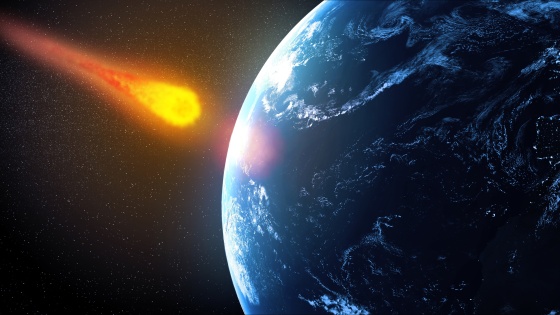
NASA says it knows of no asteroid that poses a significant threat to Earth, at least not in the next century. But that doesn’t stop some top asteroid experts from wondering — and worrying.
After all, our planet has been hit by some pretty big space rocks, including one that blew up over Chelyabinsk, Russia, in 2013, shattering windows and injuring more than 1,200 people. And then there’s the colossal eight-mile-wide asteroid that slammed into Earth 65 million years ago and wiped out the dinosaurs.
Are we doing enough to identify potentially dangerous asteroids? If we do find one on a collision course with Earth, will we be able to stop it? Could we be blindsided? To find out the answers to these and other questions, NBC News MACH’s Ella Koscher spoke with former astronaut Ed Lu, executive director of the Asteroid Institute and co-founder of the B612 Foundation, a Mill Valley, California-based nonprofit that promotes planetary self-defense.
This interview has been edited for clarity and brevity.
MACH: Let’s start with a basic question: Is Earth facing an asteroid catastrophe?
Lu: As things stood 100 years ago, the answer to that question was, “Absolutely, an asteroid’s going to hit again because eventually your luck is up.” But nowadays we have the technology to find and track asteroids. If we do our job properly, [a catastrophic hit] shouldn't happen.
What exactly is being done to protect our planet from asteroids?
The number one thing we have to do is to find and track these asteroids and calculate their orbits. We're building a map of the asteroids in the solar system of where they are and where they're going. This allows us to know ahead of time — decades ahead of time — if an asteroid might hit Earth. We can do something about it then.

What else needs to be done? What about the role of governments around the world?
What world governments need to do is to continue funding telescopes like they are doing right now. Private organizations like the B612 Foundation need to continue our work on finding and tracking asteroids. The issue is being worked on, but we're not there yet.
What telescopes are used to track asteroids today?
There are numerous telescopes around the world working to detect near-Earth asteroids, with two of the largest today being Pan-STARRS [in Hawaii] and the Catalina Sky Survey [near Tucson, Arizona]. Soon we will have the Large Synoptic Survey Telescope [in Chile] operational, which will be the largest and most effective telescope yet. To effectively find and track asteroids below about 150 meters in size, we will need a new generation of telescopes. The B612 Asteroid Institute is working on a promising new technology that could track these smaller and more numerous near-Earth asteroids.
There's a collaboration between the European Space Agency and NASA called the Asteroid Impact and Deflection Assessment (AIDA) mission. What is it, and do you think something like that will be sufficient?
This collaboration you're talking about is a test of deflection of asteroids. When you find an asteroid that is on an impact trajectory, this test is one way of keeping that asteroid from hitting Earth. It's very simple. It's going to take a small spacecraft to run into an asteroid and we're going to measure the change in the orbit of that asteroid. This test is necessary because we know it's going to work, but we know that there are probably technical challenges that need to be ironed out before it becomes a usable system. So that mission is primarily a test of the technology.
Where do asteroids come from?
Asteroids are orbiting the sun, and most come from the asteroid belt, a region between Mars and Jupiter. Some of those asteroids get thrown out of the belt, usually by coming too close to Jupiter, and they end up in the inner part of the solar system, where Earth is. Those near-Earth asteroids are the ones that run into Earth.
Are there any asteroids that currently pose a threat to Earth?
There are no asteroids that we know of right now that have a very high chance of hitting Earth in the next 100 years. However, there are many asteroids we have simply not yet tracked, so we can't say anything yet about those.
What would happen if we discovered a big asteroid on a collision course with our planet?
If an asteroid is approaching Earth, we will find it many, many years before it hits. So we have time to deploy a mission like the AIDA mission to run into it with small spacecraft. We should have time to do that years before it hits.
Related

Aside from being directly hit by an asteroid, what other ramifications of an asteroid hit could hurt or kill humans?
You shouldn't think of the damage as being actually hit by an asteroid because they’re moving so fast that they explode when they hit Earth. It's the explosion that’s the danger, not actually being hit by a rock. For instance, the asteroid that hit over the Russian city of Chelyabinsk — that particular asteroid exploded, and the energy of that explosion was about 30 times the size of the nuclear bomb dropped over Hiroshima. It was a big explosion.
In the 1998 movie “Armageddon,” astronauts use a nuclear warhead to destroy a dangerous asteroid. Is that realistic?
[Laughs] No.
