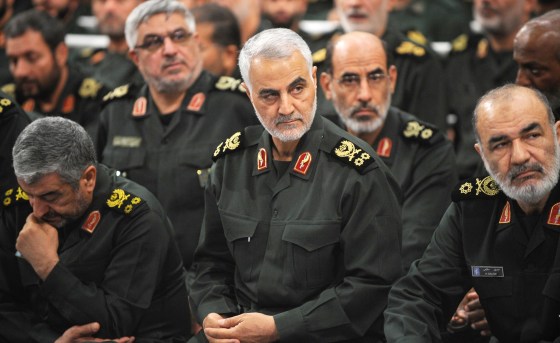
The Americans were waiting for him.
Armed with a tip from informants at the airport in the Syrian capital of Damascus, the CIA knew exactly when a jet carrying Iranian Gen. Qassem Soleimani took off en route to Baghdad. Intelligence from Israel helped confirm the details.
Once the Cham Wings Airlines Airbus A320 landed, American spies at Iraq’s main airport, which houses U.S. military personnel, confirmed its exact whereabouts.
Three American drones moved into position overhead, with no fear of challenge in an Iraqi airspace completely dominated by the U.S. military. Each was armed with four Hellfire missiles.
This account of how the United States took out Soleimani is based on interviews with two people directly familiar with the details of the operation, as well as other American officials who were briefed on it.
On large screens, various U.S. officials watched as an Iraqi militia leader walked up a set of stairs to greet the leader of Iran’s Quds Force as he emerged from the airplane.
It was past 1 in the morning, so the black and white infrared imagery wasn’t very clear. No faces could be seen.
The men on the ground had no idea that their lives were now to be measured in minutes.
CIA Director Gina Haspel was observing from agency headquarters in Langley, Virginia. Secretary of Defense Mark Esper was watching from another location. Another feed was on view in the White House, but President Donald Trump was in Florida at the time.
The imagery showed two senior figures get into a sedan, which pulled away. The rest of the entourage climbed into a minivan, which sped to catch up.
The drones followed as the vehicles began moving to exit the airport. Signals intelligence specialists sought to hone in on the cellphones of the occupants to confirm their identities. Years of mapping and terrain information from satellites was available on the screens of the drone operators.
Other vehicles passed occasionally, but traffic was light. The minivan pulled ahead of the sedan.
Download the NBC News app for breaking news and politics
At U.S. Central Command forward headquarters in Qatar, from where the operation was being run, there were no significant doubts about who was inside those vehicles.
Those watching could see the missiles strike, a manmade bolt from the sky. The vehicles were engulfed in a fireball. In total, four missiles were fired. There were no survivors.
Soleimani, who had helped kill Americans for more than a decade, was no more.
U.S. military officials watched a live feed of the strikes at various locations around the world. Despite the successful operation, the reaction was somber as the gravity of the attack set in and the officials contemplated what response it could unleash.
It was an operation utterly unremarkable for any technical or intelligence wizardry. It’s remarkable, rather, for how routine such lethal actions have become.


