
Kyne Santos is not your typical math tutor. You can find her sharing a lesson on TikTok, decked out in red statement earrings and a leopard print top, explaining how statistics can be manipulated to make Black Americans appear more violent.
Formerly a contestant on "Canada’s Drag Race," a reality competition television series based on the American series "RuPaul's Drag Race," the 22-year-old often teaches people how to do hair and makeup and sew their own clothes. However, the boredom of staying at home during the coronavirus pandemic got her to show off another passion: mathematics.
Now, the Filipino Canadian drag queen has amassed over 700,000 followers on TikTok. In the early months of the pandemic, she began posting videos explaining mathematical concepts in full drag.

Santos stresses the importance of using math “for good and not evil.”
Santos said she wants to show viewers that you can love math while being whatever you want to be.
“Math has always been a very big part of my life. I just wanted to take a risk and try something new.” Santos told NBC Asian America.
Her topics range from prime numbers to math riddles to explaining the meaning of math memes like “The limit does not exist” from the film "Mean Girls."
Santos said she was inspired to teach the subject after seeing young people leave school disliking it.
“The classic question that people ask in school is, ‘When am I ever going to need this?’ And that is a question that I try to answer in my videos,” she said.
One example of how math is used in the real world, she said, is understanding whether a graph is portraying information fairly.
In one video, she explains why a graph showing COVID-19 cases in the state of Georgia is “misleading.” The graph posted by Georgia’s Department of Public Health appears to show confirmed case counts declining. However, Santos shows that the dates on the x-axis are not in order, causing the highest values to show up on the left.
After people on social media called out the graph’s mistakes, Georgia officials apologized and corrected it.
“Math, whether you like it or not, is used to manipulate people because lots of people can be led one way or another by seeing numbers,” Santos said. “It is really important that when you see graphs, it is something that you have to analyze critically.”
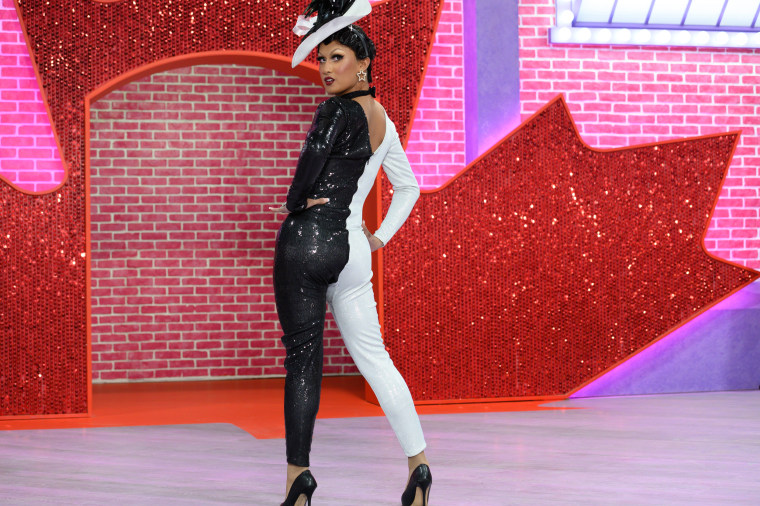
Santos, who is also a mathematical finance major at the University of Waterloo in Canada, said her dad often taught her math as a kid.
Growing up in a Filipino household, Santos said the way math and academics were talked about at home was what made her want to pursue it as a degree.
Despite the stereotype that all Asians are good at math, Kyne said she doesn’t really see it play out in her own life.
Instead, Santos said being a drag queen who loves math shows that the Asian community is not a monolith.
“I do want to show people that you can be smart and successful and be whoever you want to be,” she said. “You can wear green hair and long nails and black lipstick and have those same accolades.”
