Three years after the Supreme Court invalidated part of the Voting Rights Act, voting rights advocates and some elected officials are concerned that Asian Americans and Pacific Islanders are among those increasingly threatened by voter discrimination.
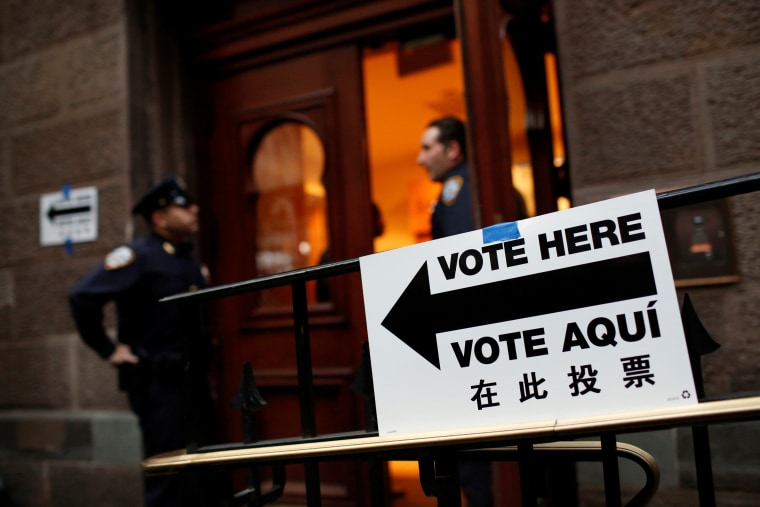
“This includes complaints of polling locations failing to provide translated ballots that especially hurt those in the Asian American and Pacific Islander community — over a third of whom are limited English proficient,” U.S. Rep. Judy Chu (D-CA), chairwoman of the Congressional Asian Pacific American Caucus, said in a statement.
In Shelby County v. Holder, the court held in a 5-4 decision that Section 4 of the 1965 Voting Rights Act was unconstitutional. That section established which local and state governments, as a result of previous voter discrimination, were required to obtain federal approval before making changes to voting policies or procedures.
Chief Justice John Roberts, in delivering the majority opinion of the court, wrote that the criteria used to decide the jurisdictions covered under Section 4 were outdated. The responsibility for updating them falls on Congress.
“Our country has changed, and while any racial discrimination in voting is too much, Congress must ensure that the legislation it passes to remedy that problem speaks to current conditions,” Roberts wrote in the court’s opinion, dated June 25, 2013.
RELATED: Hispanics, Asian Americans Among Most Purged Voters in New York City: Analysis
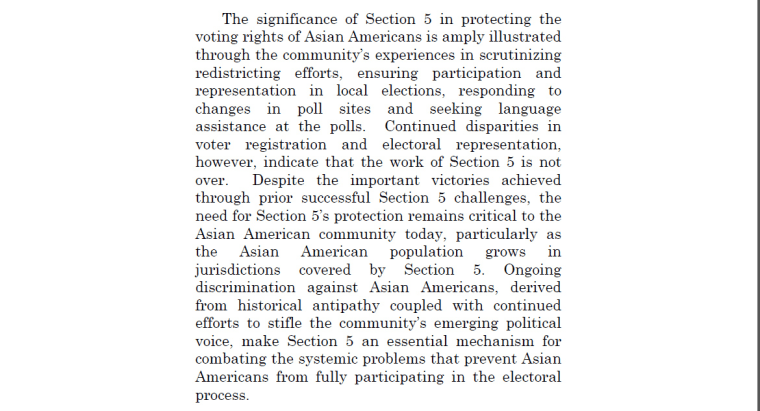
Civil rights advocates say that Section 5 of the Voting Rights Act has helped to protect AAPI voters against redistricting and changes to voting systems and polling sites. That section requires townships, counties, and states covered under Section 4 to seek federal preclearance for any voting changes they make.
Though still on the books, Section 5 no longer has any effect since the Supreme Court struck down Section 4.
Had the court ruled differently in Shelby County v. Holder, a purge of at least 120,000 voters in Brooklyn, New York, might have been avoided ahead of New York’s April presidential primary, Jerry Vattamala, director of the democracy program at the Asian American Legal Defense and Education Fund (AALDEF), told NBC News.
Brooklyn, Manhattan and the Bronx are the three New York counties that were covered by Section 4 of the Voting Rights Act.
Vattamala said the New York City Board of Elections changed voting practice or procedure by not following the first step of designating voters as “inactive” before sending out a second notice to purge them from the rolls. Under Section 5 of the Voting Rights Act, that modification would have had to be precleared by the federal government, he said.
The purge, which took place last summer, affected a disproportionate number of Hispanic voters, according to an analysis by public radio station WNYC. Asian Americans with surnames Wong, Chan, Lee, Li, and Chen were also removed from voter rolls at higher rates than others, WNYC’s analysis found.
“Our country has changed, and while any racial discrimination in voting is too much, Congress must ensure that the legislation it passes to remedy that problem speaks to current conditions.”
Particularly hard hit were voters in the 7th Congressional District, which cuts through Queens, Manhattan’s Chinatown, and Brooklyn, WNYC reported. On Tuesday, incumbent U.S. Rep. Nydia Velazquez will face off against two challengers in a Democratic primary. Asian Americans make up around 20 percent of that district and Hispanics 41 percent, according to the U.S. Census.
City Board of Elections Executive Director Michael Ryan has publicly apologized for the purge, calling it a mistake, and two top Brooklyn elections officials have been suspended without pay. Ryan has also said all the affected voters would be put back on the rolls before the congressional primary, WNYC reported.
But Vattamala added that if Section 4 had still been in effect, the Board of Elections would have been mandated by federal law to reinstate those voters.
“So we wouldn’t have to wait and hope that the board did the right thing,” he said.
RELATED: Civil Rights Groups to Hold 'All Hands on Deck' Vote Meeting
Vattamala said AALDEF will have monitors visit polling sites Tuesday, while Velazquez has asked the Justice Department to do the same.