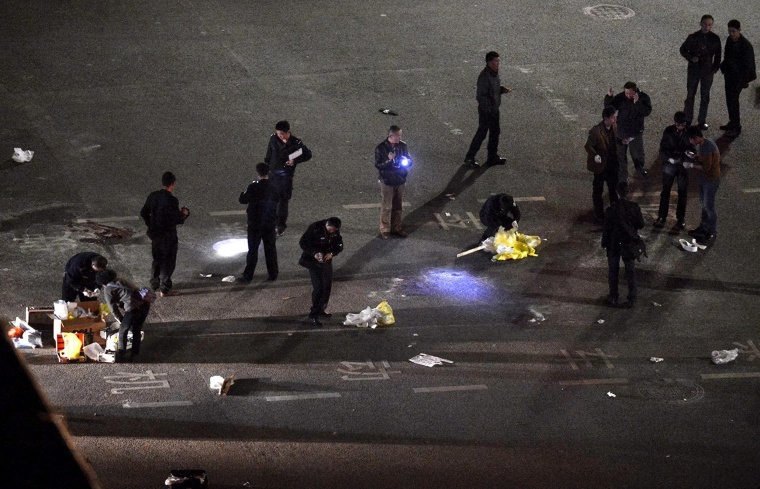
A suicide bombing last week at a train station in the capital of China's Xinjiang province marked a significant escalation in the terrorist campaign by Islamic Uighur militants against the Chinese government, U.S. officials and China experts say.
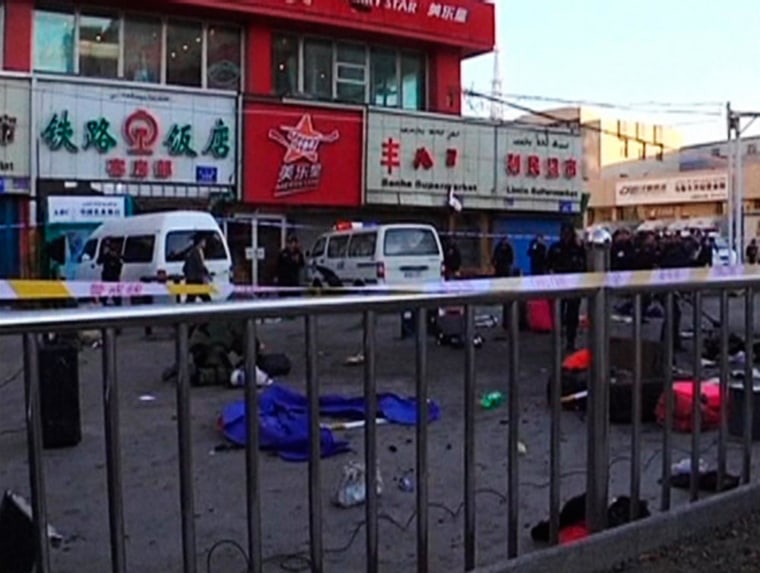
The attack in Urumqi – the third assault on Chinese targets by militant Uighurs in six months – occurred just hours after Chinese President Xi Jinping had wrapped up a visit to the area and was carried out by two suicide bombers who detonated explosive vests inside the station. It is believed to be the first time that suicide bombers have carried out such an attack in China.
Accounts in China’s official news media initially indicated that the attack on the Urumqi station, which killed three – including the bombers - and wounded 79 others, was the work of "knife-wielding mobs." Later reports, however, indicated that it was a suicide bombing.
Related: Terror on the Tracks: A Timeline
China’s state-run Global Times on Monday identified one of the bombers as 39-year-old Sedirdin Sawut, a Uighur from the town of Aksu. It also quoted an unidentified source as saying officials believe that the attack was the work of a "crime family deeply influenced by extremist ideology."
The Los Angeles Times reported Monday that police in Urumqi had sought the arrest of 10 of Sawut’s family members and took the unusual step of releasing photographs showing the faces of the two dead bombers, accompanied by a $15,500 reward for information about the second man, who remains unidentified.
Many Uighurs and international observers have accused Beijing of oppressing the Uighurs over a period of decades.
A 2013 report on human rights practices in China by the U.S. State Department said that Chinese authorities had continued in the previous year to impose “severe official repression of the freedoms of speech, religion, association, and assembly of ethnic Uighurs.” It also stated that Uighurs continued to be” sentenced to long prison terms, and in some cases executed without due process, on charges of separatism and endangering state security.”
A 2009 report by Amnesty International accused China of “systematically eroding” the identity of the Turkic speaking, mostly Sunni Muslim Uighurs through “an aggressive campaign that has led to the arrest and arbitrary detention of thousands of Uighurs on charges of ‘terrorism, separatism and religious extremism’ for peacefully exercising their human rights.”
U.S. counterterrorism officials and other experts see the latest attack as a signal that the insurgency in Xinjiang, officially an autonomous province within China, is becoming more serious and sophisticated. And that could pose a growing problem for Beijing, they say.
"There is a level of organization and sophistication in (this group)," said Michael Leiter, former director of the National Counter Terrorism Center and now an NBC News analyst. "It is on the rise and posing an increasingly deadly and aggressive role in China. The Chinese may be authoritarian but the Uighurs have figured out that the Chinese aren't omniscient."
"If you're changing the style of attacks, it indicates some kind of help."
Elizabeth Van Wie Davis, a China expert at the University of Colorado, said the use of suicide vests in Urumqi also may indicate some coordination with other terrorist groups.
"If it turns out to be accurate that the attacker was wearing a suicide vest, it’s a different type of the attacks," she said.. "… Most (previous attacks) involved vehicles or knives although there was a failed attempt to bring down an airplane from Urumqi to Beijing. … If you're changing the style of attacks, it indicates some kind of help."
There is a long history of militancy among the Uighurs, whose homeland in Xinjiang province is deep in Central Asia, bordering India, Pakistan, Afghanistan, the former Soviet states of Kyrgystan, Tajikstan and Kazakhstan, and Mongolia.
Beijing has for years pressured Han Chinese to move to the province, where they now account for nearly half of the population – up from roughly 5 percent of the Xinjiang population in 1949. The official Chinese census in 2010 reported that the Uighurs accounted for about 45 percent of the province’s population vs. 40 percent for the Hans, though Uighurs suggest that the latter number is higher.
Tensions between the two groups in Xinjiang boiled over in July 2009, when ethnic riots between the two groups erupted in Urumqi, leaving more than 150 dead and approximately 1,000 injured.
Since then terrorist attacks by the Uighurs against Chinese targets have grown more common.
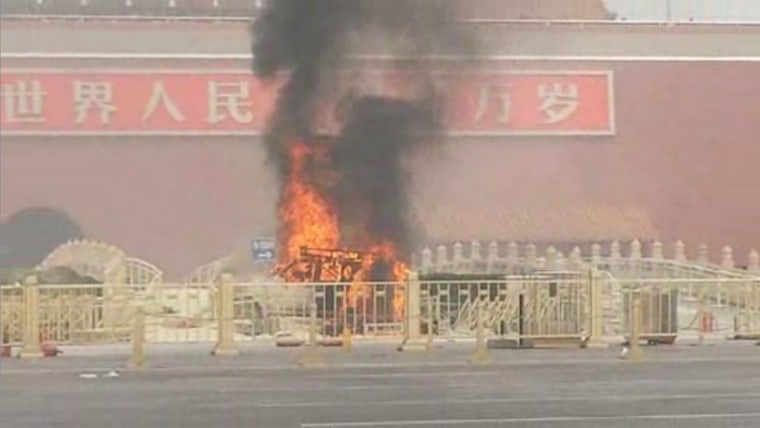
In October of last year, Uighurs were blamed for a deadly explosion in Tiananmen Square in Beijing. In that instance, an SUV plowed through bystanders and burst into flames, killing the three people in the car and two bystanders near the Mao Zedong portrait that dominates the square. China's security chief called it "organized and premeditated."