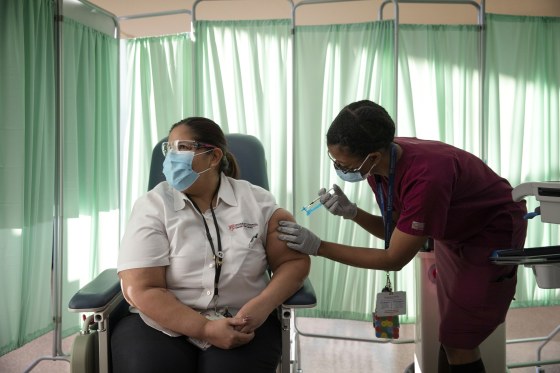
MIAMI — As vaccinations against the coronavirus begin to roll out across the country, Dr. Olveen Carrasquillo says he's been getting many questions from his predominantly Latino patients, including whether the vaccine contains the virus and whether there are side effects to taking it.
“People are not sure what’s in the vaccines. They want to know,” said Carrasquillo, the chief of general internal medicine at the University of Miami and one of the principal investigators for the Janssen vaccine trial.
Covid-19 has hit U.S. Latinos disproportionately hard in many areas of the U.S., making vaccinations a crucial public health mission. But doctors like Carrasquillo are hearing skepticism about the vaccines because of the lack of reliable information, especially in Spanish, coupled with disinformation that has been circulating.
Of all the questions Carrasquillo’s patients have come to him with, what alarms him most are conspiracy theories about the vaccine. He says they have sent him videos in English with supposed doctors falsely claiming that the vaccines will alter people’s DNA.
Evelyn Pérez-Verdía, a Democratic strategist who had been keeping track of disinformation appearing in Spanish over the November elections, says anti-vaccine propaganda has intensified in recent weeks among Latinos.
While some of it consists of QAnon conspiracy theories, she's also seeing memes or jokes about side effects.
While the jokes may seem harmless, “it’s the repetition that worries me," Pérez-Verdía said. "People are seeing this constantly.”
Carrasquillo says this is the moment for Latino leaders, including doctors, Spanish-language media, and Hispanic elected officials, to step up.
“We’re the ones who are going to have to take that charge up and reassure our community,” Carrasquillo said.
Around 63 percent of Hispanics say they would definitely or probably get a Covid-19 vaccine, a higher number than white adults, who stand at 61 percent, according to a recent Pew Research Center survey.
But another recent poll by the Kaiser Family Foundation asking more specific questions found that only 26 percent of Hispanics said they would get the vaccine as soon as possible, compared to 40 percent of whites. Around 43 percent of Latinos said they would “wait and see,” and 18 percent said they would definitely not get the vaccine, according to the survey.
Around the world, raising awareness about immunization so communities are educated and informed has always been key in executing successful vaccination campaigns. But the Covid-19 vaccines were developed so rapidly amid an intense election cycle and rising infection and death rates, that effective information targeting Latinos has been scarce.
In New York, Dr. Edith Bracho-Sanchez, a pediatrician with NewYork-Presbyterian/Columbia University Medical Center who sees children from heavily Hispanic neighborhoods, said she is seeing “distrust and fear” among her patients’ parents. They ask her what she "really" thinks about the vaccine, she says.
Bracho-Sanchez is seeing disinformation circulate among large WhatsApp groups. “The network has been used in our community to warn each other of things, like ‘la migra,'" or immigration officers, Bracho-Sanchez said. “These are networks that have grown out of necessity in the past few years. They are established. They are well rehearsed and well set up to spread disinformation."
Because Covid-19 has hit Latino neighborhoods hard, the fear makes residents vulnerable to disinformation, she said. It’s important to message the vaccine well and at a level that everyone understands, Bracho-Sanchez said.
Among farmworkers, fear, but also hope
For farmworkers, who are among the nation's essential workers, Covid-19 has been rampant since the start of the pandemic.
In California’s Salinas Valley, known as “America’s Salad Bowl,” about 20 percent of farmworkers tested positive for Covid-19 antibodies in October, versus 5 percent of the state’s population, according to a study by the University of California, Berkeley.
Many farmworkers work and live in crowded conditions that make an ideal environment for virus transmission.

