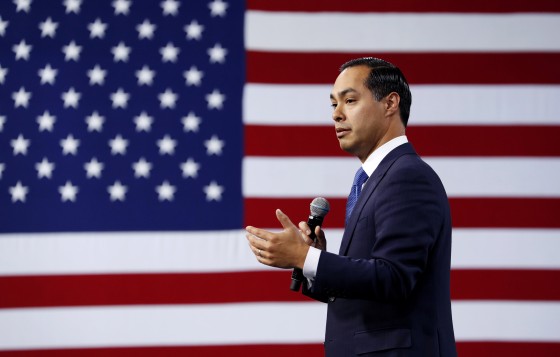
Presidential candidate Julián Castro unveiled an estimated $1.5 trillion education plan Monday that starts with what he’s most known for — early learning — but follows with detailed ideas for updating the nation’s public education system and making it more accessible, including college.
The broad plan includes proposals for pre-K to high school and into college or trade school.
Castro calls for creating a “universal, high-quality, publicly funded, full-day Pre-K” for 3- and 4-year-olds, through grants to state and local governments. He calls for eliminating tuition at public colleges, universities, community colleges and technical and vocational schools, and raising the maximum Pell grant to $10,000.
The plan seems to go into the most detail on ways to help students pay off debt, which he said now tops $1.5 trillion.
His plan is something of a critique of the nation’s education system, including the continued segregation that keeps opportunities out of reach for many.
“It’s not enough to just invest in our schools and hope that inequities are repaired — we need targeted approaches that ensure all students have access to a quality education,” Castro says in his plan, posted on his campaign website.
Related

The nation has failed to adequately invest in students, teachers and schools, which disproportionately affects students of color, Castro said. He said his plan "21st century-izes" our education system, because we haven't done that," although a lot of local communities already are doing pieces of his plan, he said.
“Education policy doesn’t exist in silos, and I’m proud to put forward the first comprehensive education plan to invest in our students holistically and keep our nation competitive in years to come,” Castro stated in a news release.
Castro, the only Latino seeking the Democratic presidential nomination, released an in-depth immigration plan in April. It has been drawing praise, including from fellow candidate Sen. Elizabeth Warren, D-Mass., but Castro is still polling in the low single digits.
Castro's plan echoes his personal story of having grown up poor, which he has told in speeches and his memoir, and his belief that educational opportunities helped him and should be available to all. Castro has said repeatedly in campaign stops he wants the country to be the smartest, healthiest, fairest and most prosperous on earth.
"There's no question I was swimming upstream," Castro told NBC News. He attended a school district with some of the most poorly funded schools in Texas, he said. But at the same time, "I had a mom who was determined I succeed and she had an education of her own," said Castro who went on to graduate from Stanford and Harvard Law School.
"What I want is no matter what the circumstances of the child are, that he or she can get a great education wherever they go to school," he said in a telephone interview.
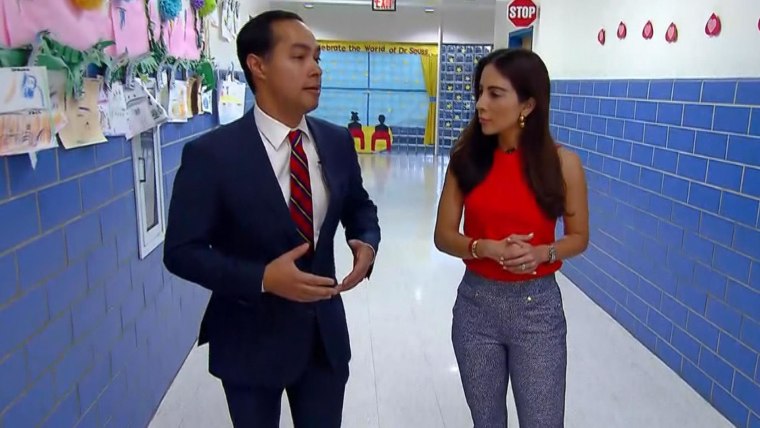
Castro is a former mayor of San Antonio and former Housing and Urban Development secretary under President Barack Obama. As mayor, he persuaded more than half of the city’s voters to approve a one-eighth-of-a-cent sales tax increase to pay for a full-day, quality pre-K program that has received good performance ratings.
He also launched Cafe College, a one-stop shopping site for school-age children to introduce them to the possibility of attending college and help them plan and start the process. The idea was meant to help schools that don't have enough counselors to give students personal attention.
Cal Jillson, a Southern Methodist University political science professor and expert on presidential politics, told NBC News in March that Castro was on the cutting edge when he pushed for the pre-K investment.
Boosting teacher pay, help with student debt
Castro's plan includes “reimagining high school” by investing $150 billion to modernize schools by improving facilities, technology and infrastructure, and supporting teachers, the arts and foreign language programs.
Castro, whose wife was a teacher and is now an elementary instructional math coach at a San Antonio school district, proposes ensuring that every high school student has the chance to graduate with at least one year of college credit, at no additional cost, and wants to create trade programs that link students with schools and employers.
He proposed a federal tax credit to boost teacher pay, with more for teachers at schools with a higher proportion of students on free or reduced lunch programs.


