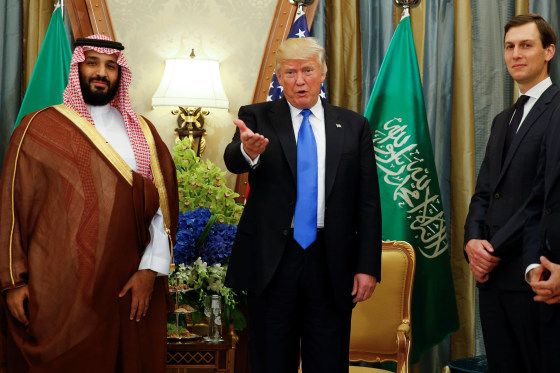
WASHINGTON — A group of private companies, including one led by President Donald Trump's fundraiser Tom Barrack, used their close ties to the White House to secure support for a nuclear power project backed by Saudi Arabia and lobbied against limits on the transfer of sensitive nuclear technology to the kingdom, according to a report from the House Oversight and Reform Committee released Monday.
Citing tens of thousands of pages of documents obtained mainly from private industry, the report from the committee's Democratic majority said the findings show the Trump administration has dangerously blurred the lines between government decision-making and corporate and foreign interests, with potentially dire consequences.
"The documents show the administration's willingness to let private parties with close ties to the President wield outsized influence over U.S. policy towards Saudi Arabia," it said. "These new documents raise serious questions about whether the White House is willing to place the potential profits of the President's friends above the national security of the American people and the universal objective of preventing the spread of nuclear weapons."
Republicans on the committee disagreed. The GOP lawmakers issued a minority report saying there was no evidence that the Trump administration had rushed to transfer sensitive nuclear technology to Saudi Arabia, had conflicts of interest or withheld information on the issue from Congress.

The majority report said the documents show contacts between IP3, a consortium of private firms pressing for a Saudi nuclear power plan, and senior members of the Trump administration "were more frequent, wide-ranging, and influential than previously known — and continue to the present day."
IP3, run by a group of retired generals, argued against restrictions on Saudi Arabia's civilian nuclear program that are identical to those that have been imposed on some other countries seeking the transfer of U.S. nuclear technology and know-how. The restrictions are known as the "Gold Standard," which require a foreign government not to enrich or re-process nuclear fuel or undertake other actions linked to the potential development of nuclear weapons.
In emails to other industry representatives, IP3 company officials called the Gold Standard nuclear limits an "obstacle" to be overcome, the report said. Industry executives said that IP3 had complained that the Gold Standard was a "total roadblock" that "killed our leverage."
Lawmakers on both sides of the aisle have previously urged the administration not to ease limits on Saudi Arabia's planned nuclear program.
The House Oversight Committee, led by Democratic Rep. Elijah Cummings of Maryland, who became the subject of scathing personal attacks on Twitter by the president in recent days, had issued an earlier report in February on the same topic. Based on accounts from whistleblowers inside Trump's National Security Council, that report focused on efforts by former national security adviser Michael Flynn to try to win support in the administration for the plan for U.S.-built nuclear power plants in Saudi Arabia.
Cummings said the new report "corroborates committee whistleblowers and exposes how corporate and foreign interests are using their unique access to advocate for the transfer of U.S. nuclear technology to Saudi Arabia."
The GOP's minority report says the "evidence before the Committee simply does not substantiate the allegations levied against the Trump administration."
The White House did not respond to a request for comment.
Although IP3’s ambitious plan never came to fruition, the consortium’s access raised worrisome questions about how the Trump administration appeared wide open to lobbying by commercial interests and foreign governments, the report said.
The Democrats' report focused on the role of Barrack, Trump Inaugural Committee chairman and longtime friend of the president, who threw his weight behind the IP3 project.
Barrack discussed taking senior posts in the administration, including special envoy to the Middle East and ambassador to the United Arab Emirates, even as he was promoting a plan that would benefit his company and other private firms, and advocating on behalf of Saudi Arabia to obtain U.S. nuclear technology, the report said.
The report said documents indicate "IP3 officials have had unprecedented access to the highest levels of the Trump administration," including meetings with the president, his son-in-law, Jared Kushner, top advisers and cabinet secretaries including Energy Secretary Rick Perry, Secretary of State Mike Pompeo and Commerce Secretary Wilbur Ross. IP3 described the Trump administration as "an extended team member," it said.
During the 2016 electoral campaign, when Trump was scheduled to deliver a major speech on energy, Barrack shared a draft of the speech with officials from Saudi Arabia and the United Arab Emirates to coordinate favorable language for the Persian Gulf states, the report said. Barrack sent the draft to Rashid Al-Malik, a businessman from the United Arab Emirates, who circulated the text to Emirati and Saudi officials and then passed suggestions back to Barrack, the report said, citing emails.
Barrack's role in the energy speech was first reported by The New York Times.
