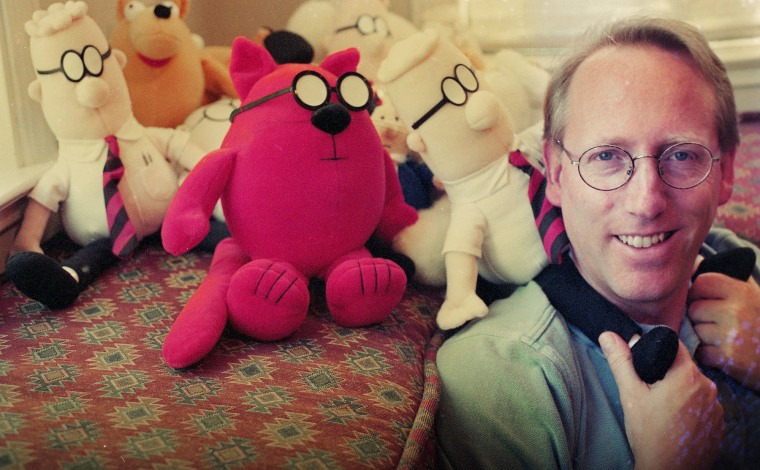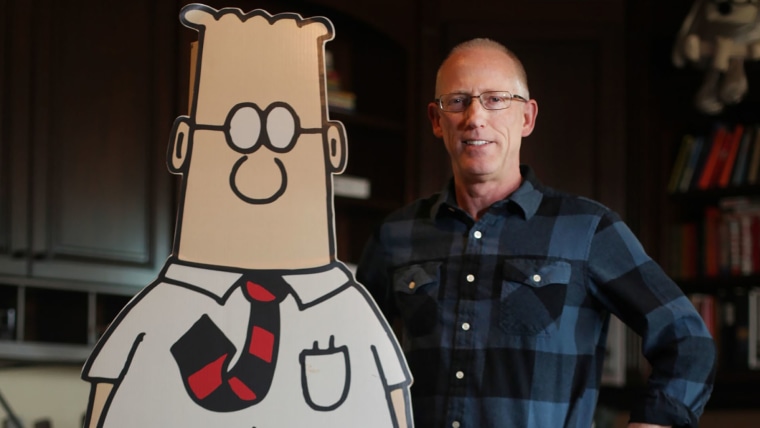
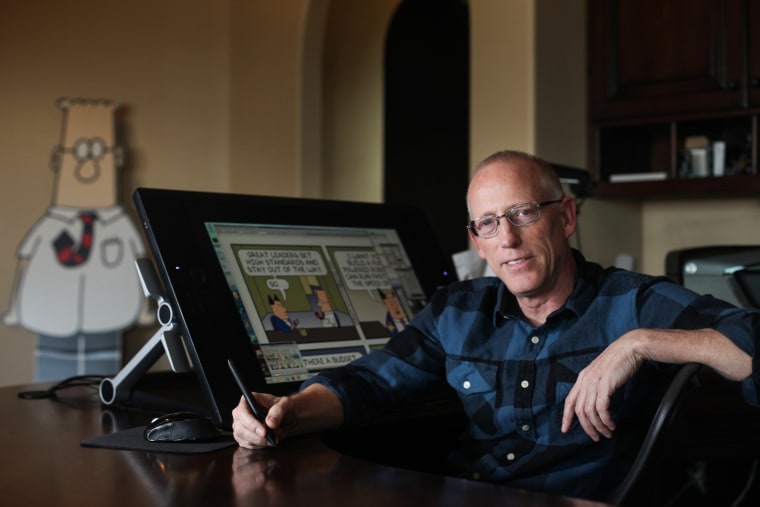
Scott Adams, the "Dilbert" creator whose cartoon was dropped by hundreds of newspapers after he made racist remarks, died months after he revealed his diagnosis with prostate cancer, his family said Tuesday.
Adams told fans in May that he'd been diagnosed with prostate cancer, which had spread to his bones.
He'd recently been in hospice care in Northern California.
"Unfortunately, this isn't good news," his ex-wife Shelly Miles told Adams' fans Tuesday on YouTube. "He's not with us ... anymore."
In a statement he wrote Jan. 1, which Miles shared Tuesday, Adams said he hoped his work brought joy to "lots of lonely people."
"I had an amazing life," he said. "I gave it everything I had."
President Donald Trump praised Adams as a "fantastic guy, who liked and respected me when it wasn’t fashionable to do so."
"He bravely fought a long battle against a terrible disease," Trump said in a statement. "My condolences go out to his family, and all of his many friends and listeners."
Just a day earlier, Adams had told fans in an online chat streamed on X that he was “way past my expiration” date and that there are “no promises” he could live for even one more day.
“You can tell I’m getting weaker and weaker," Adams said Monday. "I’ve been told that’s the way I’ll know how much time I have left is by how tired I am and how much pain I have."
"My tiredness and my pain are maxing out," he added. "I’m in quite bad shape of the bones."
In the online meeting with friends Monday, Adams thanked his former wife for being "the only thing keeping me alive right now."
Adams also expressed his gratitude for conservative writer and biographer Joel Pollak for "keeping the lights on."
"So I’m hanging on as long as I can," Adams said. "I’m way past my ... expiration [date]."
Adams’ “Dilbert” was first published in 1989, delighting generations of readers with his satiric look at ridiculous elements of white-collar office life.
He was honored by the National Cartoonists Society with its Reuben Award for Outstanding Cartoonists of the Year in 1997, joining an elite club with such iconic artists as Matt Groening (2002), Gary Trudeau (1995), Gary Larson (1990, 1994) and Charles M. Schulz (1955, 1964).
If Adams had harbored any far-right theories, he had largely kept those thoughts to himself as his cartoon flourished in popularity.
But then he questioned the scope of the Holocaust in 2006 and compared women to "children and the mentally handicapped" in 2011.