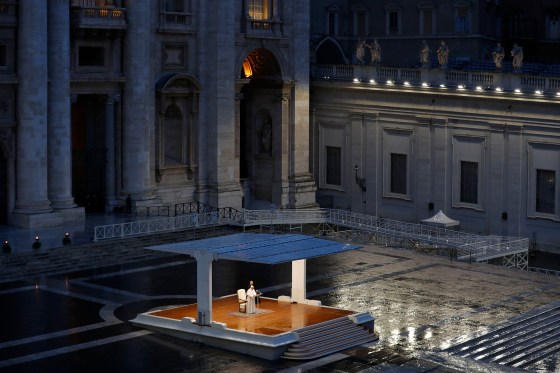
A Catholic priest in Georgia presided from his Jeep. There are drive-up prayers in Washington, D.C. And Pope Francis delivered mass to an empty and silent St. Peter’s Square in Vatican City.
As the COVID-19 pandemic shutters public spaces across the globe, religious communities are being forced to reimagine their traditions. Churches, synagogues, temples and mosques are going virtual. Religious schools are closing, holiday celebrations are canceled, and the spiritual rules surrounding milestones — from baptisms to funerals — must be rewritten for an age of isolation.
“What is community when the building where we gather is no longer available to us?” the Rev. Chloe Breyer, executive director of The Interfaith Center of New York, said. “It opens us up to a degree of creativity. Religion is a lived experience.”
But not all religious leaders are ready to accept social distancing.
In Louisiana, a pastor said he would continue services despite a state ban on gatherings of more than 50 people. Virginia Gov. Ralph Northam is urging Liberty University President Jerry Falwell Jr. to reconsider after he allowed students to return to campus. Among the potential causes of COVID-19 in the words of some pastors and televangelists: abortions, LGBTQ rights and public hatred of President Donald Trump. Others assure their listeners that God will protect people of faith against the virus, or that no believer ought to be afraid of heaven.
“When 10 people can’t assemble in church or business then healthy people are being quarantined, our Constitution & faith in God is under attack, & Tyranny triumphs when fear reigns,” Roy Moore, the controversial failed Republican Senate candidate and former judge from Alabama, tweeted last weekend.
Pastor Rodney Howard-Browne of The River Church in Tampa instructed attendees to hold hands. “If you can’t receive communion because you’re afraid of getting infected, you don’t understand what the table of the Lord is about,” he said March 17.
But the rejection of social distancing is far from mainstream among religious leaders.
“That's dumb, unbiblical and it doesn’t make sense,” Rick Warren, pastor of the Saddleback Church in California, said.
Warren and his wife, Kay, started the Saddleback Church about 40 years ago, and it now has 30,000 Sunday congregants around the world. They have moved their ministry online.
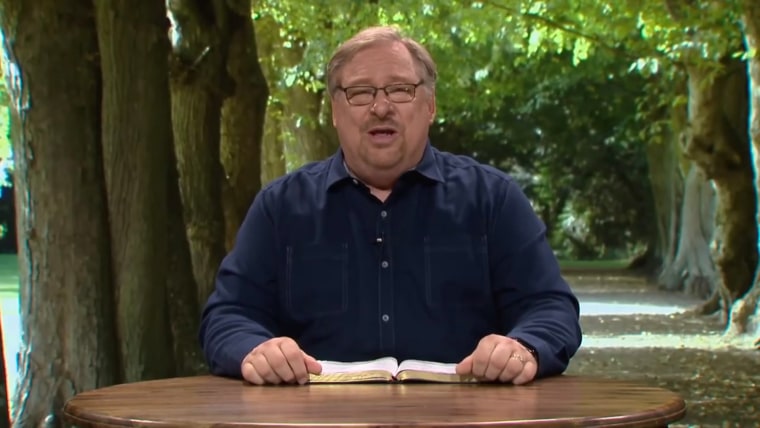
“God gave you a brain,” Warren said. “And much of what God wants to do with your life, he’s not going to write in the sky. He gave you a brain, and he expects you to use the intelligence that you were given."
Religious gatherings have already been seen to facilitate the spread of COVID-19, contributing to over half the cases at one point in both South Korea and Malaysia and recently requiring hundreds of D.C. churchgoers to self-quarantine.
Most mainstream religious associations in the U.S. appear to be embracing the need for change and advising community leaders to adhere to social distancing guidelines from the Centers for Disease Control and Prevention. In New York, the current epicenter of the U.S. COVID-19 pandemic, Breyer said she had not seen anything other than full willingness to adopt public health guidelines.
“Everyone is taking this very seriously,” she said. “This is not something unique to particular traditions.”
Allen Fagin, executive vice president of the Orthodox Union, said the need to stay apart has been taxing on his community.
“Praying together as a community is a fundamental preset for us,” Fagin said. “Not having that as the glue that binds is extraordinarily difficult.”
The new reality has inspired some religious leaders to take creative steps.
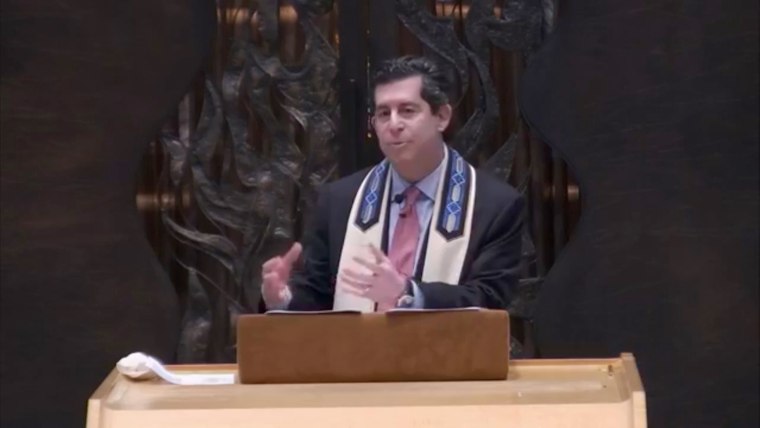
Father Mark Peacock, priest of the Holy Spirit Parish in Grand Rapids, Michigan, has populated the pews of his church with photos of those worshipping at home.


