
Migrant families and immigration advocacy groups are preparing for millions of families to potentially be separated from each other during the mass deportations planned by President-elect Donald Trump.

It is unclear how exactly the deportations will play out and how families will be impacted. But a recent study by the American Immigration Council, a pro-immigration advocacy group, estimated that up to 4 million mixed-status families — where some members are undocumented and some are U.S. citizens — could be separated.
In states like Arizona, Colorado and Pennsylvania, mixed-status families, asylum-seekers and advocates say they are planning for scenarios where children could be separated from their parents.
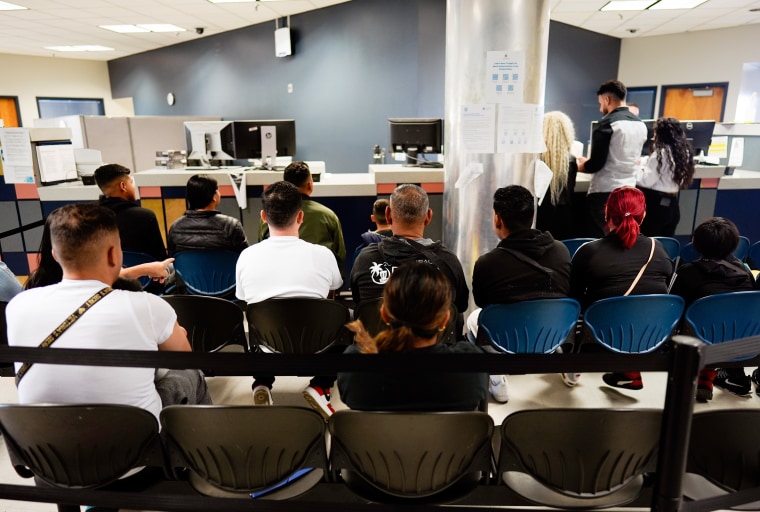
In Pennsylvania, Lillie, a U.S. citizen who did not want to use her last name out of concern for her family’s safety, has been married to her undocumented husband from Honduras for 10 years. Last week, she took her U.S.-born children to get their passports and plans to get a power of attorney drawn up in the event her husband gets deported, she said.
“If something happens and my husband is detained or he’s deported, it would be very difficult for me to get passports for my children, for our children, to be able to leave the country to go see him,” she said.

Her husband was detained back in 2017, during the last Trump administration, for about two months. The experience has affected him “mentally and emotionally,” she said.
“He’s made it clear that if it were to happen again, it would not be ‘Let’s stay and fight,’” Lillie said. “It would be ‘Let’s just go,’ because he does not want to stay in detention again.”
Throughout his successful 2024 run for the presidency, Trump has rallied supporters on the promise that he would enact the largest mass deportation effort in American history. And while Trump has said he will begin by prioritizing criminal noncitizens for deportation, the former president and his incoming administration have not ruled out separating or deporting families.
When asked by CBS News last month if there was a way to carry out mass deportations without separating families, Tom Homan, who has since been named as Trump’s “border czar,” said, “Families can be deported together.”
Specific mass deportation plans are still being developed by Trump and his transition team, but sources familiar with the planning told NBC News recently that restarting family detention and potentially building more detention facilities in nonborder U.S. cities are being considered.

Preparations in Arizona and Colorado
In Tucson, Arizona, the Coalición de Derechos Humanos, a group of more than 10 nonprofit organizations, is helping undocumented and mixed-status families create “emergency packets” ahead of potential mass deportations. The idea, organizers say, is partly based on past experiences where parents have been detained or deported while their children were in school.
“We had cases where they made calls. We had cases where they were not able to get in touch with the mother, their friends,” said coalition co-founder Isabel Garcia.
The “emergency packet,” which coalition members are helping families make in local workshops, will include key documents such as a power of attorney for parental authority, family emergency contacts and a child’s school records.
Garcia said that community interest in the coalition and its services has peaked since Trump won the 2024 presidential election.
“More people have come to our meetings. We have had more people calling us. We are now inundated with people,” Garcia said.
Advocacy groups are also bracing for state-level changes to immigration enforcement that could result in deportations. Organizers for Coalición de Derechos Humanos in Tucson say they are bracing for the impact of Proposition 314, a hard-line state immigration and border enforcement law that Arizona voters passed in November.
The measure makes it a state crime to enter Arizona between a port of entry illegally and allows local law enforcement to arrest noncitizens and state judges to order deportations. It also adds state penalties to acts like selling fentanyl that lead to the death of another person and presenting false information to an employer or a public benefits program.
Proposition 314 is one of multiple immigration-related state laws passed in the U.S. to address what supporters say is a record-high number of illegal border crossings under the Biden administration.