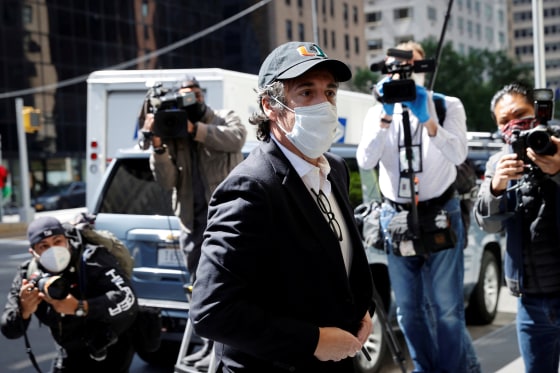
The American Civil Liberties Union and a law firm on Monday filed a legal challenge to the recent imprisonment of Michael Cohen, President Donald Trump's former personal attorney.
The groups argue that Cohen was sent back to prison this month after being released on home confinement in retaliation for his plans to release a negative book about Trump before the November election.
"He is being held in retaliation for his protected speech, including drafting a book manuscript that is critical of the President — and recently making public his intention to publish that book soon, shortly before the upcoming election," lawyers on behalf of Cohen wrote in Monday's lawsuit.
Cohen was sentenced to three years in 2018 for crimes that include tax evasion, violating campaign finance laws and lying to Congress. He was released from prison in May to serve the remainder of his prison term at home because of the coronavirus pandemic.
He was returned to prison earlier this month after refusing to sign a home confinement agreement barring him from publishing a book or speaking to the media, sources and his attorneys have said.
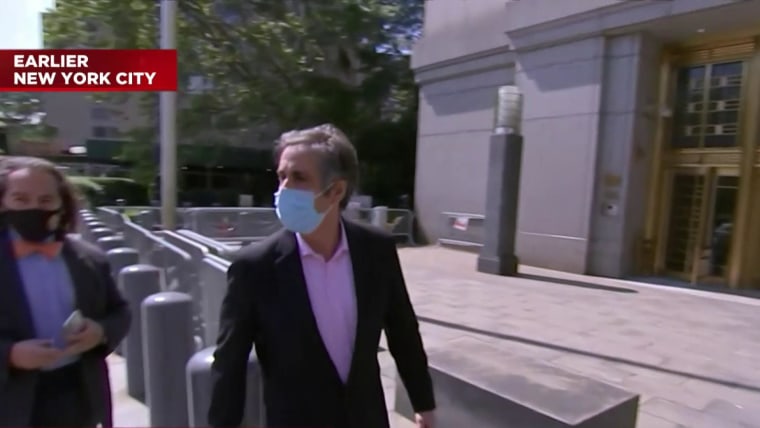
The habeus petition and motion for a temporary restraining order seeking Cohen's immediate release was filed by The American Civil Liberties Union and law firm Perry Guha LLP. They said in a statement that the move violates the First Amendment.
It names U.S. Attorney General William Barr, Federal Bureau of Prisons Director Michael Carvajal and the warden of the federal prison where Cohen is being held, Federal Correctional Institution Otisville, as respondents.
It seeks a judge's order that Cohen be released from prison and put on home confinement.
A spokesperson for the Justice Department declined to comment Monday night. An e-mailed request for comment to the Bureau of Prisons was not immediately returned.
A Bureau of Prisons spokesperson said when he was returned to custody that "Michael Cohen refused the conditions of his home confinement, and as a result, has been returned to a BOP facility."
The attorneys for Cohen argue that on July 9, the day Cohen was returned to custody, Cohen and his attorney reported to a probation office in Manhattan to formally transition from furlough to home confinement.
The "Federal Location Monitoring Program Participant Agreement" had a section in it that stipulated "no engagement of any kind with the media," including books, according to the court document.
In Monday's petition, the attorneys for Cohen say that agreement "had been custom-made for Mr. Cohen," and that it did not appear standard and was riddled with typos.
The section also included that Cohen stay off social media and tell family and friends to not post on his behalf, according to the lawsuit.
Cohen's attorney was concerned that Cohen could be seen as violating the agreement based on factors over which he could not control, like the actions of others, the suit claims.
The attorney, Cohen and probation officers then discussed changing the section of the agreement. The suit says Cohen never refused to sign the document.
After a delay of about 90 minutes to get instructions from higher-ups, U.S. marshals arrived with shackles and took Cohen into custody, the suit claims.
As for the book planned, the lawsuit says that Cohen went on social media to say it was expected to be published in September.


