IE 11 is not supported. For an optimal experience visit our site on another browser.
Alabama set to execute man who did not kill anyone
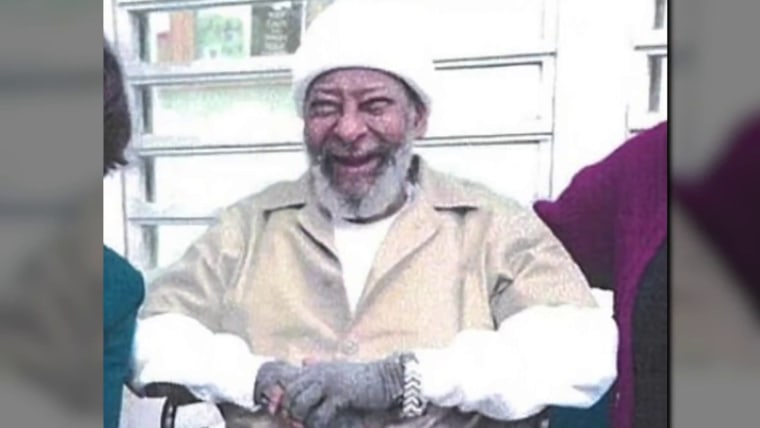
Unless Alabama Gov. Kay Ivey intervenes, Charles “Sonny” Burton, 75, will be executed Thursday. He is among thousands in America convicted under a controversial felony murder law
This fact is not in dispute: Charles “Sonny” Burton, 75, has never killed anyone.
But on Thursday, Alabama is set to execute him.
“I shouldn’t die for something I haven’t done,” Burton told NBC News in a phone interview Monday from William C. Holman Correctional Facility, the site of the state’s execution chamber, where he has spent more than 30 years on death row.
Burton’s death sentence was possible because of a legal doctrine known as felony murder, which allows prosecutors to treat anyone involved in certain felonies, such as robbery or burglary, equally responsible for a killing that occurs during the crime, even if they did not commit the act themselves.
“Felony murder allows for everybody involved in the underlying offense to be treated by the legal system as if they committed an intentional murder,” says Nazgol Ghandnoosh, director of research at The Sentencing Project, an advocacy group
In 1991, Burton was one of six men involved in the robbery of a AutoZone store in Talladega that ended with the murder of a customer, Doug Battle.
Burton admits to entering the store armed with a gun. He said he stole cash from a safe in the back room, then fled outside to wait by a getaway car.
Inside the store, one of his accomplices, Derrick DeBruce, shot Battle, 34, in the back, killing him. The state acknowledged this fact in its response to Burton’s application for a stay of execution from the U.S. Supreme Court.
“DeBruce hit Battle, knocking him to the floor, then fatally shot him in the back. Burton had already left the store when the shooting occurred,” Alabama Attorney General Steve Marshall wrote.
“I didn’t know a murder was going to happen,” Burton told NBC News. “I would have stopped that.”
Burton was convicted of murder and sentenced to death. Prosecutors argued he had been the robbery’s “ringleader,” which Burton denies.
“I didn’t assist nobody. I didn’t aid nobody. I didn’t tell nobody to shoot nobody,” he said.
DeBruce, who actually killed Battle, received a different fate. At first, DeBruce was also sentenced to death, but his punishment was later reduced to life in prison after a court ruled his attorney had provided ineffective representation during the penalty phase of his trial.
For years, the two men lived alongside each other on death row.
“He got me with my life for something stupid that he did,” Burton told NBC News, “But I forgave him.”
When DeBruce’s sentence was overturned, he moved to another prison, leaving Burton behind on death row. DeBruce died in custody in 2020.
Burton’s sentence remained unchanged, even though he has amassed unlikely support.
The victim’s daughter, Tori Battle, who was 9 years old when her father was murdered, recently published an op-ed in the Montgomery Advertiser urging Alabama Gov. Kay Ivey to spare Burton’s life.
“Mr. Burton remains on death row not because moral clarity demands it, but because procedural rules have blocked courts from correcting past mistakes,” she wrote. “When a man’s life turns on technical barriers rather than the truth, that is not justice, but a failure of the system that does nothing to honor my father’s memory.”
Even many of the jurors who voted to end his life have come forward saying they regret their decision. In all, six signed affidavits asking Ivey to show Burton mercy.
“The death sentence is too harsh for someone that did not pull the trigger,” juror Priscilla Townsend told NBC News.
“I don’t see him as a bad guy anymore. I was young, and I made a poor decision, as he did in his youth. He made poor choices. I don’t feel he should be sentenced to death for a poor choice,” she said.
Absent a grant of mercy from Ivey or an unlikely last-minute stay of execution from the Supreme Court, Burton will be the ninth person to be executed by nitrogen gas — a method first carried out in Alabama in 2024 with the execution of Kenneth Eugene Smith, who had previously survived an execution attempt after a botched lethal injection. Witnesses have reported that people killed by nitrogen gas have taken anywhere from 15 to 40 minutes to die.
The state argues Burton’s execution is justified.
“His death sentence is long overdue,” Alabama’s attorney general wrote in the Supreme Court filing.
Clemency is extremely rare; the Death Penalty Information Center estimates fewer than 1% of people on death row have had their sentences commuted since 1972. Ivey has commuted only one death sentence in her nine years as governor. When she signed Burton’s death warrant last month, she said she “currently has no plans to grant clemency in this case,” but she retains the authority to do so at any time. Most recently, Oklahoma Gov. Kevin Stitt commuted the death sentence of Tremane Wood in November.
The felony murder rule has swept up thousands of defendants across the country.
According to the Felony Murder Reporting Project, there have been more than 10,000 felony murder cases across the country, sometimes resulting in a mandatory sentence of life without parole or even death, like in Burton’s case.
In 2019, six teenagers tried to break into a house in Illinois when the homeowner told them to leave, then fired a gun after they refused. The youngest of the group, 14, was killed.
In 2004, Ryan Holle was sentenced in Florida to life in prison for a murder he didn’t commit and didn’t know was going to happen. He lent his car keys to some men, who used it to drive to a home to commit a burglary where an 18-year-old, Jessica Snyder, was beaten to death.
Holle, then 20, was at home and asleep when the killing happened. But prosecutors argued he shared responsibility because he loaned the car, knowing the group might commit a crime. Under Florida’s felony murder law, that was enough for a conviction.
“I would have never have let them get the damn keys to my car if I thought they were serious,” he says, about the group committing a robbery.
He was sentenced to life in prison. After years of legal challenges and advocacy, Holle received an extraordinary and rare act of clemency. In 2018, Florida Gov. Rick Scott commuted his sentence to 25 years to life.
Holle was released in December 2024. He’s now serving 10 years of probation.
In Alabama, Burton says he is hoping for the same kind of mercy.
“I’ll never lose hope, even when I’m sitting in the chair with the [gas mask] strapped on my head,” he said. “I want people that listen to me to know that I didn’t kill nobody. These are my last words,” he said.