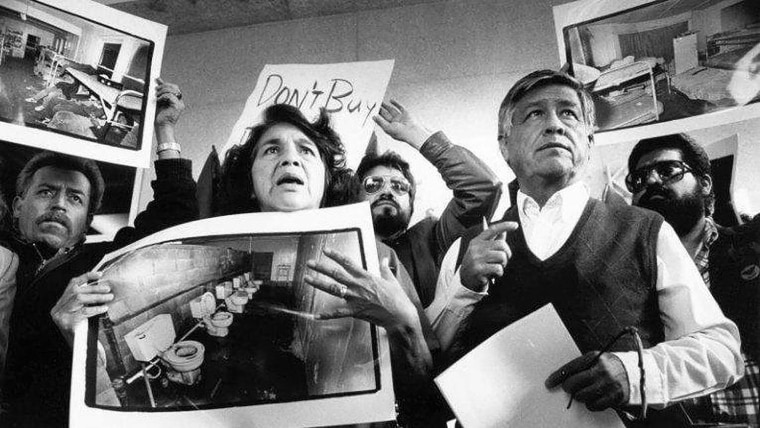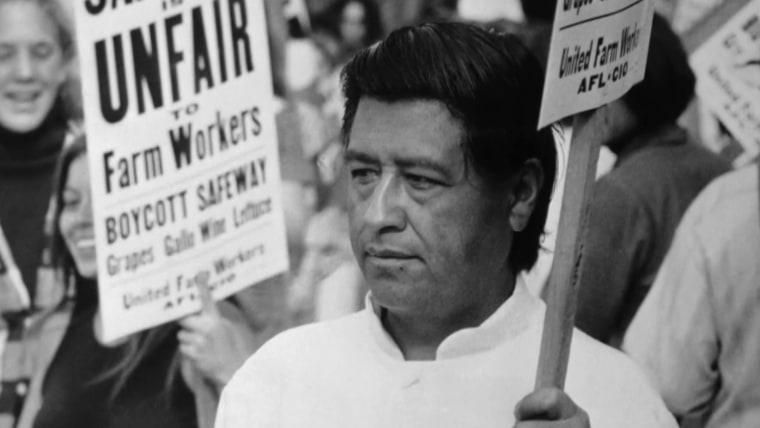
Latino allies and admirers of once-celebrated civil rights leader Cesar Chavez worked swiftly to erase his name, likeness and image from memorials and honors, distancing themselves from the shocking allegations that he abused girls and women.
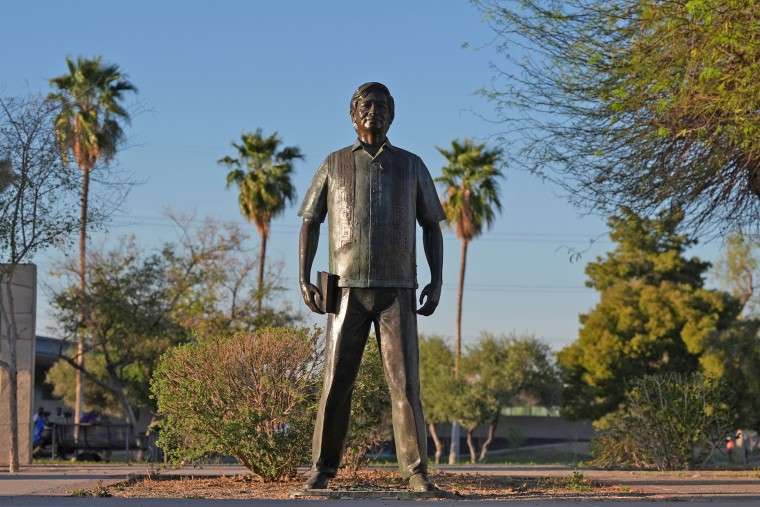
They removed a statue at Fresno State University. They canceled or renamed marches, family celebrations and other events scheduled for his birthday. They yanked his name — or called for it to be removed — from streets, parks and schools, and they repainted murals.
But many are left to contend with how to erase the veneration of Chavez the man without obliterating the history of the struggle to improve the lives of Latinos, the country’s second largest ethnic and racial group.
“Thirty years after the passing of Cesar Chavez, survivors have said ‘ya basta,’” or enough, said Sonja Diaz, a California civil rights attorney and activist.
“They’re tired of his name being a piece of their daily lives and lived experiences, psychologically but also physically, right in their neighborhoods, in their communities, a constant reminder,” she said.
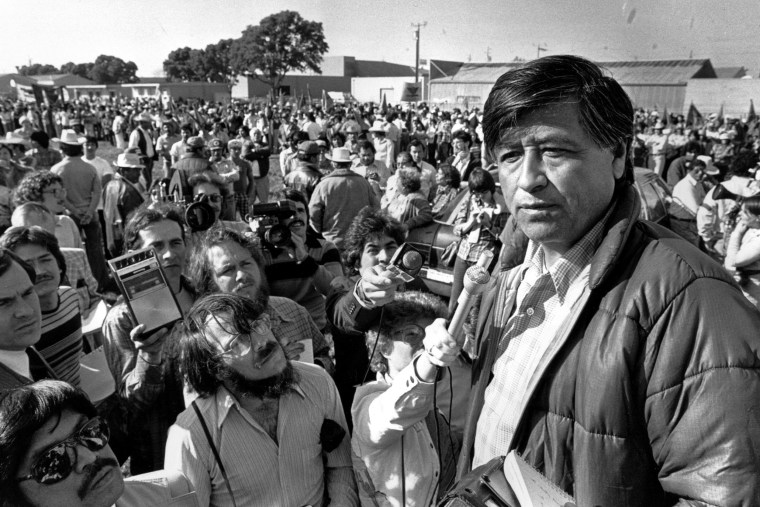
Scholars and experts say the challenge to separate Chavez from the cause is exacerbated by a Trump administration-led campaign to downplay, distort or deny key parts of the nation’s history, such as slavery and racism, the origins of the Mexican-American War, the recognition of Mexican American and Latino military leaders and efforts to improve racial and economic disparities that are now being dismantled as part of “woke” DEI practices.
Decades after Chavez waged grape boycotts and labor strikes, some Latinos say they are experiencing racial profiling amid President Donald Trump’s mass deportation campaign, which has included the arrests of U.S. citizens as well as detentions and deportations targeting immigrants with no criminal convictions, including asylum-seekers.
“Our community already is in pain,” said Delia Garcia, who made history as Kansas’ first Latina and youngest female state legislator in 2004 and the state’s first Latina labor secretary in 2019. The Chavez allegations are “extra pain to have to deal with,” she said.
Garcia said the shocking allegations became public at a time when many Mexican Americans are seeing immigration arrests ripping families apart, people afraid to leave their homes, immigrants in prolonged detention and some dying in immigration custody.
The media and others became enamored with Chavez and the farmworker movement, said Rosie Castro, a civil rights activist in Texas who participated in fielding Mexican American candidates under La Raza Unida Party, a political party formed during the 1970s Chicano Movement.
But at that time, there were many other people who worked hard to advance civil rights, fair pay and all the other issues that were central to the Chicano Movement, said Castro, mother to Rep. Joaquín Castro, a Texas Democrat, and Julián Castro, a former U.S. labor secretary and 2020 Democratic presidential candidate.
She ticked off the names of Reies Lopez Tijerina, who fought for the return of land that belonged to people of Mexican and Spanish descent in New Mexico, and Rodolfo “Corky” Gonzales, who led Chicano youth movements for social justice and La Raza Unida Party.
The veneration of a single man in Chavez led to a reliance on him as a sole representative of Latino history, in particular worker and civil rights movements, said Mireya Loza, an associate professor of history at Georgetown University and a scholar of the Bracero Program.
“That’s the particular reason why it’s devastating, right? When a community is only allowed to have one figure, we take it hard, when the truth is we have a million and we also need to take them all to task,” Loza said. “We can’t think that anyone is above really looking at their actions and really thinking deeply about who they are.”
Chavez had been a controversial figure in many ways. There were those who opposed his work and how he managed the farmworker union and interacted with its staff. Some have criticized his past behavior toward undocumented workers, who had been brought in by farm owners during the Chavez-led farmworker strikes.
James Garcia, an Arizona journalist and playwright, canceled the September premiere of his play “The Two Souls of Cesar Chavez” following the allegations. The play he had written illuminated the conflict between Chavez’s civil rights work and his problematic personality, documented in books such as “From the Jaws of Victory” and “The Crusades of Cesar Chavez.” Garcia said he was not aware of the sexual abuse allegations before The New York Times published its story this week.
The Times’ story “unmasks Chavez’s biography as a grotesque and elaborate lie,” Garcia wrote in an opinion piece in the Arizona Mirror.
Garcia had originally “set out to write a play about a human being, deeply flawed but still worthy of our admiration for his monumental civil rights achievements,” he said in an editor’s note below the column. “These new revelations tell a very different story.”
More on the Cesar Chavez allegations
- Officials across the U.S. push to remove Cesar Chavez’s name from streets, parks and holidays
- Cesar Chavez accused of abusing girls and women, drawing outrage and a reckoning for civil rights movement
- Cesar Chavez Foundation ‘deeply shocked’ over allegations against civil rights leader
- Video: Women allege labor rights icon Cesar Chavez sexually assaulted them
Chavez has become synonymous with Latino history in the same way that Martin Luther King Jr. has for Black history, according to Manuel Pastor, a professor of sociology, American studies and ethnicity at the University of Southern California.