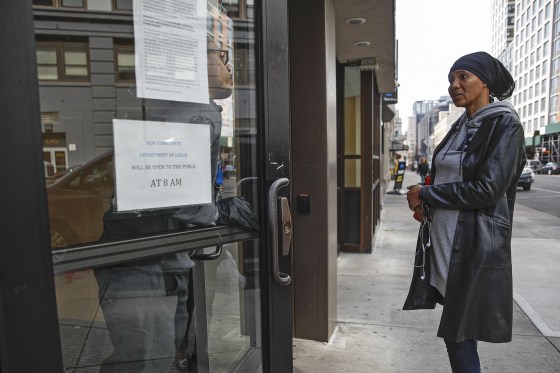
When Simone Nelson was finally able to reach someone from the unemployment office in New York state on Tuesday, she was overjoyed.
Nelson, 22, had been making hundreds of calls a day, endlessly pressing redial after learning that she no longer had a job at the bakery where she worked as a caterer and an events coordinator.
"I started with only 100 calls a day. And then on Saturday, I had three consecutive hours when I had two phones calling the unemployment office, and it wasn't working," Nelson said. "It kept saying the reps were busy and hung up."
Nelson is just one of the millions of Americans who are part of the largest mass-unemployment event ever recorded in the U.S. Two weeks ago, 3 million people applied for unemployment benefits, a number that dwarfed any single week of jobless claims during past economic crises.
On Thursday, new data showed that 6.6 million more people applied for unemployment benefits last week.
Representatives of state unemployment offices across the country say the shock of such numbers has hit their workers almost as hard as the people calling after losing their jobs have been hit — and they describe the wrenching emotional toll the work is taking on call center staff members, many of whom are still required to go into the office.
"The difference between the job loss of the 2008 recession and where we are now is we had more time to prepare then," said Cher Haavind, deputy executive director of the Colorado Department of Labor and Employment. "From a staff perspective, we just haven't had time to really readjust in terms of both resources and support to staff, which includes this new role of our employees acting as mental health counselors."
Labor and unemployment offices around the U.S. are adding staff, shoring up websites that have crashed from the high traffic, extending work hours, calling in retired workers and opening on weekends to handle the influx of filings.
Unemployment workers are also facing personal risk.
Workers at the New York Labor Department's call center for unemployment, most of whom are based in Binghamton, are still coming into the office, according to Wayne Spence, president of the New York State Public Employees Federation, a union representing employees at the department.
Many of the people taking the calls are working 10-hour days, Spence said.
"Going into work at the unemployment office comes with a lot of fear, as they often work in tight locations and the idea of social distancing is pretty damn near impossible," Spence said.
Unemployment office workers in many states are continuing to report to their desks, despite strict recommendations from the Centers for Disease Control and Prevention and state governments that people stay home and self-quarantine to slow the spread of the virus. These workers are considered essential employees — they're staffing the phone lines to help the millions of people recently out of work apply to receive unemployment checks to help support their families, buy food and pay bills, rent and mortgages.
Unemployment office workers in Georgia are also coming into the office, said Kersha Cartwright, communications director for the state Labor Department.
"We can't work from home due to the number of claims that need to be processed and because we're dealing with personal information, so we need to make sure our systems are secure," Cartwright said.
"We are trying to get Georgians paid. They are scared. They are worried, and they are anxious. We are doing whatever we can," she said, adding that employees have distanced their desks and aren't holding meetings in the same room anymore but rather are videoconferencing even though everyone is in the same office.
The New Jersey Department of Labor and Workforce Development said in an email that it has been practicing social distancing at its office, too. In Florida, employees at the state's Department of Economic Opportunity are also going into the office and trying to keep their distance.
