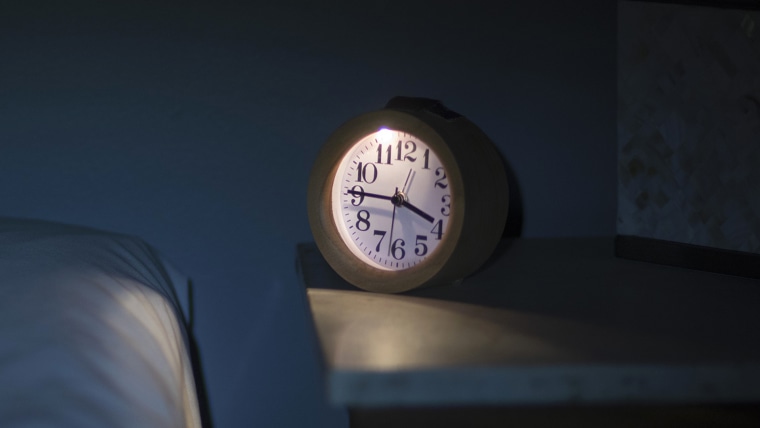
No matter who you are, it’s not fun to “spring ahead” as a result of daylight saving time. But when you’re a parent of young kids, the impact is significantly worse.
Sleep is a precious commodity in the early years of childrearing. Losing that hour of sleep can mean a week or more of meltdowns, wakeups and general crankiness ... from your child and from you.
Sure, you can prepare kids for the jump by getting blackout curtains or shifting the schedule gradually, but in this reporter’s experience it’s all a crapshoot.
But not everyone has this issue.
Parents who live in several specific parts of the country do not have to spend two weeks a year dealing with extra-cranky kids. Can you imagine? Their kids are just the regular amount of cranky all year long!
These U.S. states and territories do not observe daylight saving time: Hawaii, most of Arizona, Puerto Rico, American Samoa, Guam, the Virgin Islands and the Northern Mariana Islands.
We spoke with several families who live in places that don’t observe daylight saving time to see if not worrying about the time change is as glorious as we suspect it is.
When does daylight daving time end this year?
Most of us observe daylight saving time by moving clocks one hour ahead in the spring and one hour back to standard time in the fall. This gives us more sunlit hours in the evening during the warmest-weather months, according to the National Institute of Standards and Technology.
You may have heard that we began doing this to give farmers extra hours in the sun, but Scientific American reported that it was actually put into practice to conserve energy during World War I. However, the actual energy-saving has been minimal at best.
Whatever energy saved surely is outweighed by the energy parents use to get their kids on a new schedule twice a year.
Daylight saving time begins every year on the second Sunday in March and ends on the first Sunday in November. This year, daylight saving time begins on Sunday, March 8, 2026, when clocks “spring ahead” from 2:00 a.m. to 3 a.m.
What is it like to not observe daylight saving time?
“Crossing time change off the list has been great for the kids,” says Mandy Dowies, who moved from northern Virginia to Hawaii in 2019. “The kids are so much better behaved when they get the rest they need without having to adjust to a new time change.”
At the time, she had two children, and she has since added a third. Dowies went from observing the time change with her kids to living in a literal paradise that keeps the same time all year round.
Jennifer Marcuson, mother of a 6-year-old, moved from Indiana to Arizona in June 2023. Like Dowies, she appreciates being on standard time all year because it is “just one less thing to worry about parenting-wise.”
Rachel V. Smith grew up in Arizona and didn’t have any experience with daylight saving time until she went to college in Rhode Island.
“I absolutely hated it,” she said. “I hated that it got dark at 4:30 p.m., and that from one day to the next we had less ‘sun’ hours in an already gloomy winter season.”
Smith moved to Italy (a country that also observes daylight saving time) and had to adjust her oldest child — who is now 5 — to the time changes that she once dreaded. Then in 2021, Smith moved back to Arizona, had another baby and said goodbye to daylight saving time for good.
“Once we moved back to Arizona and I didn’t have to worry about it anymore, it’s honestly so great,” says the busy mom. “I really love not having time change and would dread moving back to a place that did.”
Why do we torture parents with daylight saving time?
Short answer: no idea.
