WASHINGTON — National Transportation Safety Board members were deeply troubled Tuesday over years of ignored warnings about helicopter traffic dangers and other problems, long before an American Airlines jet and an Army Black Hawk collided a year ago, killing 67 people near Washington, D.C.
The placement of a helicopter route in the approach path of Reagan National Airport's secondary runway without regularly reviewing it was a key factor causing the crash, along with air traffic controllers' over reliance on asking pilots to avoid other aircraft. Throughout the daylong hearing, investigators emphasized the history of missed opportunities to address the risks related to helicopter traffic.
"I'm sorry for you, as these pages of these reports are written in your family members' blood," board member Todd Inman told the audience. "I'm sorry that we have to be here."
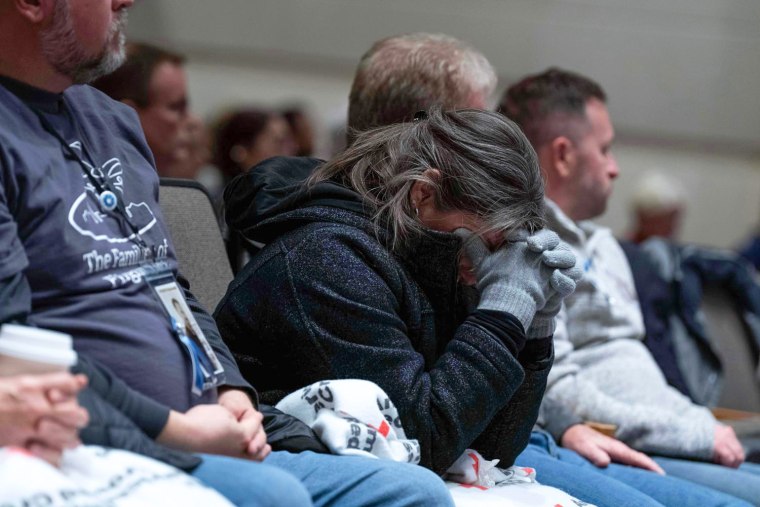
Family members listened intently during the hearing. Some were escorted out, including two in tears, as an animation of the flights was displayed on video screens. Others wore black shirts bearing the names of first responder units.
"The negligence of not fixing things that needed to be fixed killed my brother and 66 other people. So I'm not very happy," Kristen Miller-Zahn, who watched from the front row, said during a break.
Victims' families say they hope there's meaningful change in response to the NTSB's recommendations.
Systemic problems caused the crash
Before hearing from investigators, Inman said "systemic issues across multiple organizations," not an error by any individual, caused the tragedy.
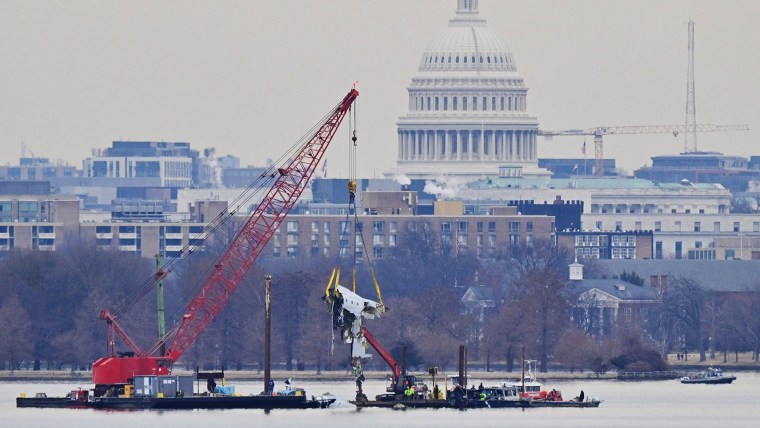
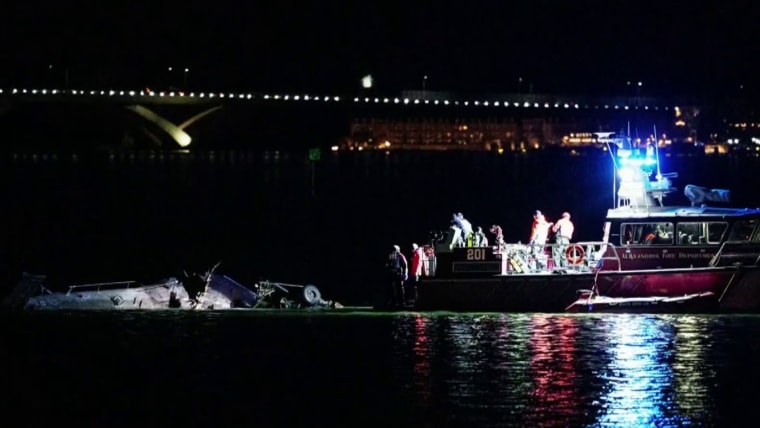
Everyone aboard the jet, flying from Wichita, Kansas, and the helicopter died when the two aircraft collided and plummeted into the icy Potomac River. It was the deadliest plane crash on U.S. soil since 2001, and the victims included 28 members of the figure skating community.
The Federal Aviation Administration last week made some changes permanent to ensure helicopters and planes no longer share the same airspace around the airport.
Missed warning signs
NTSB chairwoman Jennifer Homendy said she couldn't believe the FAA didn't realize the helicopter route in use during the crash didn't provide adequate separation from planes landing on Reagan's secondary runway. She noted that the FAA had refused to add detailed information about helicopter routes to pilots' charts so they could better understand the risks, and it wouldn't change the helicopter route even after a near miss in 2013.
"We know over time concerns were raised repeatedly, went unheard, squashed — however you want to put it — stuck in red tape and bureaucracy of a very large organization," Homendy said. "Repeated recommendations over the years."
Mary Schiavo, a former U.S. Department of Transportation Inspector General, said it's troubling to hear how many times the FAA failed to act.
"It was just a shocking dereliction of duty by the FAA. And they have so much work to be done to fix it. And just from my background, I don't know if the people there are up to it," Schiavo said.
But just Monday, Transportation Secretary Sean Duffy announced a plan to reorganize the FAA and create one single safety office that can track concerns agencywide and enforce the same standards instead of the fragmented approach taken by different silos within FAA.
NTSB investigators said the Army and FAA weren't sharing all safety data with each other before the crash, and that Army helicopter pilots often weren't even aware when they were involved in a near-miss around Reagan.
Overwhelmed controller
NTSB human performance investigator Katherine Wilson said an air traffic controller felt a "little overwhelmed" when traffic volume increased to 10 aircraft about 10 to 15 minutes before the collision, but then "felt the volume was manageable when one or two helicopters left the airspace."
Yet about 90 seconds before the collision, Wilson said, "traffic volume increased to a maximum of 12 aircraft consisting of seven airplanes and five helicopters. Radio communication showed that the local controller was shifting focus between airborne, ground and transiting aircraft."
The workload "reduced his situational awareness," Wilson said.
Details were difficult for families to hear
NTSB investigators showed a video animation to demonstrate how difficult it would have been for the pilots in both aircraft to spot the other amid the lights of Washington. The animation also showed how the windshields of both aircraft and the helicopter crew's night vision goggles restricted views.