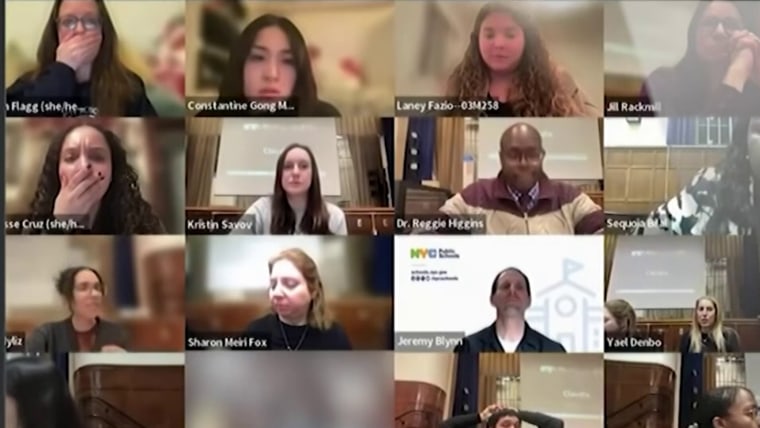
Parents and council members gathered in a nearly empty high school cafeteria this week, reconvening for the first time since a college professor’s remarks about Black students disrupted a New York City school meeting and shook the community.
Roughly two dozen people met in the basement of Joan of Arc Junior High School in the city’s Upper West Side neighborhood on Thursday night while another 150 logged in on Zoom. The mood was tense and subdued. At the front of the room, two Black students held handmade signs reading, “Student dignity. Accountability is not optional.”
By the end of the two-hour emergency meeting, Community Education Council District 3 members voted unanimously to condemn the remarks that had drawn national outrage and to call for clearer video conference protocols, anti-bias training for parents and stronger guardrails to prevent future disruptions.
“The anti-Black words spoken by an adult have been heard ‘round the world,” council co-President Jill Rackmill said, opening the meeting by reading the eighth grader’s speech that had been interrupted weeks earlier. “But the words of the student who courageously came to what should have been a safe and affirming space have not been. They have been drowned out. Adults failed her.”
The emergency gathering was the latest fallout from a Feb. 10 council meeting in which Allyson Friedman, a tenured associate professor at Hunter College, was heard over Zoom saying of Black students, “They’re too dumb to know they’re in a bad school,” as a Black eighth grader pleaded to save her middle school from possible closure.
A recording of the moment quickly spread online, pushing a contentious debate over local school closures and equity into the national spotlight. New York City Major Zohran Mamdani condemned the remarks as “racist,” and just hours before Thursday’s meeting, Hunter College placed Friedman on leave pending an investigation.
“On the Upper West Side, they far sooner would smile at your face and do anti-Black things as opposed to say anti-Black things,” public school parent and CEC District 3 council member Noah Odabashian said. “And so I was a little shocked that they would say the quiet part out loud.”
Friedman has not responded to NBC News’ multiple requests for comment. In a statement to The New York Times, Friedman said she made the remarks to teach her child about racism.
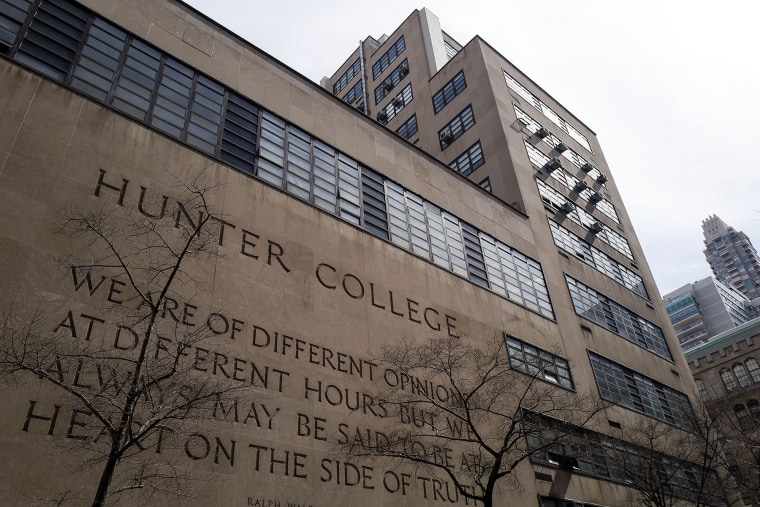
For months, school officials have floated proposals to relocate or close at least four middle schools on the Upper West Side, citing low enrollment, funding squeezes, academic performance and compliance with a 2022 law requiring class-size reductions by 2028.
Proposals to close or merge schools in New York City frequently spark backlash because they affect funding, enrollment and neighborhood influence and can deepen long-standing racial and economic divides.
It is unclear whether and when the proposals in the Upper West Side will be carried out.
“At this time, no formal proposals have been finalized or circulated,” Dominique Ellison, a spokesperson for the New York City Department of Education, said in a statement.
The proposals have divided the Upper West Side community, with some parents and students arguing that the changes would be disruptive and spoil thriving communities that each school has built.
Elizabeth Sofro, a parent in the district who attended the meeting, said the proposals made people feel like they were “being pushed to the wall with what they can handle,” arguing that the closures were introduced with little time for the families to absorb the implications.
“So, stuff comes out. People’s true colors come out, whether it’s good or bad,” she said.
Rita Joseph, a Black member of the City Council who chairs the committee on higher education, told The New York Times that discussion of school closures and relocations is also racial. Twenty-seven percent of the district’s students in grades six through eight are Black, according to data from the city’s Department of Education. Across the city, the data says, 23% percent of middle schoolers are Black.
“We cannot talk about school closures, equity or educational opportunity without confronting the culture and systems that devalue Black students and communities,” Joseph told the outlet.
The Feb. 10 community meeting was meant to be a public forum for families to comment on the proposals. Several times throughout the meeting, District 3 interim acting Superintendent Reginald Higgins invoked Carter G. Woodson in recognition of Black History Month.

