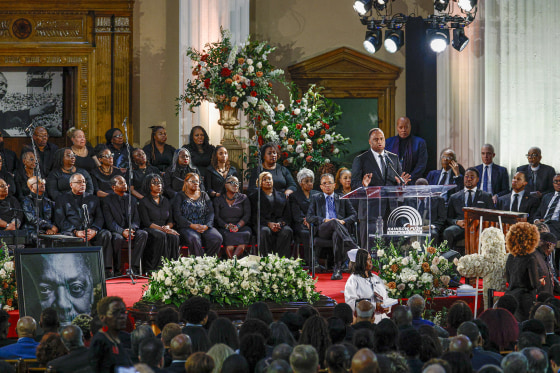
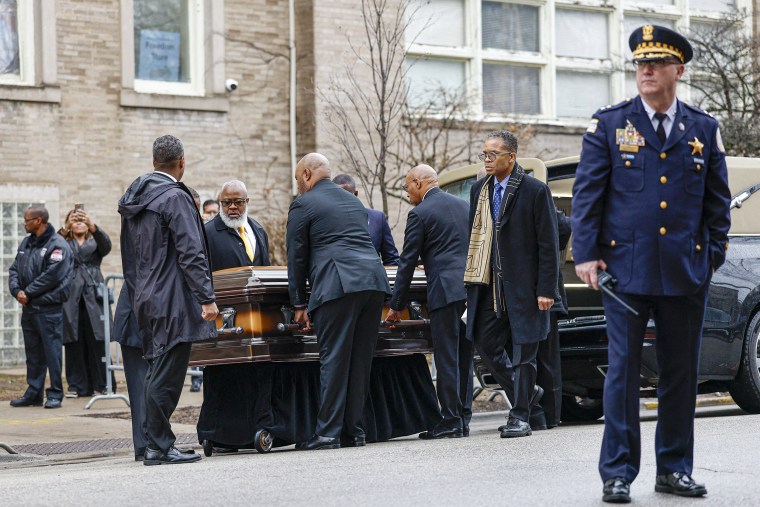
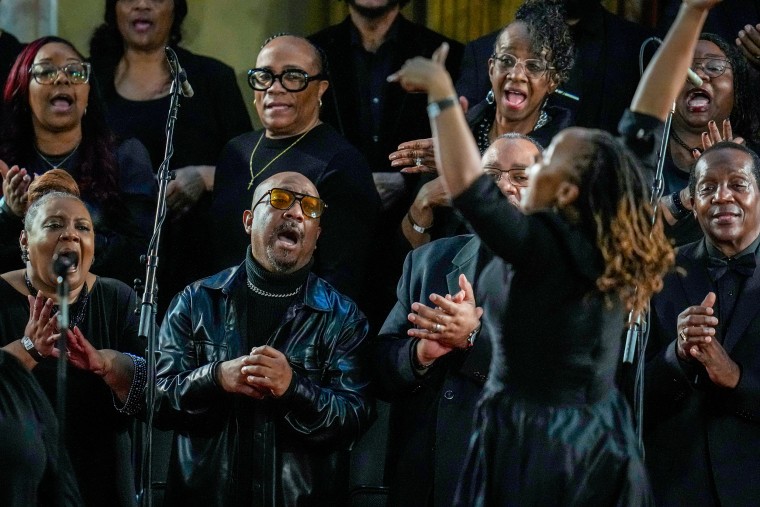
CHICAGO — A day after former presidents, sitting governors and local Chicago residents alike attended a vibrant, televised celebration for the late Rev. Jesse Jackson Sr., the family and friends who knew him best hosted a more intimate gathering Saturday to grieve the civil rights leader at his organization's headquarters.
The private memorial service at the Rainbow PUSH Coalition's headquarters on the South Side of Chicago includes only a few hundred attendees, most of whom are family members, allies and confidants. The homegoing is meant as a capstone to a week of services held across the country.
"I foresee tomorrow will represent everything that Rev. Jackson stood for," the Rev. Chauncey D. Brown, a pastor to a Chicago-area church and mentee of Jackson's, said Friday.. "It will include dignitaries and icons, as well as many from where the true power lies, with the people in the streets."
Some members of the public who gathered outside the PUSH headquarters were allowed to enter the chamber.
"Over the last two weeks, we've been focusing on connecting to people that Reverend worked with across the years," said Rev. Janette Wilson, a longtime senior advisor to Jackson and executive director at Rainbow PUSH Coalition. "When you look at his work, it is so vast in the economic and political arenas."
Since his death last month, Jackson's family and allies have honored the late reverend with commemorations, community service and demonstrations they say continue his work.
Mourners were first allowed public visitations at the Rainbow PUSH headquarters in February, giving Jackson's longtime neighbors a chance to say goodbye to the civil rights leader.
The late reverend then lay in state at the South Carolina Capitol. Jackson grew up in segregated Greenville, South Carolina. As a high schooler, he led fellow students into a protest that desegregated a local library, starting a lifetime of civil rights activism.
Services honoring Jackson in Washington, D.C., were postponed after a request for him to lie in honor at the U.S. Capitol was denied. House Republican leadership cited the precedent that only former presidents and senior generals regularly receive the privilege.
Jackson's mentees also honored his legacy by organizing on issues such as voting rights, economic inequality and political organizing in the weeks after his passing. Rainbow PUSH hosted a forum for community organizers and clergy whom Jackson mentored to discuss his impact on their careers.
Wilson said that the best way to honor Jackson is to continue advocating for progressive, inclusive solutions to the pressing economic and political challenges of the day. She cited policies that addressed the impending socioeconomic effects of artificial intelligence, improved public schools and a focus on youth mental health as areas he was contemplative on at the end of his life.
She also said that Jackson never shied away from being political.
"We're in a global moment where peace in the world is in jeopardy, where we just have bombs being dropped carelessly, killing children, innocent victims of political actions," said Wilson of the ongoing war in the Middle East. "When the government cuts SNAP benefits and you have millions of children and families who will be food insecure, I think you have to tell them that we're fighting for you."
On Thursday, the headquarters also hosted a series of events that celebrated Jackson's life ahead of the public celebration. Hundreds of members of Omega Psi Phi Fraternity gathered at the headquarters to honor Jackson.
Jackson's life "is a dream fulfilled," said Michael Barksdale Jr., one of the fraternity brothers who honored Jackson. A Chicago public school counselor who first met Jackson as a high school freshman, Barksdale said the PUSH Coalition awarded him a college scholarship after he worked as one of the group's local youth organizers.
"It is up to my generation now to continue that legacy of Jackson and all the civil rights dignitaries who came before," said Barksdale, 37. "They did all of the heavy lifting, and we are going to continue to build."
That same night, the chamber hosted a reunion for Rainbow PUSH alumni to commemorate the late reverend and his years of activism. The group included state and local lawmakers, academics, longtime organizers and former diplomats.
Carol Moseley Braun, the first Black woman ever elected to the U.S. Senate, paid her respects alongside longtime veterans of the organization who supported Jackson throughout his life. Braun, who served as a volunteer on Jackson's 1988 presidential campaign, was supported by Jackson in her successful 1992 election.

