https://media-cldnry.s-nbcnews.com/image/upload/rockcms/2026-02/260206-Yerson-Paul-Herrera-Vargas-maria-ew-1222p-68f82f.jpg
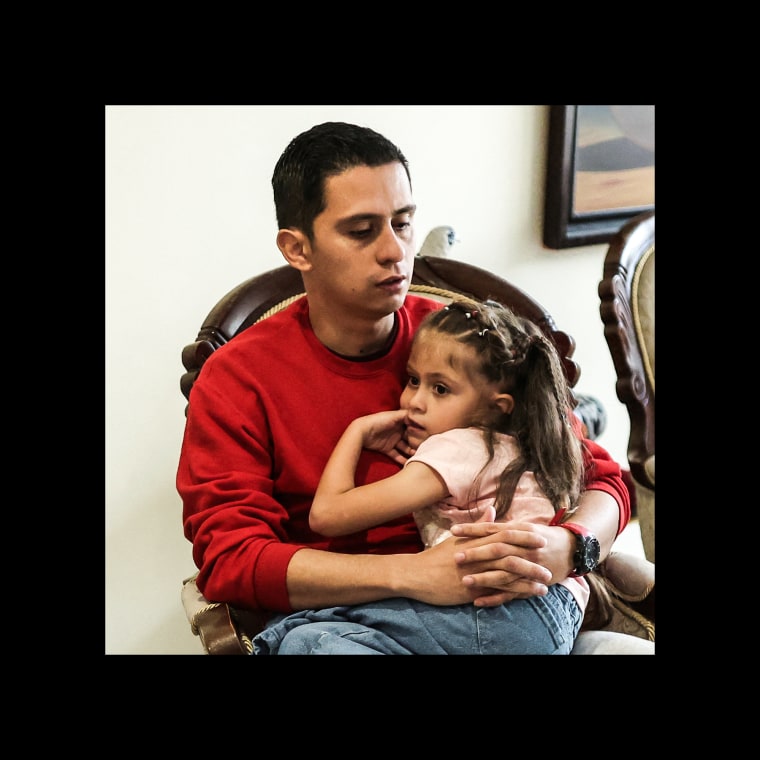
Yerson Vargas and his wife, Kelly, say their their 6-year-old daughter, Maria, languished at the Dilley Immigration Processing Center. Luisa Gonzalez / Reuters file

Children trapped in Texas immigration facility recount nightmares, inedible food, no school

A photo of Liam Conejo Ramos, a scared 5-year-old, drew attention to a detention center in Dilley, Texas. Advocates say his experience reflects what hundreds of children have endured out of public view.

Listen to this article with a free account

Before she arrived at the Dilley Immigration Processing Center last fall, Kelly Vargas said, her 6-year-old daughter was thriving. Maria loved school and spent her afternoons drawing and playing with her cat.

But Vargas said that within days of the family’s being detained and sent to the prisonlike facility in South Texas — where guards patrol the halls and the lights never turn off — her daughter began to unravel.

After years without accidents, Maria started wetting her pants and her bed. She cried through the night, asking when she and her parents would return to their apartment in New York. She begged to start breastfeeding again.

Vargas, who was deported to Colombia with her family in November after having spent nearly two months at Dilley, said she never imagined the United States could act so callously.

“How are they going to do this to a child?” Vargas told NBC News, speaking in Spanish. “How could this happen here?”

Accounts from detained families, their lawyers and court filings describe the federal detention center in Dilley as a place where hundreds of children languish as they’re served contaminated food, receive little education and struggle to obtain basic medical care.

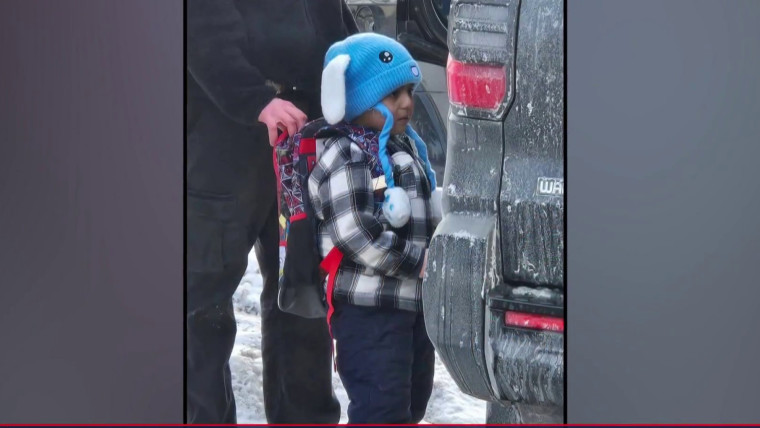
The center was thrust into the national spotlight last month after Immigration and Customs Enforcement took Liam Conejo Ramos, a 5-year-old boy, to the facility following his father’s arrest in Minneapolis — an encounter captured in a photograph showing the boy in a blue bunny hat as he was taken into federal custody.

The image ricocheted across the country, igniting outrage from lawmakers and the public. To many Americans, it was a sudden introduction to the harsh realities of ICE’s increasing reliance on family detention. But to Vargas and the lawyers who have spent months tracking conditions at Dilley, Liam’s fearful expression — and his father’s account of the child falling ill while detained — captured something painfully familiar.

appeared to show him being escorted by an ICE agent into a vehicle.
The photo of Liam Conejo Ramos being escorted into a vehicle by a federal immigration agent sparked national outrage.Courtesy Columbia Heights Public Schools

“Liam is all the kids there,” said Becky Wolozin, a senior attorney at the National Center for Youth Law, which monitors conditions at the facility under a long-standing federal court settlement. “Just like Liam, we’ve had families tell us how their children have been horribly sick and throwing up repeatedly, refusing to eat and becoming despondent and listless.”

Those concerns have taken on new urgency in recent days after health officials confirmed two measles cases among people detained at Dilley. Advocates and medical experts warn that a highly contagious disease spreading inside a crowded facility housing young children — some already medically vulnerable — poses an acute public-health risk.

Lawyers representing families at Dilley say they have struggled to get clear answers from the Department of Homeland Security about the outbreak, including any steps being taken to limit its spread or verify whether children are vaccinated.

DHS didn’t answer questions from NBC News about conditions at Dilley. It has defended its use of family detention, saying in statements and legal filings that detainees are provided basic necessities and that officials work to ensure children and adults are safe.

Ryan Gustin, a spokesperson for CoreCivic, which has a contract to run the facility that’s expected to bring in $180 million annually, referred questions about Dilley to DHS and said in a statement that “the health and safety of those entrusted to our care” is the company’s top priority.
Since April, when the federal government resumed large-scale family detention as part of the Trump administration’s vow to dramatically escalate immigration arrests and deportations, an estimated 1,800 children had passed through Dilley as of December, according to figures provided by court-appointed monitors. About 345 children were being held there with parents that month, Wolozin said. Some families remain for a few weeks; others have been detained for more than six months.

Family detention was common during the Obama administration, and it expanded in President Donald Trump’s first term, before being largely halted under President Joe Biden. Unlike earlier iterations of family detention, many of the children now held at Dilley are U.S. residents, apprehended not at the border but at their homes, outside schools, in courthouses and during routine immigration check-ins.
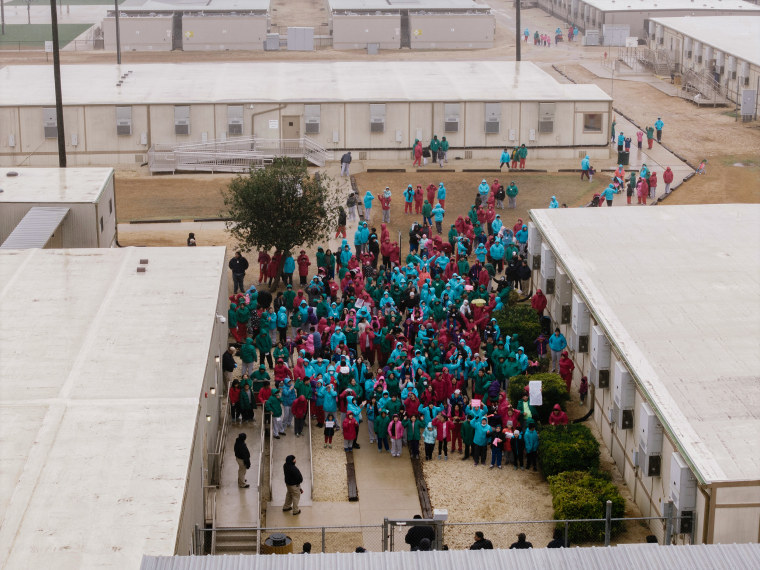
A dense crowd of hundreds of people wearing raincoats and hoods is seen from an aerial perspective. Many of them are holding signs.
Detainees at the Dilley Immigration Processing Center wave signs during a demonstration in January.Brenda Bazán / AP

The Trump administration has argued the practice allows parents and children to remain together while removal proceedings are pending. But advocates and human rights groups say detaining children is harmful and never warranted, noting that families with pending immigration cases have historically been allowed to remain together outside detention, including through the use of ankle monitors.

The overwhelming majority of parents detained with children are sent to Dilley, a sprawling complex set amid scrubland an hour south of San Antonio, far from the communities where the families had been living.

As immigration lawyers began sounding the alarm about conditions at the facility, the Trump administration filed a motion last spring to overturn a decades-old legal settlement requiring basic rights for immigrant children in federal custody — safeguards that advocates say DHS is already violating. The protections, known as the Flores Settlement Agreement, trace back to a 1985 class-action lawsuit against the federal government alleging that immigrant children were being held in unsafe conditions.

Interviews with immigration lawyers, Liam’s father and the Vargas family and dozens of sworn declarations from detained families filed as part of the recent Flores litigation describe a facility that functions far more like a prison than a child care center: constant surveillance, rigid schedules, overnight bed checks. Parents report that many children stop eating, lose weight and become withdrawn.

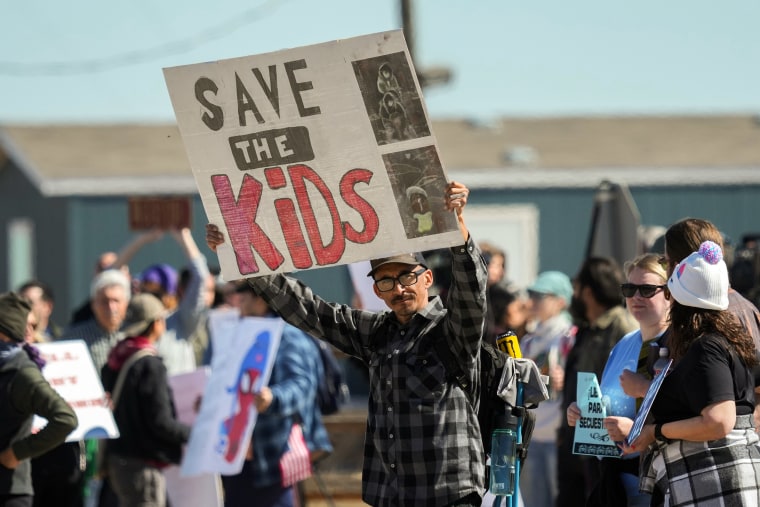
A man holding a sign reading SAVE THE KIDS stands among a crowd of fellow protesters.
Demonstrators protest outside the Dilley Immigration Processing Center in January following Liam Conejo Ramos' detention.Eric Gay / AP file

Families describe sleeping in crowded, dorm-style rooms with little privacy and filthy shared bathrooms. Outdoor areas are largely concrete and tightly supervised, parents say, and there are few toys or activities to occupy children indoors.

“It is a prison where we are keeping children as young as 1 year old,” said Elora Mukherjee, a professor at Columbia Law School and director of its Immigrants’ Rights Clinic, who has represented several detained families. “We’re keeping children there who are currently breastfeeding. It’s unconscionable.”

Food is a recurring source of distress. Court filings describe meals that are greasy, heavily seasoned or inappropriate for preschoolers and infants. Several parents said they found worms or mold. Some children survive largely on crackers and juice. One mother said she resorted to sucking pasta sauce off noodles for her child, hoping he would eat.

“My younger son does not eat the food here, he is hungry all the time,” another mother wrote in a sworn declaration submitted to federal court. “He will only accept breastmilk and it is not enough for him. He is growing. He is two and a half, and he needs to eat.”

Parents of children too young to grasp what was happening said they struggled to keep up a facade of normality. Adrián Alexander Conejo Arias, Liam’s father, told Noticias Telemundo he passed the time by retelling stories from episodes of “Bluey,” the popular children’s show about a family of blue heeler dogs, and recounting happy memories. He could do little else “except hug him and tell him everything would be OK,” Conejo said.

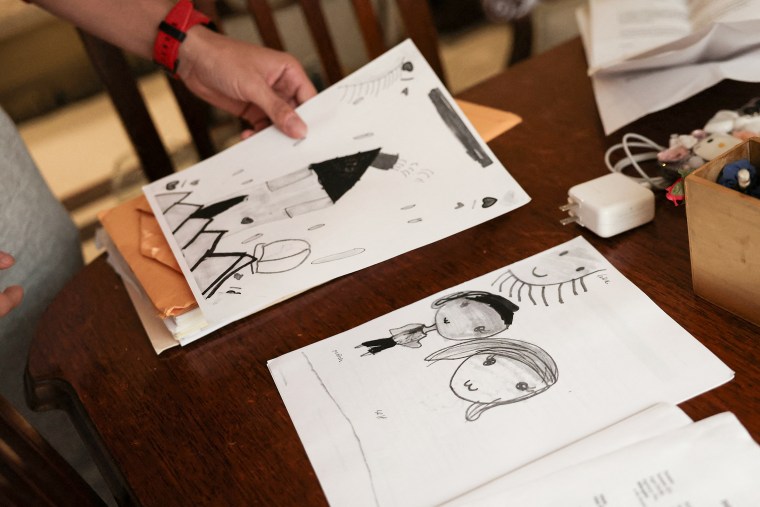
A hand holds a child's drawing on a sheet of white paper. Another drawing lies beside it on a table.
Yerson Vargas shows drawings made by his 6-year-old daughter, Maria, during their detention at Dilley.Luisa Gonzalez / Reuters file

Education is an afterthought at Dilley, parents and lawyers say. Children get no more than an hour of daily instruction, and overcrowding means some are turned away. The work consists largely of worksheets and coloring pages, parents say. Older children say they’re bored, falling behind and missing their teachers and classmates.

“Inside the classroom, there are two women laughing in English and watching YouTube,” a 14-year-old detainee wrote in a sworn declaration. “I was in 9th grade before I came here. If I had to go back to my country now, I’d have to repeat the grade because of all the school I’ve lost.”

Medical care also is often cursory, families report, even when children show signs of serious illness or injury. In several cases described in court declarations, children — including some with developmental delays or chronic conditions — regressed while they were detained, losing language skills, wetting themselves or engaging in self-harm. Some parents said their complaints were dismissed until their children’s conditions worsened significantly.

Eric Lee, an immigration attorney who has represented families at Dilley, described a child suffering from appendicitis who collapsed in pain after having been denied meaningful medical attention. The child passed out in a hallway vomiting and writhing, Lee said, only to be offered Tylenol.

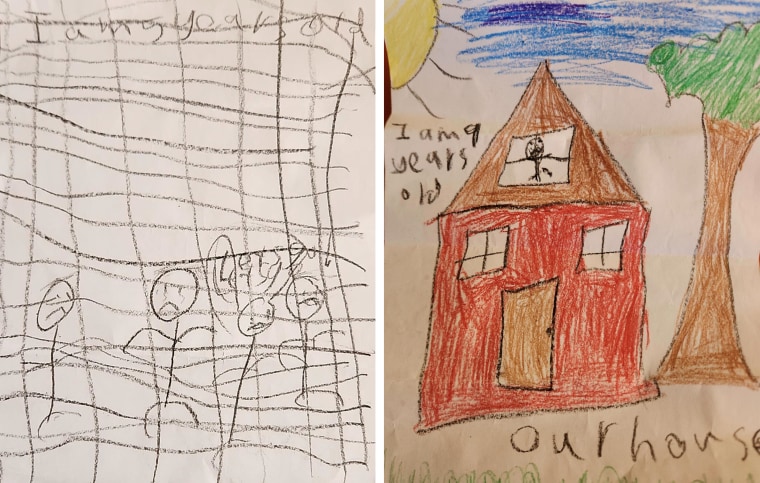
Two children's drawings are displayed in a diptych image.
A 5-year-old girl held at Dilley drew a picture of stick figures behind bars saying, "Let us go." Her older sibling drew a picture of their home. via Eric Lee, Lee & Goshall-Bennett, LLP

The psychological toll can be just as severe. During a recent visit, Lee said, a 5-year-old girl described a recurring nightmare: A large animal chases her, but she can’t outrun it because she’s trapped in a cage.

She and her siblings “wake up crying for their mom every night because they’re worried they’re going to get separated from her,” Lee said.

Lawyers representing detainees argue that prolonged confinement in harsh conditions — coupled with repeated warnings about family separation — is meant to coerce parents into abandoning pending asylum claims that could allow them to remain in the U.S.

DHS tells detained families, “Well, if you want this to stop, agree to give up your case,” said Javier Hidalgo, legal director for RAICES, which provides legal support for immigrant families in Texas, including at Dilley. “We’ve heard that time and time again.”

Kelly Vargas said she and her husband felt that pressure from the moment they arrived at Dilley with their daughter, Maria.

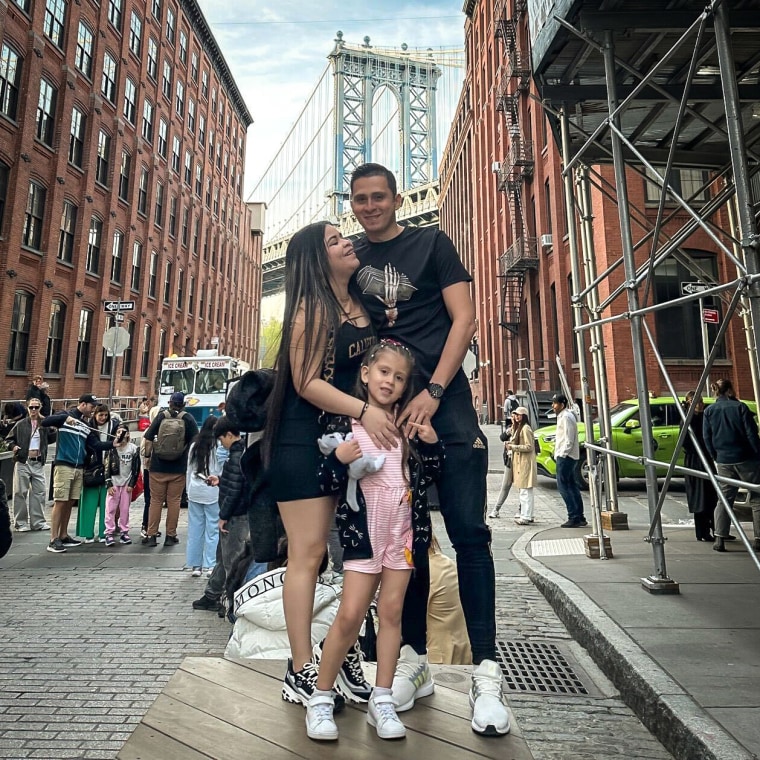
Kelly Vargas with her husband Yerson Herrera and daughter Maria.
Kelly Vargas and her husband, Yerson, say their daughter was thriving while living in New York.Kelly Vargas

The family came to the U.S. in 2022 after having fled Colombia and settled in New York, where they checked in regularly with immigration officials. They had applied for special visas for human trafficking victims, saying they were subjected to forced labor and death threats while they were traveling through Mexico.

After they were arrested during a September check-in and sent to Dilley, Vargas said, officers repeatedly pressured her and her husband to drop their visa applications.

“He told us that if we didn’t deport ourselves, they were going to take our daughter from us,” she said. “Our daughter would be left in the custody of the state, where not even our lawyers would know where she was.”

At first, Vargas said, she and her husband resisted, determined to fight for the life they had built in New York, where he worked in construction during the day and she worked as a waitress and cleaner overnight. They initially told Maria they were on vacation in Texas, but the girl knew better. She would drop to her knees and beg to go home to see her cat, Milo. At times, Vargas said, she screamed so intensely that even staff members appeared shaken.

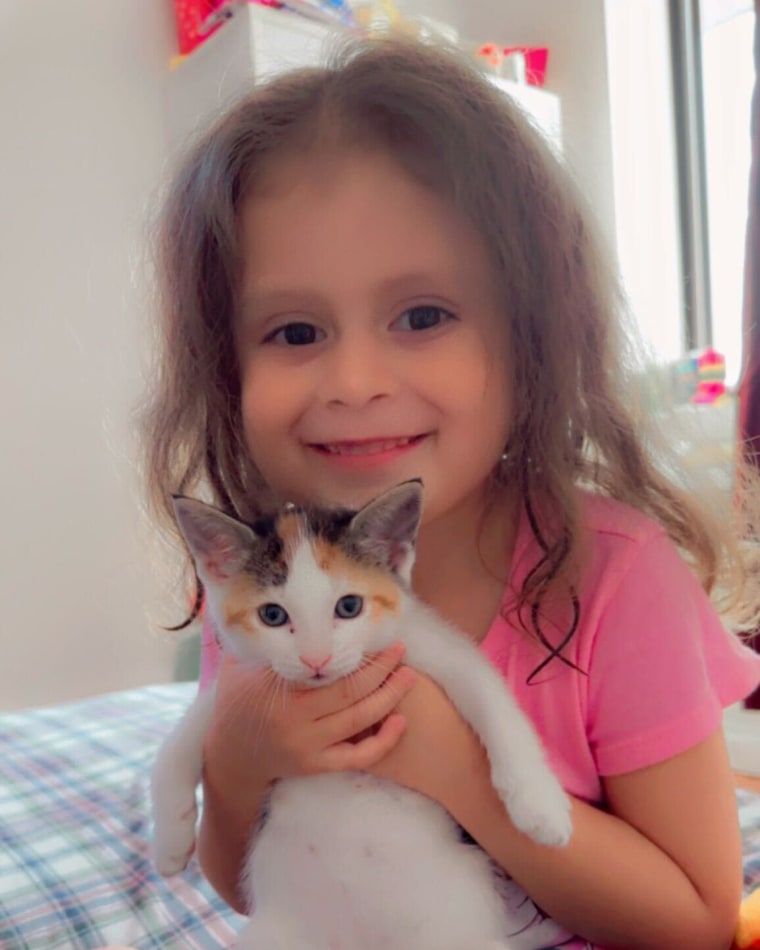
Maria and Milo
At Dilley, Maria begged to be reunited with her cat, Milo.Kelly Vargas

“Get me out of here,” she would cry. “I want to leave.”

Maria’s health quickly declined, Vargas said. She developed a persistent cough and struggled to eat, losing weight as the days passed. Then, Vargas said, a staff member who was cleaning accidentally struck her daughter in the eye with a mop, drawing blood.

Despite her daughter’s continued complaints of blurred vision, sensitivity to light and hearing problems, Vargas said, doctors dismissed her concerns and delayed further evaluation.

With her daughter ailing, Vargas said, she and her husband finally agreed to leave.

They were deported to Colombia in November.

Healing from the ordeal has taken longer, Vargas said. Maria still has vision problems and headaches. The sweet girl who loved her teacher and played with Barbies is now fearful and withdrawn, talking often about her weeks in Texas and the workers who watched over her.

Whenever she sees a police officer, she tenses.

“It’s the bad men,” she says.