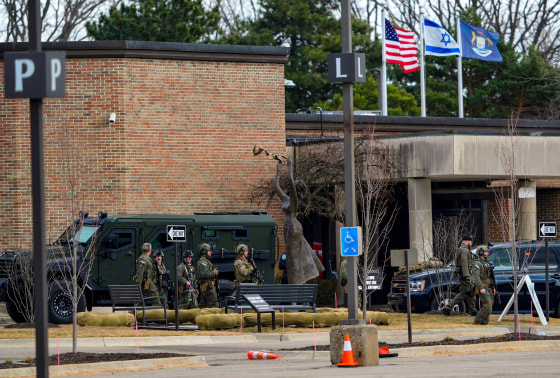
Jewish leaders said they knew an attack like the one that unfolded Thursday at Temple Israel was possible, which is why they were prepared and why the car-ramming and fire wasn't deadly for the dozens of children and staff inside the Michigan synagogue.
Quick action from security guards, safety protocols, drills and training likely all played a role in limiting the devastation caused by an armed driver who plowed into the Detroit-area temple with his explosives-laden pickup.
“We’re angry, we’re sad. I wish I could say we were surprised, but this is the kind of stuff that’s happening in our world right now," said Steven Ingber, a member of the congregation and CEO of the Jewish Federation of Detroit.
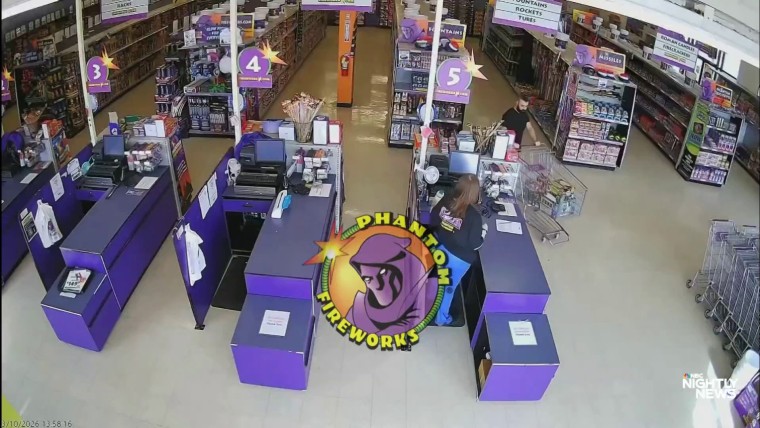
The FBI has called the attack “a targeted act of violence against the Jewish community."
As the investigation continued Friday into the attack carried out by Ayman Mohamad Ghazali, Jewish leaders surveyed the damage to the shuttered temple in West Bloomfield Township, Michigan, and re-examined the security measures and networks they say they've had to take to combat a growing threat of targeted violence.
Multiple security officers — and more than 100 preschoolers —were at the synagogue when Ghazali, 41, plowed into the building with his truck. The temple’s security director was hit by the pickup and knocked unconscious, according to Gary Torgow, chairman of the Jewish Federations of North America, and Oakland County Sheriff Mike Bouchard.
Engaged in a gunfight
The Ford F-150 Ghazali was driving got jammed between hallway walls, said Jennifer Runyan, special agent in charge of the FBI Detroit field office. That’s when Ghazali began firing through the windshield, and a security officer engaged him in a gunfight.
Ghazali was “unable to extract himself due to the vehicle being jammed,” Runyan said. A second security officer exchanged gunfire with Ghazali, and the truck’s engine compartment caught on fire. “At some point during the gunfight, Ghazali suffered a self-inflicted gunshot wound to the head,” the FBI agent said.
That was the only fatality from Thursday's attack, which is a credit to the security personnel who Torgow said “helped ensure that the outcome yesterday was very different from what might otherwise have been.”
“No preschool children were injured, no staff members were harmed. The only injury was the heroic security guard,” Torgow said during a virtual law enforcement briefing Friday afternoon.
Teachers, staff and security personnel seamlessly executed evacuation protocols that led all the children, all under the age of 5, to safety, the sheriff said Friday.
Temple Israel’s injured security director was taken to the hospital for treatment and is expected to continue recovering at home, Ingber said.
That director had been working to increase security personnel and provide preparedness training since September.
Staff at Temple Israel had participated in a “run, hide, fight” drill just a couple of weeks ago, Ingber said.
'An FBI for the Jewish community'
According to Torgow, the Jewish Federations of North America spends more than $750 million every year on security efforts to protect their communities. A key partner helping them establish security protocols across the nation is the Secure Community Network, a nonprofit that says it serves as the official safety and security organization for Jewish communities in North America.
“We’ve created SCN as an FBI for the Jewish community,” said Michael Masters, chief executive officer of nonprofit.
Masters said Temple Israel had a clear, multi-layered security plan, including bollards and access control, and a security team that was capable of “identifying, deterring and mitigating or neutralizing a threat.”
He commended the officers who engaged with the suspect and put themselves between the threat and the people they were trying to protect. “That is a trained response,” Masters added.


