WASHINGTON — Twelve Russian intelligence officers have been indicted in connection with the bitcoin-funded hacking of Democratic organizations and the Hillary Clinton campaign "with the intent to interfere" in the 2016 election, officials announced Friday.
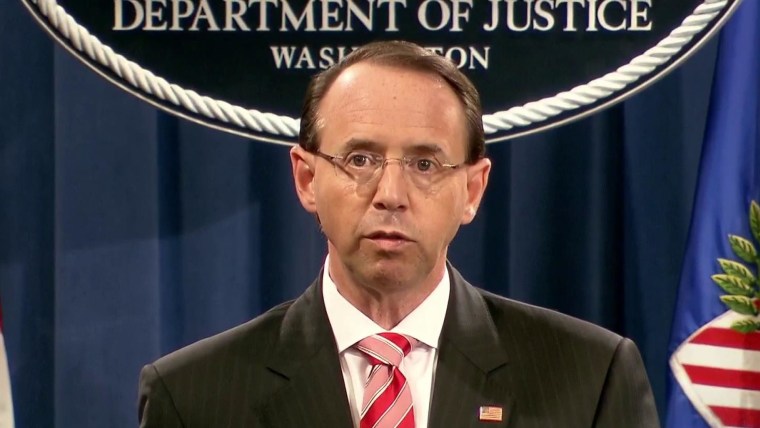
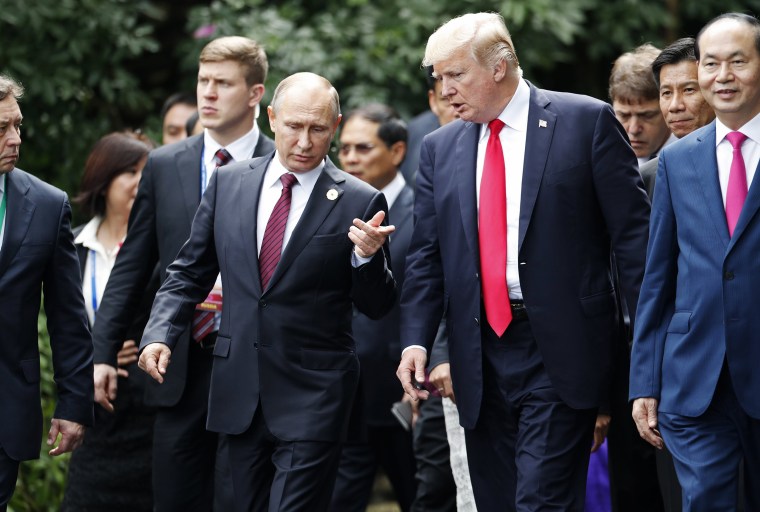
The charges, brought by special counsel Robert Mueller and announced by Deputy Attorney General Rod Rosenstein, come at a diplomatically sensitive time — just days before President Donald Trump meets formally for the first time with Russian President Vladimir Putin in Helsinki.
Among the new details: the conspirators allegedly first tried to compromise email accounts used by Clinton's personal office on July 27, 2016, the same day that Trump appeared to urge Russia to go after her emails at a campaign press conference in Florida.
Prosecutors say that in August 2016, a U.S. congressional candidate requested and received from stolen documents related to an opponent from an online persona created by the Russian cabal. And a state lobbyist received stolen data on Democratic donors later that month, the indictment alleges.
Rosenstein, who laid out the allegations at a news conference that began while Trump was meeting with Queen Elizabeth in London, said he had briefed Trump earlier in the week and that the president was "fully aware" of the charges in the indictment.
A statement from the White House did not address the allegations of Russian government interference and focused only on what was not in the indictment.
"Today’s charges include no allegations of knowing involvement by anyone on the campaign and no allegations that the alleged hacking affected the election result. This is consistent with what we have been saying all along," the statement said.
The broad strokes of the hacking operation had already been made public, but the indictment provided new details and named names.
The court papers say that the defendants — two of whom were also charged with orchestrating attacks on state election systems — disseminated emails stolen from the Democrats through two online personas that they created, Guccifer 2.0 and DC Leaks.
William Bastone of the Smoking Gun website tweeted later Friday that he was the "U.S. reporter" referred to in the indictment who had received from Guccifer 2.0 the "password access to a nonpublic, password-protected website" that contained emails that had been stolen from "Victim 1."
The defendants used spear-phishing techniques to steal user names, passwords and emails and paid for the operation with bitcoin and other cryptocurrencies, the indictment alleges.
Related

"The goal of the conspiracy was to have an impact on the election," Rosenstein said, adding that the indictment does not allege the Russian conduct changed the vote count or outcome of the 2016 election that put Trump in the White House.
Mueller, who has been investigating Russian interference in the 2016 election and possible collusion by the Trump campaign for more than a year, says the 12 defendants in Friday's indictment are members of the GRU, Russia’s military intelligence agency.
Beginning in March 2016, they allegedly used fake identities and bogus accounts to trick volunteers and employees of Clinton’s 2016 campaign and gain access to usernames and passwords that they used to steal emails and hack into other computers.
They allegedly also hacked into the networks of the Democratic Congressional Campaign Committee and the Democratic National Committee.
The goal of the conspiracy was to have an impact on the election.
The indictment says that in August and September 2016, Russians posing as Guccifer 2.0 were in contact with a person who communicated with senior Trump campaign officials, flagging emails posted and offering assistance.
"Please tell me if i can help u anyhow...it would be great pleasure to me," Guccifer 2.0 wrote, according to the indictment. The description matches a contact that longtime Trump associate Roger Stone has previously said he had with Guccifer.