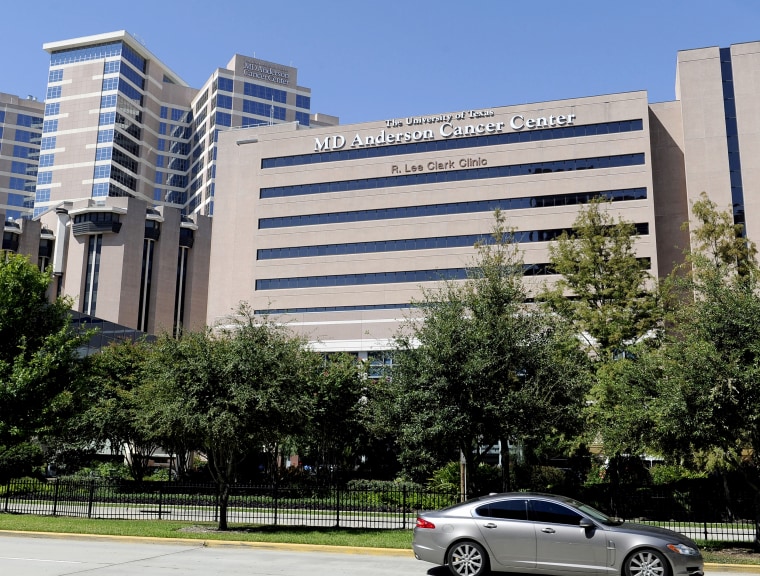
HOUSTON — In early December, a nurse at the University of Texas MD Anderson Cancer Center gave a 23-year-old leukemia patient a blood transfusion that, unbeknownst to the medical staff, had become contaminated with bacteria.
The patient’s blood pressure soon plummeted, but there’s no evidence anyone at the nation’s top-ranked cancer hospital was actively monitoring her vital signs in the crucial moments during and after the procedure, a federal investigation found. She died a little more than a day later.
The potentially preventable death drew a harsh rebuke from the Centers for Medicare and Medicaid Services, whose subsequent investigation, made public Monday, uncovered systemic safety lapses at the hospital. Nurses were not properly monitoring patients’ vital signs while administering blood transfusions, not only in the case of the patient who died, but also in 18 out of 33 other cases examined, the investigation found.
Since receiving the federal report this month, the hospital’s leaders have made changes to improve training for nurses and require hourly checks on patients during transfusions.
“We are unwavering in our commitment to our patients, not only in their battle against cancer, but to provide the safest, highest quality environment to receive their care," Rosanna Morris, the hospital’s chief operating officer, said in an interview Tuesday. "This event only helps to make us even better.”
But the death raised a question that has confounded patient safety advocates: Given all the advancements in technology and safety protocols over the past three decades, how can such errors still happen at even the most prestigious hospitals?
Fatal blood transfusions are so rare and so preventable that they are counted among a class of medical mistakes that experts say should never happen. Included on the list of so-called never events: Leaving medical equipment inside a patient after surgery. Operating on the wrong patient or on the wrong body part. Giving patients contaminated drugs.
Such egregious errors can seem shocking to the general public, said Dr. Peter Pronovost, a leading hospital safety expert and the chief clinical transformation officer at University Hospitals in Cleveland.
“What do you mean I can get a contaminated transfusion? What do you mean you operated on the wrong part of the body or on the wrong person?” Pronovost said. “The reality, unfortunately, is these things still do occur, and it means we have to put better systems in place.”
Blood transfusions are considered a poster child for how hospitals can improve outcomes and prevent errors, Pronovost said. Every day across the country, tens of thousands of people receive donated platelets, plasma or red blood cells to combat disease or replace blood lost during surgery. In the vast majority of cases, the procedure is lifesaving.
“It’s risky,” Pronovost said, “yet also incredibly safe.”
Of 17 million blood transfusions in 2017, 37 patients died as a direct result, according to the Food and Drug Administration. Most died of allergic reactions or other complications, but in five cases the patients received platelets contaminated with bacteria, and in seven cases patients were given the wrong blood type.
Related

Transfusion deaths have become rarer over the past two decades with the advent of bar-coding technology, which ensures patients always receive the right type of blood, and with the implementation of strict protocols to catch adverse reactions before patients become gravely ill.
But those safeguards only work if hospitals make them a priority, said Erica Mobley, director of operations at the Leapfrog Group, which grades hospitals based on safety. She said too many hospitals still fail to do so, prioritizing volume over quality and leaving patients vulnerable.
“In many cases, when these horrible mistakes occur in hospitals, it’s a system error,” Mobley said. “Humans are inevitably going to make errors, but there should be systems in place to prevent those mistakes from leading to harm.”
Experts say it’s important to track a patient’s temperature, blood pressure and pulse during a transfusion, which allows the medical staff to identify adverse reactions early and, in most cases, stop the procedure before a patient is seriously harmed. That failed to happen in the MD Anderson case.
News of the death shocked some hospital safety experts, given MD Anderson’s reputation as one of the nation’s best cancer centers. The hospital draws patients from across the world every year to its gleaming facilities in Houston. The death came two months after one of the hospital’s top researchers was awarded the Nobel Prize in Medicine for his work in developing a revolutionary treatment that harnesses the immune system to attack cancer cells.
“These deficiencies have been determined to be of such a serious nature as to substantially limit your hospital’s capacity to render adequate care,” the Centers for Medicare and Medicaid Services wrote in a June 3 letter to Dr. Peter Pisters, MD Anderson’s president.