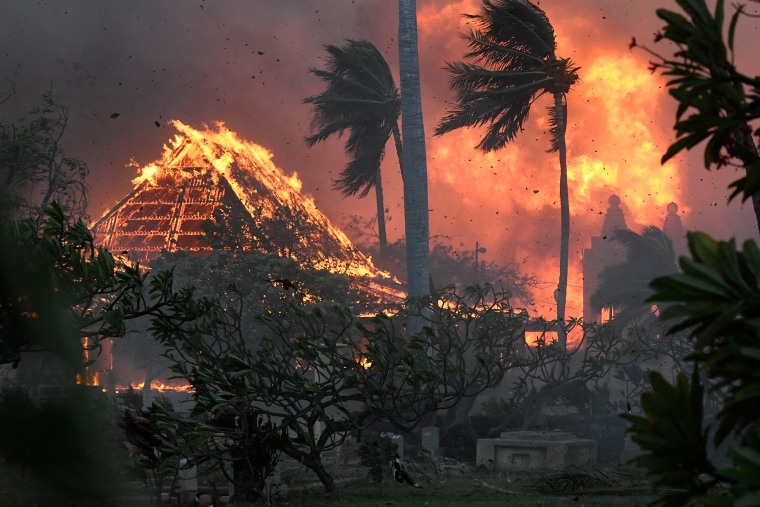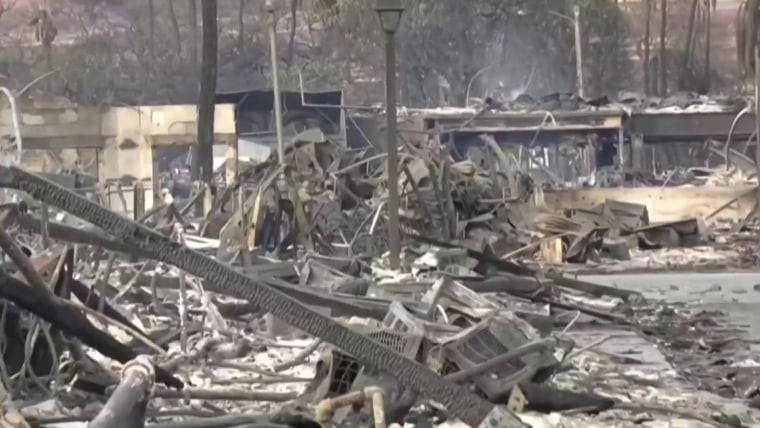
On the day wildfires destroyed much of Lahaina and killed at least 101 people, poor communications between Maui’s mayor and top state and local emergency officials stymied their realization of how serious the situation was.
At one point, Maui’s top emergency management official rejected an offer of additional help from Honolulu. And evidence since gathered indicates the catastrophic fire that exploded on the afternoon of Aug. 8 ignited in the same area where a downed powerline had sparked an earlier blaze that the county had quickly declared was "100 percent contained."
Such details are among the latest to emerge about Maui's deadly wildfires through a comprehensive timeline released Wednesday as part of an ongoing investigation commissioned by Hawaii Attorney General Anne Lopez.
The minute-by-minute timeline — the first installment of what’s planned as a three-part probe — was described by investigators as the fact-gathering phase into how preparations and responses unfolded over a 72 hour-span.
The 376-page narrative report, based on interviews, emergency dispatch communications, weather data and other records, is meant to provide the public with an unvarnished look into how events unfolded without drawing conclusions, Lopez and investigators with the nonprofit Fire Safety Research Institute said in a news conference Wednesday.
Critical analysis and recommendations for improvement will come in future installments to be released later this year, they said.
“Let me be clear: we are not here to place blame or draw conclusions,” Lopez said. “The purpose of this independent analysis is to find facts and develop new policies and procedures to save lives and property in the future.”
The tick-tock of events provided in the report aimed to give more factual insight into what key emergency agencies, officials and others did to prepare, warn and respond to critical fire conditions from Aug. 7 to Aug. 9 in the hours before and after the disaster.
Much of what was released Wednesday repeated what was said in other official after-action reports, news accounts and social media posts.
The official cause of the fire remains under investigation and is being handled separately by the federal Bureau of Alcohol, Tobacco, Firearms and Explosives.
The Aug. 8 fire — the deadliest in the U.S. in the last century — killed at least 101 people. It also burned 6,271 acres, destroyed 2,173 homes, businesses and other structures and caused more than $6 billion in damage to Lahaina.
Maui resident and community activist Tiare Lawrence said she was disappointed in the report.
“We were hoping that we would get more information in terms of the actual cause that led up to the fire,” Lawrence said Wednesday. “I think, you know, if you’re from Lahaina and from Hawaii, we pretty much know what the cause was. And we’ve always known the issues for years.
“We’ve been asking the county for well over a decade to fix a lot of the problems that led up to this catastrophe.”
Some new details that emerged in the timeline, including statements made to investigators by Maui Mayor Richard Bissen, text messages of former Maui Emergency Management Administrator Herman Andaya, reflect problems such as communications breakdowns, under-equipped personnel and the apparent slowness of officials to grasp the severity of the situation.
In an interview with investigators, Bissen recalled that most of the focus that morning for him and others was on a fire on another part of the island, in Kula. During a virtual meeting with state and federal emergency management officials, the main concerns were the Kula fire and blazes on the Big Island, he told investigators.
But as the day wore on, Bissen recalled information started “trickling in” over social media and in calls from the lieutenant governor, telling them there “was no reliable communication other than (public safety) radio.”
“Nobody knew how bad it was,” Bissen recalled to investigators.