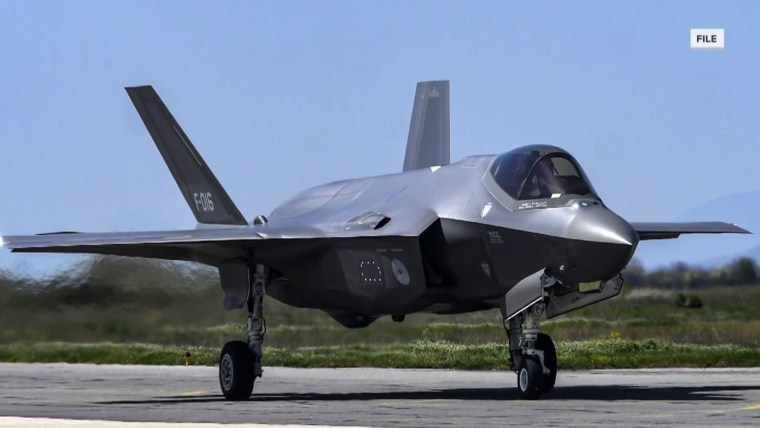
Military investigators are facing a slew of questions about why an F-35 stealth fighter jet went missing for more than 24 hours before its wreckage was found in rural South Carolina.
As scrutiny mounts of the sophisticated warplane, which also saw a pilot eject last year during a failed landing in Texas, investigators are expected to take months piecing together a timeline of events that began Sunday afternoon to determine why the pilot ejected and why the jet appeared to have continued flying undetected.
After initially saying the jet had been left in autopilot when the pilot ejected from the aircraft, Jeremy Huggins, a spokesman at Joint Base Charleston later told NBC News that authorities did not know whether that was the case and were still investigating the matter.
When Joint Base Charleston in South Carolina asked for the public's help to find the jet, the internet lit up with memes like "Dude, where's my F-35?" and expressing astonishment that an aircraft with stealth mode capabilities could, in fact, vanish so stealthily.
"How in the hell do you lose an F-35?" Rep. Nancy Mace, R-S.C., asked in a social media post. "How is there not a tracking device and we're asking the public to what, find a jet and turn it in?"
What do we know?
The F-35B Lightning II jet, manufactured by Lockheed Martin and operated by the Marine Corps since 2015, took off from Joint Base Charleston on Sunday afternoon. It was one of two planes involved in a routine training flight, Capt. Joe Leitner, spokesperson for the 2nd Marine Aircraft Wing, told reporters, according to The Post and Courier.
Just before 2 p.m., one of the pilots ejected, parachuting into a home's backyard in Charleston, two defense officials said. The pilot, who was not identified, was taken to a hospital in stable condition.
After 5 p.m., Joint Base Charleston posted on social media that a "pilot ejected safely" following an afternoon "mishap" involving an F-35. Officials said they were focusing on a pair of lakes north of the base.
"If you have any information on the whereabouts of the F-35, please call our Base Defense Operations Center," officials wrote.
They launched an intense hunt for the jet, but it wasn't until almost 6:30 p.m. Monday when the base announced that law enforcement had located a debris field in Williamsburg County, a rural stretch about a two-hour drive northeast of the base.
The pilot was released from the hospital earlier Monday, and no other damage or injuries were reported, defense officials said.
Why did the pilot eject?
Military officials could not immediately explain why the pilot parachuted from the plane, but experts and former F-35 pilots said such a decision would not be made lightly.
"The ejection is a last-ditch decision," said David Berke, who served as a commanding officer in the Marine Corps' first F-35 squadron in South Carolina from 2012 to 2014.
"Something has occurred catastrophically where the risk to the aircraft and the surrounding environment is so high that ejection will preserve the life of the pilot."
The F-35B is unique compared to other models, said Dan Grazier, a senior defense policy fellow at the Project on Government Oversight, a nonprofit federal watchdog.
"The F-35B has an auto-eject function," he said. "I'm curious to know if it ejected him involuntarily."
The decision to abandon the aircraft meant it would eventually crash, a costly outcome because this version is about $140 million, the watchdog group said in a 2020 report.
"I don't fault a pilot for bailing out of an aircraft if that's the right course of action," Grazier said, adding that the military will want to know if it was done out of mechanical or software failure, pilot error or something else.
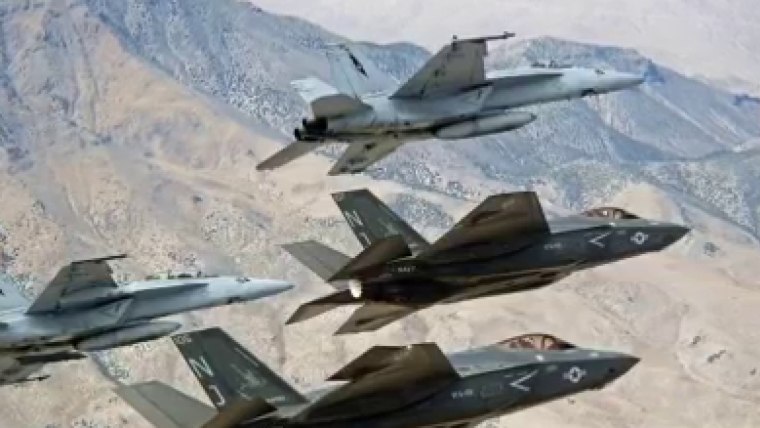
Regardless, experts said it could have been worse.

