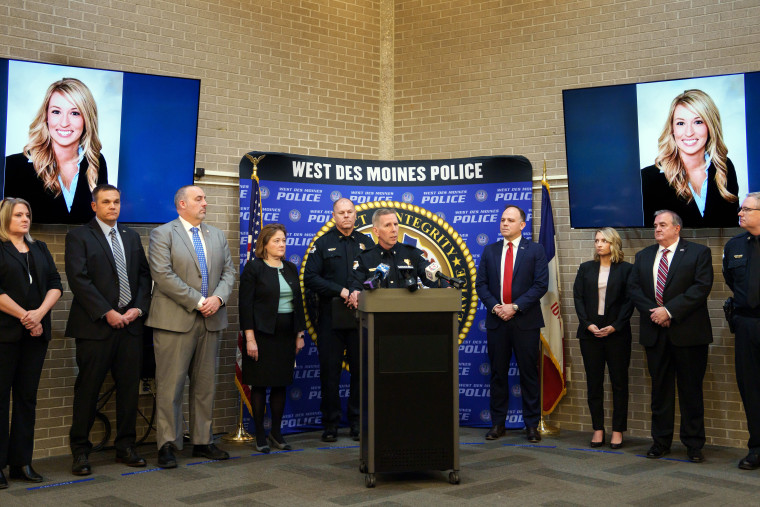
The fatal shooting of a 27-year-old real estate agent during an Iowa open house in 2011 shook her industry, which responded with a slate of measures aimed at keeping others in the profession safe.
But in interviews with NBC News after an arrest earlier this month in the long-dormant case, some in the industry said the barrage of threats and risks persist and not enough has been done to protect agents.
Gavin Blair, CEO of the Iowa Association of Realtors, described Ashley Okland’s killing as a “worst case scenario” that pushed the industry to confront the sometimes dangerous reality of real estate work with a “safety pledge” of best practices.
What emerged in the years after Okland’s death is a job that, in some ways, might be unrecognizable to past generations of agents. Many now carry guns or other means of self-protection, according to a survey released two years ago by the nation’s largest real estate trade organization, the National Association of Realtors.
In interviews, some agents said they screen would-be clients with a background check service before they ever speak. Some require identification for showings ahead of time and refuse to park in driveways to prevent being boxed in by a possible assailant. Such measures are included in the pledge.
Beth Andress, who with her husband, Rob Andress, teaches violence prevention and self-defense to real estate professionals in Canada and the U.S., described the potential dangers agents face as urgent and said certain safety measures should be required by law, and not merely recommended.
“We need to really understand that real estate is one of the only professions where you meet strangers alone in private, enclosed spaces, with no standardized screening process,” Beth Andress said. “The entire industry has normalized that risk, so many people don’t even recognize that risk anymore.”
In a statement, a spokesperson for the National Association of Realtors said the organization “is committed to the welfare and safety of its members, with a sustained focus on providing resources, education, and research to support real estate professionals in the field. We strongly encourage state and local associations, brokerages, and members to keep safety top of mind every day of the year.”
Making a deal or staying safe
Data included in the association’s 2024 survey — its most recent — shows that nearly a quarter of the 1,423 respondents experienced a situation that made them fear for their personal safety or the safety of their personal information. That number was unchanged from the year before, the survey shows.
Nearly half of the respondents said their brokerage either did not have safety procedures in place or they weren’t aware of such protocols. Forty percent said they’d met a new or prospective client alone at a secluded location. Nearly half said they’d shown a vacant property in an area with poor or no cell coverage in the last year.
The association spokesperson said the data shows progress from previous years, “underscoring the importance of continued education and tools that support agent safety in real-world conditions.”
To Katy Caldwell, a longtime agent in Louisiana and co-host of the real estate podcast “Hustle Humbly,” the data shows something else.
“There’s no drastic change to the behavior of agents, because it’s such a cutthroat industry,” she said. “The vast majority of agents are barely making a living wage. You really don’t want to turn away potential business.”
But since those safety recommendations are not required, she said, agents may forgo them, fearing lost business from possible clients who aren’t used to providing identification before a showing, for example. Or those possible clients may just walk away if the process isn’t what they’re used to, she said.
Other agents described the push for safety and the need to make a deal as a sometimes complicated balancing act.
Alex Harper, an agent in Texas, has a safety checklist that is robust. She often carries a gun, she said, and she uses an app to run background checks on any phone numbers she doesn’t recognize. If she’s meeting a man for a showing, she said, she’ll have someone tag along. She never parks in driveways, she said, and any time she walks into a vacant home alone, she locks the door behind her.
“We’re given the safety pledge of, hey, do your best to be safe,” she said. “But at the same time, we have a fiduciary duty to our clients to sell their property. The phrasing and the verbiage and the way that these listing agreements read is like, you’re going to do your utmost best to sell this property, and that means if someone calls you, you’re going to show it.”
The unpredictable nature of the job can easily tweak the best laid plans, said Chelsea Pearson, an agent in North Carolina who has her own safety checklist that includes carrying multiple “items” for protection during showings.