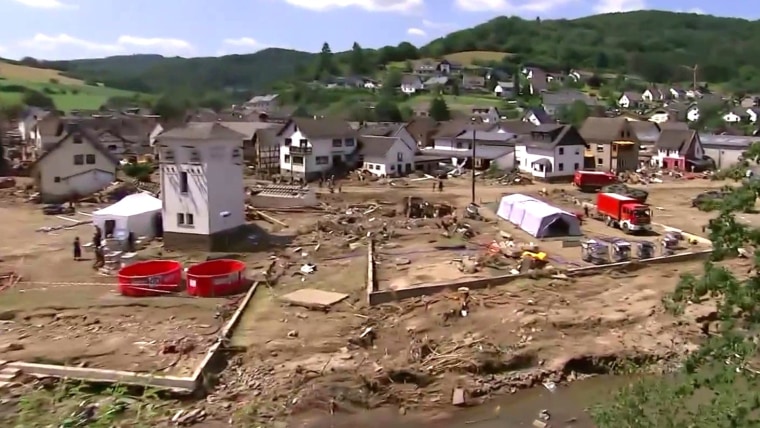
AHRWEILER, Germany — Almost 200 people were dead and more than 700 injured, with many still missing Monday, as Germany counted the cost of the devastating floods and asked whether more could have been done to save lives.
Torrential rain last week led to severe flooding and destruction across western Europe, wreaking havoc in parts of Belgium and the Netherlands, and leaving Germany reeling from its worst natural disaster in decades.
As the death toll continued to grow, the country grappled with what or whom to blame, from climate change to political leaders.
Download the NBC News app for breaking news and politics
Officials confirmed the deaths of at least 117 people in the worst-affected German region, Rhineland-Palatinate, bringing the total confirmed dead to 196 with another 749 injured as of Monday morning.
Another 46 were killed in the neighboring state of North Rhine-Westphalia and at least two people died in the southern state of Bavaria, while 31 were killed in Belgium.
Rescuers were engaged in a desperate search for survivors, with hundreds of people still unaccounted for.
Police in Koblenz told NBC News they are currently searching for as many as 170 people who have been reported missing in Rhineland-Palatinate.
Meanwhile, in neighboring North Rhine-Westphalia, police in Cologne have said they are still searching for at least 150 people who are still unaccounted for.
NBC News spoke to one man, Jurgen Lenz, who said he was trapped on the fourth floor of a building in the town of Heimersheim for two days, waiting for the waters to recede.
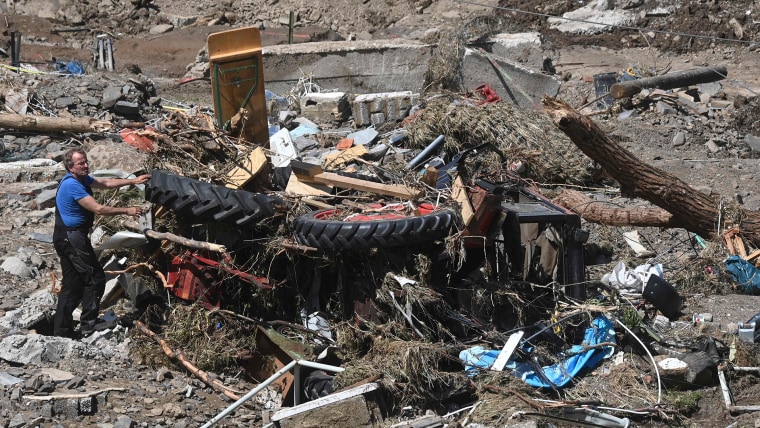
In Ahrweiler, Mike Ahrens said that six cars smashed into his house at 2 a.m. when the floods hit, and were then washed away in the rising tide.
"It was more than scary, it was like a dream that you hope you wake up from," he said via a translator.
Related

The damage to infrastructure not only hampered immediate rescue efforts, but also threatened to leave the affected regions facing a long and difficult road to recovery.
Phone and power lines were down across the area, police said, potentially complicating efforts to contact loved ones.
At least 80 train stations were closed and a dozen lines out of service, Germany's main train company Deutsche Bahn said in a statement Sunday, a sign of the sheer scale of the damage.
In an interview with a regional newspaper in Passau, Germany’s transport minister said 20 of the 35 bridges along the River Ahr, a tributary of the Rhine, had been destroyed.
Supplies of drinking water in the most heavily affected regions were also likely disrupted for weeks.
German Chancellor Angela Merkel called for more to be done to tackle climate change in the wake of the floods on a visit to the region Sunday, but questions are now being asked over whether authorities were also at fault for a lack of preparation.


