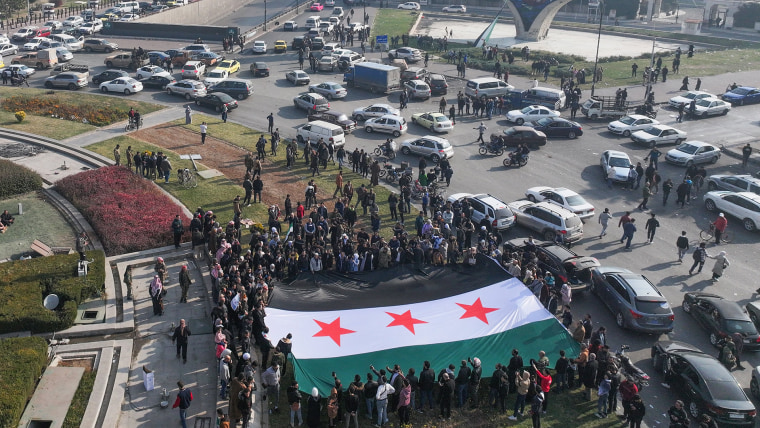
The swift collapse of Bashar al-Assad’s Syrian regime represents a devastating defeat for Iran, the latest in a string of setbacks that have punctured long held assumptions in the West about Tehran’s military prowess.
In recent months, Iran has proved unable to thwart Israeli covert operations from targeting key figures in the regime, defend itself from damaging Israeli airstrikes, or protect an ally next door that was a linchpin in its regional proxy network, dubbed the “axis of resistance.”
For decades, Syria has served as a vital land bridge to Iran’s Hezbollah militia in Lebanon, allowing Tehran to ferry weapons to its partners across the Syrian border. After a mass uprising against Assad in 2011, Russia provided air power for Damascus and Iran propped up the brutal ruler with weapons, cash, Iranian Revolutionary Guard officers and militants from Iranian-backed proxy forces in Lebanon, Iraq and elsewhere.
But when Syrian rebel forces seized Aleppo last month against poorly trained, demotivated Syrian army troops, Iran was caught off guard at a difficult moment, with its military depleted from Israeli air raids and its proxy forces in Lebanon decimated from fighting with Israel, current and former U.S. officials said. As the rebels pressed ahead, there was no concerted effort to stop the advance with Russian warplanes or Iranian-backed proxy forces.

The dramatic events over the weekend marked “a fundamental change in the equation of the entire Middle East,” a senior Biden administration official told reporters on Sunday.“Assad was effectively abandoned because his only friends ... Iran, Hezbollah and Russia, no longer had the capacity to help,” the official added.
Iran’s weakened position has challenged prevailing assumptions in Washington and other capitals about Iran’s power and resilience, as well as expectations about how a direct clash between Israel and Iran would play out, former U.S. intelligence officials and experts said.
“You have a series of myths that have evaporated over the last year,” said one former U.S. official.
The United States and other governments had feared an Israeli attack on Iran would produce an overwhelming response against Israel by Iran’s proxies. There also was a widespread view that Iran’s vast missile arsenal would deter Israel from ever directly attacking, and if it did, Tehran might overwhelm Israeli air defenses in retaliation.
And there were fears that a direct clash between Iran and Israel would result in an open-ended conflagration that would draw in the United States and other countries.
None of those scenarios came to pass.
Israeli air raids against Iran did not trigger a crippling response from Iran’s proxies in Lebanon, Gaza, Iraq or Yemen. It was unclear whether those proxy forces lacked the means and the will to act more aggressively, or whether Tehran’s leadership was reluctant to confront Israel directly, former officials said.
With crucial help from the United States and its allies, Israel was able to shoot down most of the ballistic missiles and drones launched by Iran. Hezbollah, the Lebanese militia armed and trained by Iran, have proved no match for Israel’s military and intelligence operations, which have killed much of its leadership and penetrated its communications.
Those incorrect assumptions about Iran “shaped and indeed constrained regional and U.S. policy on Iran,” said Norman Roule, former senior U.S. intelligence official and senior adviser to United Against Nuclear Iran, a nonprofit that focuses on combating threats posed by Iran.
The loss of Syria as a reliable and subservient ally has likely irreparably damaged Iran’s proxy network, which Tehran viewed as a defensive wall protecting Iran and a way of fighting countries with more powerful conventional militaries, current and former U.S. officials said.
“The fall of Assad really puts a big question mark around whether the ‘axis of resistance’ is still feasible,” said Alex Vatanka of the Middle East Institute, a Washington-based think tank. “Iran paid billions in the last two decades to establish this ‘forward defense’ model — and for a long time it delivered results,” he said.
“But once under pressure, the model and the Arab partners of Iran have proven to lack the capacity to withstand pressure," Vatanka added. "It began with Hezbollah and now Assad."
Mohammad Ali Abtahi, a former vice president of Iran, wrote on social media shortly before the Assad government collapsed that the fall of the regime “would be one of the most significant events in the history of the Middle East.” Abtahi added that “resistance in the region would be left without support. Israel would become the dominant force.”
Recent events, including the failure to fend off anti-regime rebel forces in Syria over the past two weeks, have exposed a “rot” inside Iran’s military and security apparatus, Roule said.

