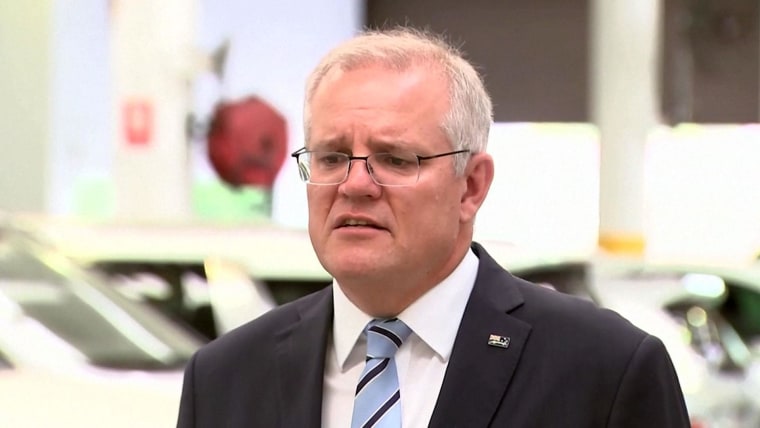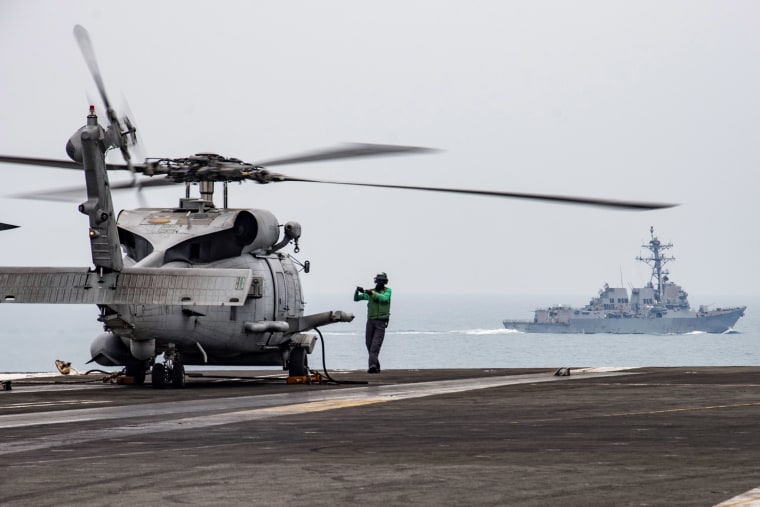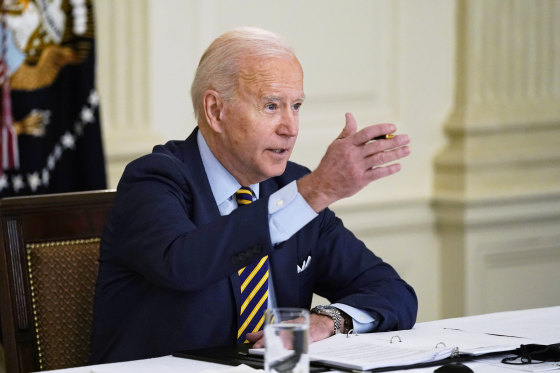
President Joe Biden on Friday took part in the first leaders' summit of the informal international alliance known as the "Quad" as his administration steps up efforts to deal with China's growing influence.
The group, which also includes India, Japan and Australia, met virtually due to coronavirus restrictions.
Biden began the summit meeting by emphasizing the need for a “free and open” Indo-Pacific region.
"The United States is committed to working with you, our partners, and all our allies in the region, to achieve stability," he said.
In a joint statement after the meeting, the four leaders reaffirmed their commitment to cooperating on Covid-19, security challenges and climate change.
"Today, we pledge to respond to the economic and health impacts of COVID-19, combat climate change, and address shared challenges, including in cyber space, critical technologies, counterterrorism, quality infrastructure investment, and humanitarian-assistance and disaster-relief as well as maritime domains," they said.
The leaders also restated their commitment to denuclearizing North Korea and agreed that their nations would establish a "vaccine expert working group" to help with Covid-19 distribution, among other things.
The four counties made a commitment Friday to deliver up to 1 billion doses of the Covid-19 vaccine to the Association of Southeast Asian Nations and Indo-Pacific countries by the end of 2022 using Indian manufacturing, U.S. and Japanese funding and Australian logistics, national security advisor Jake Sullivan told reporters at a White House briefing.
Download the NBC News app for breaking news and politics
Each country also has been at pains to make clear they're not an anti-Beijing club.
"It was established not to counter one single threat or to focus on one single issue," State Department spokesman Ned Price told reporters on Thursday, but "to showcase what democracies can deliver together, both for our own populations and for the broader world."
Despite these protestations, the alliance is widely viewed as an effort to combat Beijing's growing military and economic power.
"It's a group of countries all concerned about China, and all trying to hold the line for an open, democratic non-Chinese way forward," author and China analyst Bill Hayton told NBC News.
However, he added, the "Quad" is not a formal alliance in the same way as NATO and thus carries no strict duty to defend one another.
Representatives for the four members of the "Quadrilateral Security Dialogue" met sporadically after it was formally established in 2007.
But the group was revived by former President Donald Trump, whose Secretary of State Mike Pompeo attended meetings as Washington sought to reinvigorate the alliance amid escalating tensions with Beijing.
Relations between the world's two largest economies have deteriorated with clashes over trade, Covid-19, Hong Kong's autonomy, Taiwan and alleged human rights abuses in Xinjiang.
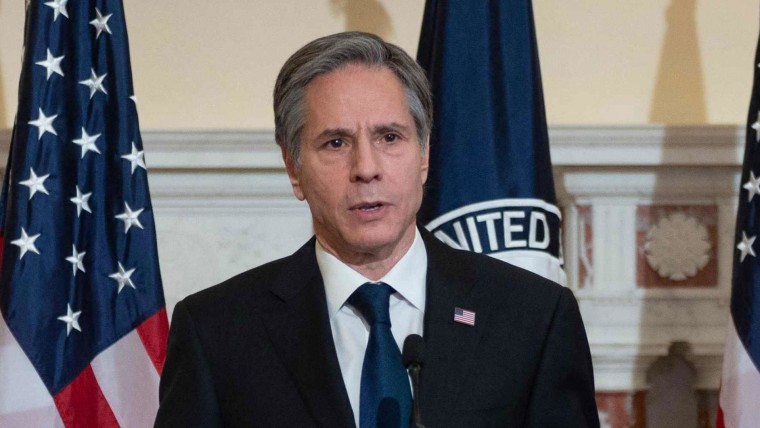
In a sign that the Biden administration will continue to take a tough stance, Secretary of State Antony Blinken labeled China America's "biggest geopolitical test of the 21st century."
It's not just the U.S. that has been clashing with China, however.