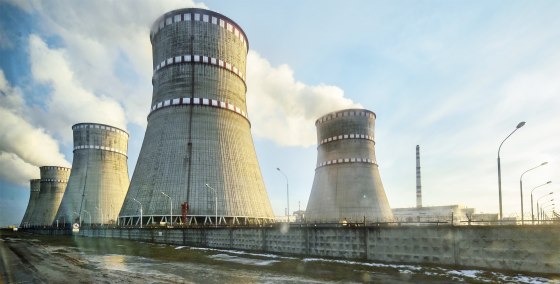
While much attention has been paid to Chernobyl this week as Russia's invasion of Ukraine continues, there is growing concern about the four active nuclear power plants that supply half of the nation's power.
Those four power plants, located near towns and cities in western and southern Ukraine, contain 15 operating nuclear reactors. The concern is that a nuclear disaster could occur if during the conflict they were accidentally damaged, left unmaintained or cut off from the power grid needed to cool the reactors.
Ukraine reported that its country's nuclear power reactors are still operating "safely and securely," the International Atomic Energy Agency said Friday morning.
But the organization, which is dedicated to the peaceful use of nuclear energy, said it remained deeply concerned.
IAEA Director General Rafael Mariano Grossi reiterated his "appeal for maximum restraint to avoid any action that could jeopardize plant safety," the group said.
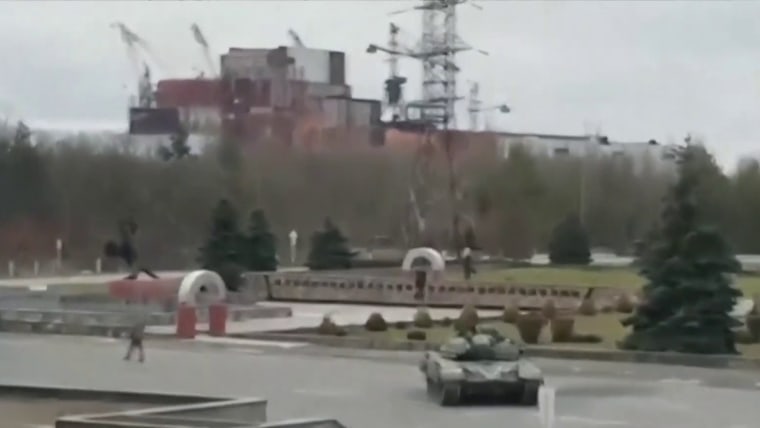
James Acton, co-director of the Nuclear Policy Program at the Carnegie Endowment for International Peace, wrote in a blog post Friday that he is more concerned about the four nuclear power plants than Chernobyl, the site of the 1986 disaster that forced the then-Soviet Union to abandon the nearby city and create the 1,000- square-mile Chernobyl Exclusion Zone.
While there was reported fighting near the site until Russian forces overtook it, the 15 operational nuclear reactors are closer to populated cities and towns, and their fuel is much more radioactive than that of Chernobyl, Acton wrote.
"To put it simply, nuclear power plants are not designed for war zones," he added. "It seems exceedingly unlikely that Moscow would authorize deliberate attacks on these facilities, but they could nonetheless become targets in a war that will, in any case, disrupt their operations."
The issue is not just that the reactors may be damaged in the fighting, experts say, but that the staff tasked with safely operating the plants may fear traveling to work and those who are responsible for addressing an accident, such as firefighters, could be stymied by the ongoing conflict.
The plants also use electric power to cool the reactors, said Edwin Lyman, director of nuclear power safety for the Union of Concerned Scientists, and it could cause problems if they were cut from Ukraine's grid.
He said that if they are disconnected from the electric grid, plants need to be able to use emergency diesel generators to power a shutdown and keep the reactor fuel cool — though the generators have their own limited fuel supply. Electricity is also needed to keep the spent nuclear fuel, contained in wet storage pools, from heating up.
If those cooling operations are disrupted, there is a possibility of a meltdown, he said, or even a fire in the spent fuel pool where there is a great deal of radioactive material.
"The goal is to keep the electricity flowing and let the cooling systems operate," he said.
The public utility company that operates the plants, Energoatom, did not respond to a request for comment about safety concerns during the conflict. However, Petro Koti, the head of the organization, told the United Nations in early February that the plants are prepared for a "special period" such as a "bombing attack."
"In such a case, the plant is shut down and unloaded until the threat is eliminated," he said, though he claimed the "Ukrainian power units are ready even for an aircraft crash" because the reactor was designed for such a risk.
The Ukrainians were also prepared to operate each plant autonomously in case access to the internet or telephone communications is lost, Koti said, noting that each plant had stockpiled diesel fuel to run generators if power was ever shut off. The generators would, if necessary, keep the plants operational and the reactors cool.
Each plant also has a stockpile of two years worth of nuclear fuel, he said — a strategic decision recommended by the United States — in case the Russians ever cut the nuclear fuel supply.
Weeks prior to the invasion, Energoatom said it was working with the American company Westinghouse Electric Corp. to become fully independent of Russian nuclear fuel within the next two years. The two organizations also struck an agreement in November to "optimize a dozen reactors in Ukraine," which the U.S. Department of Energy said at the time would "significantly increase the country’s clean power production."
The Energy Department did not respond to a request for comment, but Westinghouse said in a statement that it was "watching with horror the events surrounding the Russian invasion of Ukraine," adding that the company remains "in active communication with our counterparts around the globe regarding its effects."

