Violent protests after the police killing of George Floyd sweep the United States — and China is watching.
"I can't breathe," wrote Hua Chunying, a spokeswoman for China’s Foreign Ministry, in a tweet on Saturday — a reference to the final words uttered by Floyd as Minneapolis Police Officer Derek Chauvin knelt on his neck last Monday.
Hua's tweet, aimed at her U.S. counterpart, State Department spokesperson Morgan Ortagu, has been shared nearly 8,000 times on Twitter.
Beijing's own treatment of protesters and political dissidents, most recently the crackdown on demonstrators in Hong Kong, has long been met with withering criticism from Washington. Now, China has found an easy comparison, with some ridiculing the U.S. response to the disturbances.
China's state media has been quick to resurface a comment by House Speaker Nancy Pelosi in 2019, when she called pro-democracy demonstrations in Hong Kong "a beautiful sight to behold."
China's Global Times newspaper, seen as a mouthpiece for the Communist Party, ran an editorial on Saturday entitled: "Watch out! 'Beautiful sight' in HK is spreading across the U.S."
Editor Hu Xijin compared the two situations in the column, writing that it was "as if the radical rioters in Hong Kong somehow snuck into the U.S."
"Let's wait and see which country will encounter more chaos," he wrote.
In a tweet on Saturday, Hu also urged President Donald Trump not to "hide" behind Secret Service officers after the president thanked them for maintaining their cool as protesters converged near the White House.
"Go to talk to demonstrators seriously," Hu said. "Negotiate with them, just like you urged Beijing to talk to Hong Kong rioters."
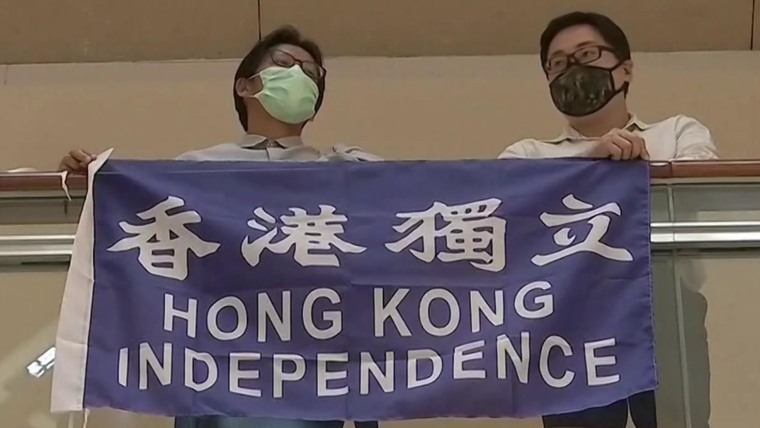
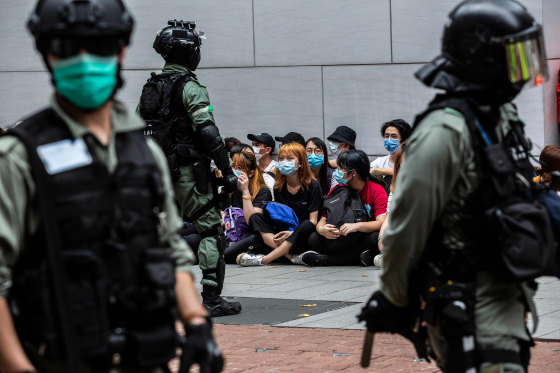
Last week, protests erupted in the semi-autonomous territory of Hong Kong over the passage of a new security law from Beijing, leading to the arrest of more than 400 people.
Tensions between China and the U.S. have been growing.
Last year, the two engaged in a bitter economic trade war, finding a fragile truce in January with a $200 billion trade deal, widely hailed by President Donald Trump. Senior officials in both countries have also been publicly critical of the other's handling of the coronavirus pandemic, with some analysts warning of a new Cold War.
The recent protests against racism and police brutality, and ensuing violence, have swept more than 100 U.S. cities, with shops looted and police buildings burned down. Law enforcement and the National Guard have been ordered onto city streets to quell demonstrations.
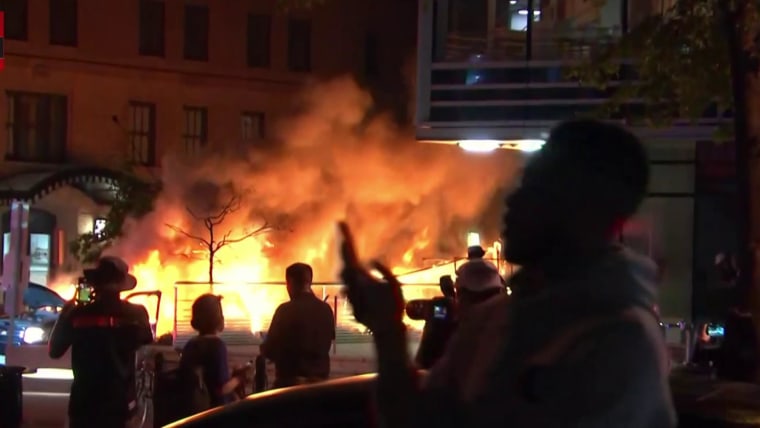
China Central Television, state-owned media that often reflects senior leadership thinking, also called out the "hypocritical double standards" of U.S. support of protesters in Hong Kong — deeming the U.S. demonstrations "self-inflicted."
The two powers have often traded barbs on internal protests and social fault lines.
During the 1989 Tiananmen Square protests in China — which mark their 31st anniversary next week — President George H.W. Bush condemned China for "brutally suppressing popular and peaceful demonstrations" and praised the demonstrators. More recently, China's internment of hundreds of thousands of Uighur Muslims has also provoked condemnation from Washington on China's human rights record.
In response to an annual State Department report on global human rights, the Chinese have since 1998 published their own white paper focused on U.S. human rights violations.